Your AI Agent Is Not an Employee — And Treating It Like One Is Dangerous
The org chart was never a seating plan. It routes blame. That's why adding an agent to it costs more than anyone expects. Somewhere in your company, a person is deciding whether an AI agent gets a row…

In this article · 5 sections +
The org chart was never a seating plan. It routes blame. That’s why adding an agent to it costs more than anyone expects.
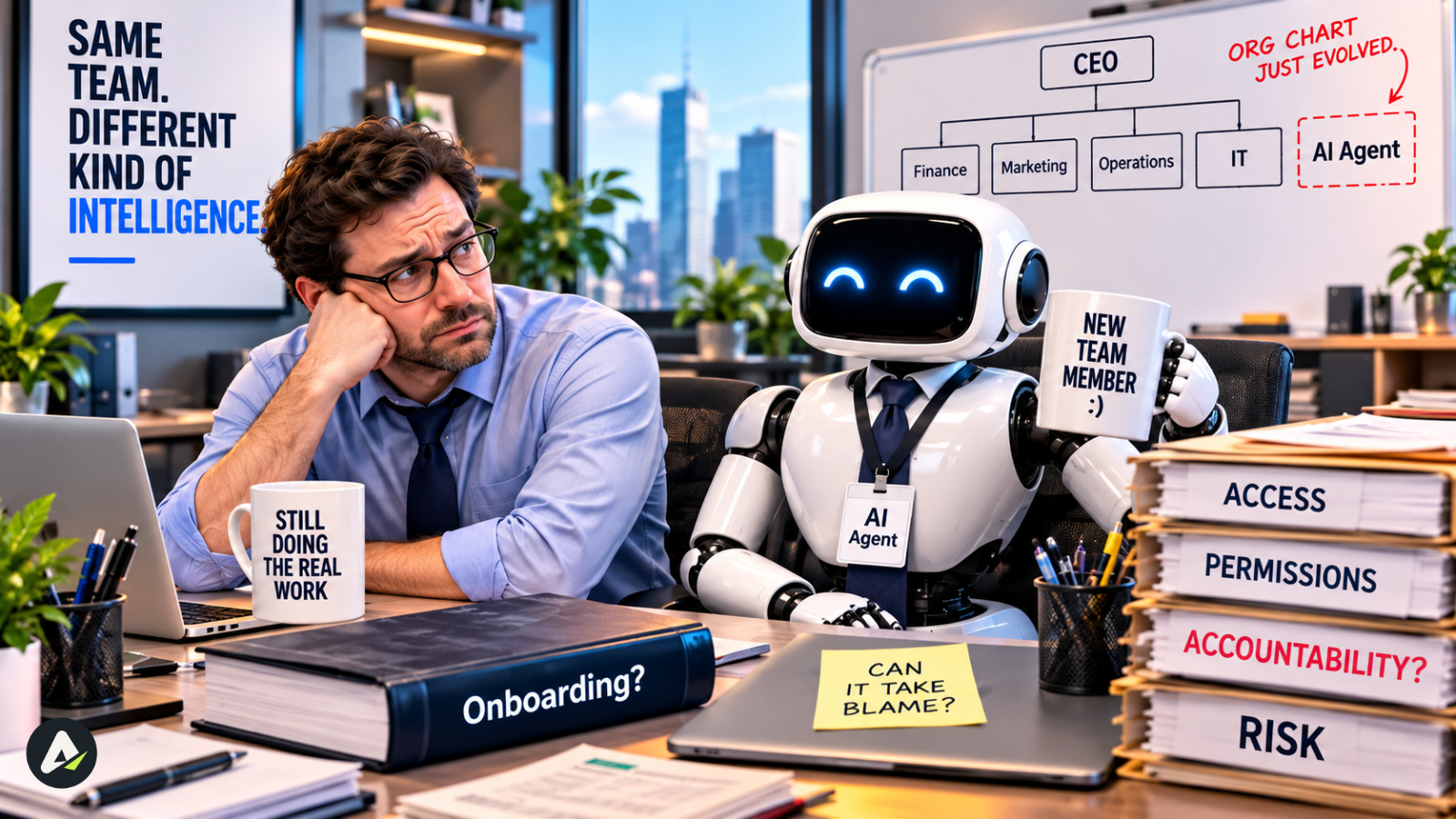
Somewhere in your company, a person is deciding whether an AI agent gets a row in a spreadsheet or a box on the org chart.
Sounds like an internal tooling question. It isn’t.
The org chart compresses one fact into a diagram: who answers for what. Auditors read it. Regulators read it. Lawyers read it first. Adding a node doesn’t name a thing. It routes liability toward that thing.
Software can’t receive liability. It can only absorb it, which is a much worse outcome.
Pat Brans laid out the debate for Computerworld this month, with CIOs on three sides of it. The reporting is good. The implication runs further than the piece goes.
The number that should end the argument
Research covering 1,261 managers found something awkward. Frame an AI system as an employee instead of a tool, and managers take less responsibility for what it produces. They shift more onto the system, escalate more, and catch fewer errors. Harvard Business Review published the full study in May.
Read that as an engineer, not an ethicist. A naming convention degraded error-detection rate. That’s a regression, and it shipped without a ticket.
Psychologists already named the mechanism. The bystander effect describes what happens when a crowd watches someone collapse, and everyone assumes somebody else has it handled. Enterprises have now productized it. Give a system a face, and the people around it quietly demote themselves from operators to witnesses.
One detail makes it worse. The effect showed up strongest in managers who had worked with agents the longest. Familiarity didn’t protect them. It relaxed them. So training won’t fix this. The human stayed in the loop and stopped looking.
The metaphor breaks on arithmetic, not ethics
Most objections to the employee analogy go philosophical. Agents lack judgment, intent, moral stake. All true. None of it helps you on a Tuesday.
The real problem is simpler.
You can’t clone Steve from Accounting.
Every practice we inherited from HR assumes scarcity. Onboarding, probation, supervision, performance review — all of it rations expensive humans who arrive slowly, tire predictably, and notice when something feels off. A confused employee botches one refund an hour. Biology rate-limits the damage.
Agents break every term. Free to duplicate. Instant to deploy. Error rate capped only by API throughput. A confused agent botches four thousand refunds before the dashboard refreshes.
DXC Technology supplies the number that makes this concrete. On one major platform, staff have built roughly 8,000 personal agents against about 100 professional ones. Eighty to one, informal to governed.
No HR function scales to that. And notice what sits inside the larger bucket: personal agents mostly inherit the identity and access of whoever created them. The most common agent in the enterprise already looks human in the logs. The merger happened before the debate started.
Identity answers what. A person answers who.
The sharpest idea in this whole conversation is a distinction, not a framework.
Raja Iqbal of Ejento AI splits it cleanly. An agent needs a technical identity so you can reconstruct what acted. A named human owns what that action meant. Identity is the audit primitive. Ownership is the accountability primitive. Two fields, two systems, never joined on one key.
Iqbal also co-wrote the HBR piece arguing enterprises should think of agents as team members, so his warning carries weight: The metaphor is dangerous when it’s decorative.
Decorative does the work in that sentence. Trouble starts when a company buys the costume — the name, the avatar, the cheerful first person, the seat in standup — and skips the parts that earned the analogy. Spend caps. Approved data sources. Scoped permissions. A kill switch. A human whose bonus depends on the outcome.
Strip those out and you haven’t hired anyone. You’ve installed a mascot with production credentials.
Scoping that authority properly takes more thought than an access matrix. The workable frameworks all ask the same four things about a workflow: how sensitive the data is, how many systems it touches, how hard a wrong action is to undo, and how close a human stands. Answer those honestly and the permission tier picks itself.
The opposite mistake costs just as much
None of this argues for treating agents as ordinary software.
Russell Jukes, who runs IT at DXC across roughly 115,000 employees, tried that. Ship the app, define the workflow, wait for adoption. Nobody used it. Traditional SaaS pushes users down a fixed path and returns predictable output. An agent reads a goal, picks its own tools and data, and improvises the route.
So both instincts fail, in opposite directions. Call it an application and you under-govern something that chooses. Call it a colleague and you over-trust something with no stake in being right. That tension shows up in every honest assessment of an agentic product, which is why autonomy and human control belong on separate axes rather than collapsed into one score.
Nina Tatsiy, global CIO at Quadient, holds both at once. Govern it as software — credentials, controls, security review. Supervise it as something probabilistic, because it is.
Her accounts-payable rollout shows the shape. The agent shadowed humans first. It learned from their corrections. It handled rising complexity under observation. Only then did it start recommending anything, and people still decided.
The agent earned trust. It never earned accountability. Keeping those two separate is the entire job.
Strip-mine HR for mechanisms, not metaphysics
Take the machinery. Scoped permissions, graduated autonomy, probation, demotion after failure, retirement at obsolescence, a written scope of work. IDC’s Amy Loomis calls that artifact an operations charter, which beats “job description” for one reason: nobody feels warmly toward a charter. NIST’s AI Risk Management Framework covers similar ground in more bureaucratic prose.
Leave the rest. The name. The pronoun. The persona. The box on the chart.
One test settles most cases. When something breaks, can any sentence in the incident report start with the agent’s name and end the inquiry? If yes, you built an accountability sink. Responsibility goes in and nothing comes out.
Who carries the loss when an autonomous system makes an expensive call — the vendor, the deployer, or nobody — remains the unsolved question underneath all of this. Every governance model currently shipping is a bet on one answer.
Give the agent a badge. Badges are access control with a lanyard.
Just don’t put a face on it. People trust faces.
Related: AI Tools vs. AI Agents: What’s the Difference and Which Wins?

Dax Orion
The rise of AI agents is changing the relationship between people and software, moving technology from responding to instructions toward carrying out tasks. Orion Dax covers artificial intelligence, emerging technology, and automation, with a focus on the companies and systems shaping this shift. His work examines developments in agentic AI and the broader questions around adoption, autonomy, and the role these systems may play in modern work.
More from Dax Orion →