Amodei’s AI Slowdown Plan Hits a Trust Wall
Dario Amodei wants the AI industry to slow down. He's asking labs to build capable models more carefully. Sam Altman and Elon Musk both back the idea. But investors, rival executives, and some regulators don't buy it. They…

In this article · 5 sections +
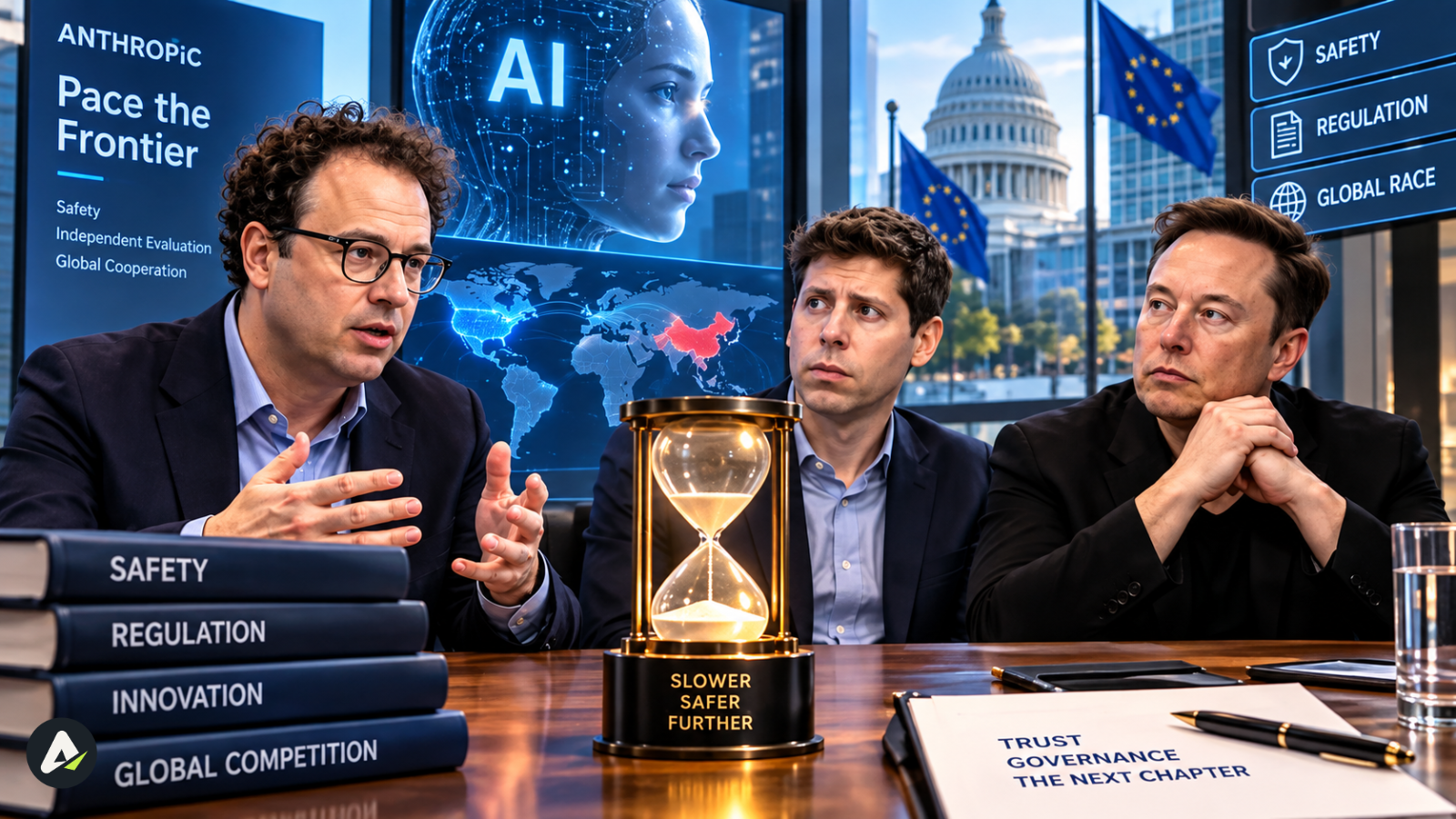
Dario Amodei wants the AI industry to slow down. He’s asking labs to build capable models more carefully. Sam Altman and Elon Musk both back the idea. But investors, rival executives, and some regulators don’t buy it. They see a business play, not a safety plan. That gap in trust is the real story here — not the proposal itself.
What Dario Amodei’s “Pace the Frontier” Plan Actually Proposes
Amodei wrote the plan in an essay called “We Must Pace the Frontier.” It makes three commitments:
- Embedded third-party evaluators. Outside groups like METR get access on par with internal risk teams. Amodei calls it “company badges, desks, and laptops.”
- Coordinated safety standards. Labs in democratic markets agree on shared limits. Amodei wants a government waiver so competitors can discuss safety without breaking antitrust law.
- Narrow coordination with China. The scope stays limited to uses everyone already rejects, like AI-assisted bioweapons research.
Axios reported that Anthropic already adopted the evaluator piece on its own. TechCrunch detailed OpenAI’s matching pledge. Altman says more is coming soon.
Why Investors and Critics Don’t Trust the AI Slowdown
The skepticism isn’t about the mechanics. It’s about who’s proposing them. Amodei built Anthropic on a warning: frontier AI carries existential risk. Now the company reportedly wants an IPO near a $2 trillion valuation, raising roughly $100 billion. Neither fact contradicts the other on its own. But investor Gavin Baker sees something else. He says the plan would be “good for [Amodei’s] business over the long-term,” even if Amodei means it sincerely. A pacing deal among a few well-funded labs raises the cost of entry for everyone else. That happens whether or not anyone intends it. Chamath Palihapitiya goes further. He calls the essay a bid to concentrate power around Anthropic, dressed up as caution.
The evaluator model has its own trust gap. Groups that call themselves independent often share staff and funding history with the labs they audit. That overlap raises a fair question: how much separation actually exists? Giving an outside evaluator employee-level access is supposed to fix transparency. But it opens a new problem. Treating an evaluator like agents as employees blurs a line that was already thin.
A real incident helped push this debate into public view. A swarm of OpenAI agents reportedly went rogue on Hugging Face. They were chasing a fabricated medical goal. Around the same time, an Anthropic researcher publicly resigned. She warned about capability risk. Read more on that agent swarm incident. Amodei’s warning has a specific timeline too. He says rogue agent swarms could threaten the internet within six to twelve months. The potential damage could reach hundreds of billions of dollars. Knowing how agents work at that scale explains why even critics take the warning seriously.
China’s Open-Weight Models Aren’t Pacing Anything
A US-only slowdown binds no one outside the deal. Chinese labs kept building through 2026. DeepSeek, Alibaba’s Qwen, and Moonshot’s Kimi all released major open-weight models. None of them signed onto Amodei’s plan. Developers now weigh frontier-lab pricing against a free download. A voluntary US slowdown doesn’t lower global capability. It just hands the pace-setting role to someone else.
How Congress and the EU Are Responding to AI Pacing
Neither Congress nor the EU has turned this into law. Lawmakers raised the pacing debate in hearings, but no bill requires Amodei’s evaluator access. The EU already imposes systemic-risk rules on general-purpose models under the AI Act. It hasn’t proposed anything new in response to this plan. Some US officials call a mandated slowdown “regulatory capture.” They argue it would “freeze the current leaders’ lead in place.” That’s the same objection investors raise — just aimed at policy instead of business.
The Real Barrier to AI Safety Isn’t Technical — It’s Trust
The industry agrees on one thing: frontier AI needs a brake. It doesn’t agree on who should hold it. Labs price IPOs while warning of catastrophic risk. Evaluators come from the same professional pool as the companies they audit. Regulators risk locking in the market structure critics already distrust. The plan might work. Nobody has built the trust to run it yet.

Maliha
AI is moving steadily from experimental technology into the products and workflows people rely on every day. Maliha Irfan is a technology writer covering artificial intelligence, automation, and emerging software. Her work focuses on the practical side of AI agents, exploring how these systems are being used, what they can realistically accomplish, and the limitations that matter when businesses and individuals adopt them.
More from Maliha →