Best AI Voice Agents for Australian Restaurants (2026)
It's 7:15 on a Friday night. Every table is full, the pass is stacked, and the phone has rung six times in ten minutes. Nobody can grab it. Most of those calls were a booking or a takeaway…

In this article · 12 sections +
- What a Restaurant AI Voice Agent Actually Does
- Do You Actually Need One?
- AI Voice Agents for Australian Restaurants: 2026 Comparison
- Which Provider Fits Which Kind of Restaurant
- What It Actually Costs, and a Worked ROI Example
- How to Test an AI Voice Agent Before You Buy: The CALLS Framework
- Australian Privacy, Call Recording and AI Disclosure
- AI Receptionist Privacy Rules in Australia
- Rolling Out an AI Voice Agent: 7 Steps
- 7 Ways Restaurant Voice AI Goes Wrong
- Where Restaurant Voice AI Is Heading
- Frequently Asked Questions
It’s 7:15 on a Friday night. Every table is full, the pass is stacked, and the phone has rung six times in ten minutes. Nobody can grab it. Most of those calls were a booking or a takeaway order — and each one just rang out.
AI voice agents exist to fix that: software that answers your restaurant’s phone, understands what the caller wants, and books the table or takes the order without a staff member picking up. If the term itself is new to you, it’s worth first getting clear on what an AI agent actually is as distinct from a chatbot or a script — the short version is that an agent perceives, decides, and acts toward a goal, rather than just following a fixed menu of replies.
Nearly every article on this topic is written by a company selling one of these tools. This one isn’t. You’ll get a plain explanation of what these agents do, a comparison of providers operating in Australia, a five-point framework for testing them properly, a worked cost example, the legal points most vendor pages skip, and a rollout plan. No single tool wins for every venue — a pizza shop running 80 phone orders a night needs something different from a 40-seat fine diner.
What a Restaurant AI Voice Agent Actually Does
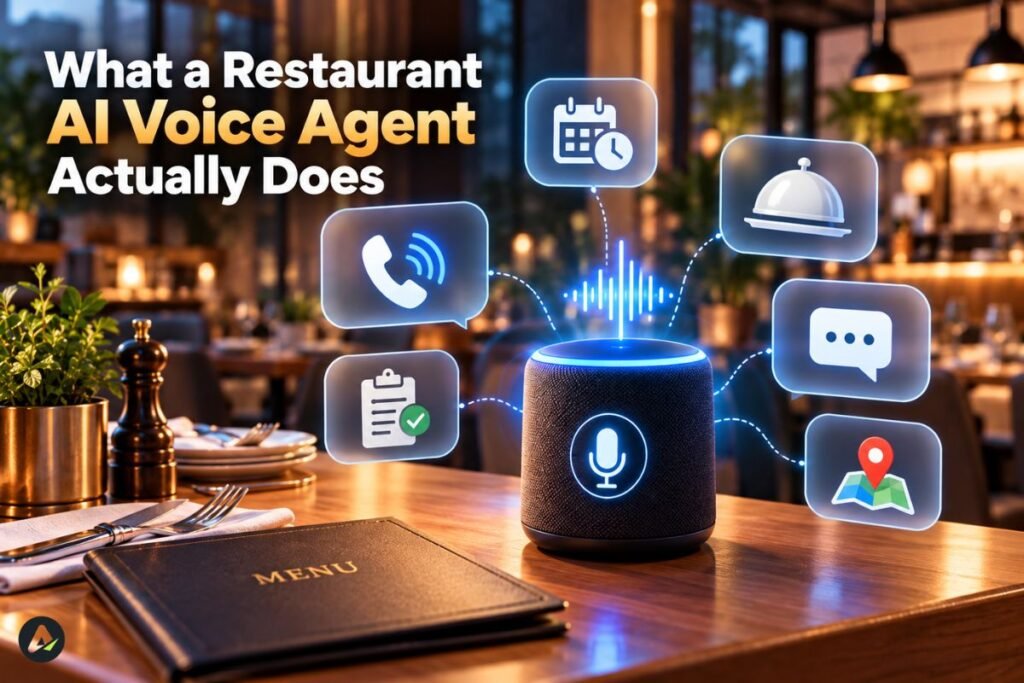
It’s an AI receptionist trained on one venue: your menu, hours, floor sections, and house rules. A call runs like this:
- The guest calls your normal number. Most providers keep it unchanged and route calls to the agent in the background — always, after a few rings, or only after hours.
- Speech becomes text, and the agent works out intent: book, order, ask, complain.
- It checks live data — table availability, stock on a menu item.
- It completes the task and sends an SMS confirmation or payment link.
- It hands off to a person when the call is complex, a VIP, or a complaint.
This differs from an old “press 1 for bookings” phone tree, which only routes calls, and from a human answering service, which takes a message someone still has to return mid-service. A voice agent is meant to finish the job on the call itself — which is really the core distinction between an AI tool and an AI agent: a tool waits to be operated, an agent carries a task through to completion on its own.
What it handles well: table reservations, changes and cancellations; full takeaway and delivery orders with modifiers; routine questions on hours, parking, BYO, corkage and dietary basics; function and catering leads; after-hours calls. Some tools also place reminder calls the day before a booking to cut no-shows.
Where a person still needs to take over: complaints, complex group bookings involving deposits or split sittings, and serious allergy questions. An agent can read out your allergen list, but shouldn’t be the one confirming a dish is safe for someone with anaphylaxis — route that to the kitchen or a manager. And if your 86’d-item list isn’t synced to the agent, it will happily sell a dish you don’t have.
Do You Actually Need One?
Start with your own numbers. Pull 30 days of call logs and count unanswered calls between 5 pm and 9 pm — that figure tells you more than any industry statistic. If you want a repeatable way to run this, see our guide to calculating missed-call revenue.
For scale: Otto’s Restaurant Phone Report 2026, based on roughly 1,000 Australian venues, put the average missed-call rate at around one in three, concentrated on Friday and Saturday nights, with most of those calls revenue-related. That’s a vendor’s figure, so treat it as a starting point and check it against your own logs rather than assuming it applies to your venue. Independent industry research points in the same direction: PolyAI has reported that restaurant groups routinely miss between 30 and 60 percent of front-of-house calls, and cites a National Restaurant Association survey in which 62% of operators said they didn’t have enough staff to meet existing demand.
Beyond revenue, hospitality staffing is tight, and every trip to the phone pulls someone off the floor. That’s the benefit several providers’ customers describe most — less disruption during service, not just more bookings. It’s the same pattern showing up in other service industries; retail, for instance, is already using similar voice and chat agents for styling and product questions — see how this plays out in a fashion retail agent example, which is a useful sanity check that this isn’t a hospitality-specific gimmick but a broader shift in how customer-facing tasks get handled.
AI Voice Agents for Australian Restaurants: 2026 Comparison
Pricing in this market shifts often — treat the figures below as a starting point and confirm current numbers on each provider’s own pricing page before you sign anything.
| Provider | Best fit | Booking | Ordering | Key integrations | Based/supported | Published pricing |
|---|---|---|---|---|---|---|
| Hey Buddy | Multi-venue groups, reservation-led venues | Yes — manages sections and pacing | No | SevenRooms, OpenTable | Australia (founders of me&u and Dimmi) | Demo/quote |
| Otto (Callotto) | Takeaway and cuisine-specific venues | Yes | Yes — phone ordering, SMS payment | POS ordering, KDS/printer on higher plans | Australia | Tiers reportedly from ~A$99/month ex GST plus overage — verify current tiers |
| AIssie | Cafes and small restaurants wanting voice + chat | Yes | Limited | Own floor plan or your booking system; also web chat and Instagram DMs | Australia (Perth) | Multiple tiers reported, starter to business — verify current tiers |
| Biteperk (VoxTable / VoxOrder) | Sydney-based and independent venues | Yes (VoxTable) | Yes (VoxOrder — separate product) | Own dashboard, POS | Sydney | Reported low monthly entry fee — confirm which product it covers |
| Aisyst | High phone-order-volume venues | No | Yes | POS | Australia | Quote |
| VOICEplug AI | Larger chains, drive-thru, kiosks | Yes | Yes | POS, OpenTable partner | International, serves AU | Quote |
| OpenTable voice AI partners (Sadie, Slang AI, PolyAI, Loman, others) | Venues already on OpenTable | Yes | No | Native OpenTable integration | Mostly US-built, listed for AU | Varies by partner |
Which Provider Fits Which Kind of Restaurant
Reservation-heavy venues — fine dining, bistros, pubs with dining rooms — should weight live booking-system integration above everything else: Hey Buddy or an OpenTable voice-AI partner are the natural fit, but insist on seeing it write into your actual system before anything else. On this front, it’s worth knowing that OpenTable has been actively building out this category — its partnership with PolyAI and its integration with the AI receptionist Sadie both route bookings straight into the OpenTable platform, which is the kind of native write-back you should be testing for regardless of which partner you shortlist.
Worth a direct question to every vendor: several claim to be “the only” Australian-built option in their category. That’s a category-definition game more than a fact.
What It Actually Costs, and a Worked ROI Example
Published entry-level plans cluster around A$80–A$100 a month ex GST for low volumes, rising to A$250–A$600 for higher-volume tiers, with an extra charge once you exceed the minutes included in your plan. Enterprise and multi-venue tools are usually quote-only.
Worked example (illustrative — swap in your own numbers):
- Calls per month: 400
- Missed at roughly 1 in 3: ~133
- Revenue-related share (~70%): ~93
- Assume half those callers don’t try again: ~47 lost orders or bookings
- Average phone order value: A$40–A$60
- Revenue at risk: ~47 × A$50 ≈ A$2,350 a month
That “half don’t call back” figure is a guess and the biggest lever in the maths. Run it at 25%, 50%, and 75% to see how sensitive your own numbers are.
On the cost side, routing only overflow and after-hours calls to the agent usually fits a mid-tier plan; routing everything raises the bill once you’re paying by the extra minute. How you route calls changes the economics more than which vendor you pick.
Hidden costs to ask about: setup fees, POS or booking-platform integration charges, SMS and payment processing fees, contract lock-in, and your own time keeping the menu synced. One easy to miss: if your phone provider charges for call diversion (common on legacy PBX and SIP trunk setups), forwarding every unanswered call to the agent’s number can add a small but real line item — check with your telco before rollout.
How to Test an AI Voice Agent Before You Buy: The CALLS Framework
Vendor demos are built to sound good. Score each vendor 1–5 on each letter, out of 25 — but use the total as a guide, not a verdict. A vendor scoring 23/25 with the wrong POS integration is still the wrong vendor.
| Letter | What you’re checking | How to test it | Red flag |
|---|---|---|---|
| C – Call mix | Does it handle the calls you actually get? | List your top 5 call reasons from a month of logs | Strong on bookings when 60% of your calls are orders |
| A – Accuracy & accent | Does it follow Australian accents, suburb names, your menu? | 10 test calls: fast talker, strong accent, noise, tricky modifier | It confirms the wrong order back to you |
| L – Links | Does it write directly into your booking system and POS? | Watch it complete a booking inside your own account, not a demo environment | “We’ll email you the booking” |
| L – Local support & legal | Can you reach a human at 6:30 pm Saturday? Where’s data stored? | Ask support hours in AEST and data location directly | No clear answer on either |
| S – Spend | What does it cost at your actual volume? | Estimate monthly minutes and add the overage rate | Cheap base plan, steep per-minute cost past the cap |
A few things worth doing on the calls themselves: call from a noisy spot, change your mind mid-call (“actually, make that six, not four”), ask something off-script (“can I bring a birthday cake?”), and check afterward whether the booking or order actually landed in your system. If it isn’t there, the demo doesn’t count.
Australian Privacy, Call Recording and AI Disclosure
General information, not legal advice — check your specific setup with a lawyer.
Call recording consent varies by state. NSW, SA, WA and Tasmania generally lean toward requiring all-party consent under state surveillance laws, alongside the federal Telecommunications (Interception and Access) Act. Since you can’t control where a caller is standing, most venues play a short notice — “Hi, you’ve reached [Venue]. I’m the virtual assistant, and this call may be recorded.” That’s good practice, but it isn’t a guaranteed legal fix on its own; have the exact wording checked for the states you operate in.
The small-business exemption doesn’t cover allergy data. Businesses with less than A$3 million in turnover may qualify for the Privacy Act’s small-business exemption, but the OAIC says the exemption can stop applying when a business handles health information. That can include dietary requirements, allergy details, or medical notes collected during a booking. If your staff or AI receptionist records allergy information over the phone, check your privacy obligations rather than assuming your turnover keeps you exempt.
AI Receptionist Privacy Rules in Australia
Automated decisions add another layer. From 10 December 2026, new transparency requirements will apply when businesses use personal information for automated decisions that could significantly affect someone’s rights or interests. The Privacy and Other Legislation Amendment Act 2024 introduces these requirements through new APP 1.7. The OAIC has been consulting on guidance for automated decision-making, so businesses should avoid assumptions about whether routine actions, such as table bookings, meet the threshold. Check the final guidance as it develops.
Your agent’s system access matters. If an AI receptionist connects to your booking system or POS, give it its own credentials and limit what those credentials can access or change. Don’t give the agent broad staff-level permissions when it only needs to check availability, create bookings, or update specific customer details. Separating AI agent identity from human identity and access controls can help you design those permissions safely.
Ask the vendor what customer information the agent stores, where it goes, how long the system keeps it, who can access it, and whether you can delete it. Check whether the agent records sensitive details such as allergies in call transcripts or booking notes. A system that answers calls can quickly become a system that collects, stores, and acts on personal information.
Questions worth asking every vendor: Where are recordings and booking data stored? Are calls used to train AI models? Can you set your own retention period or disable recording? Does the agent identify itself as AI?
Rolling Out an AI Voice Agent: 7 Steps
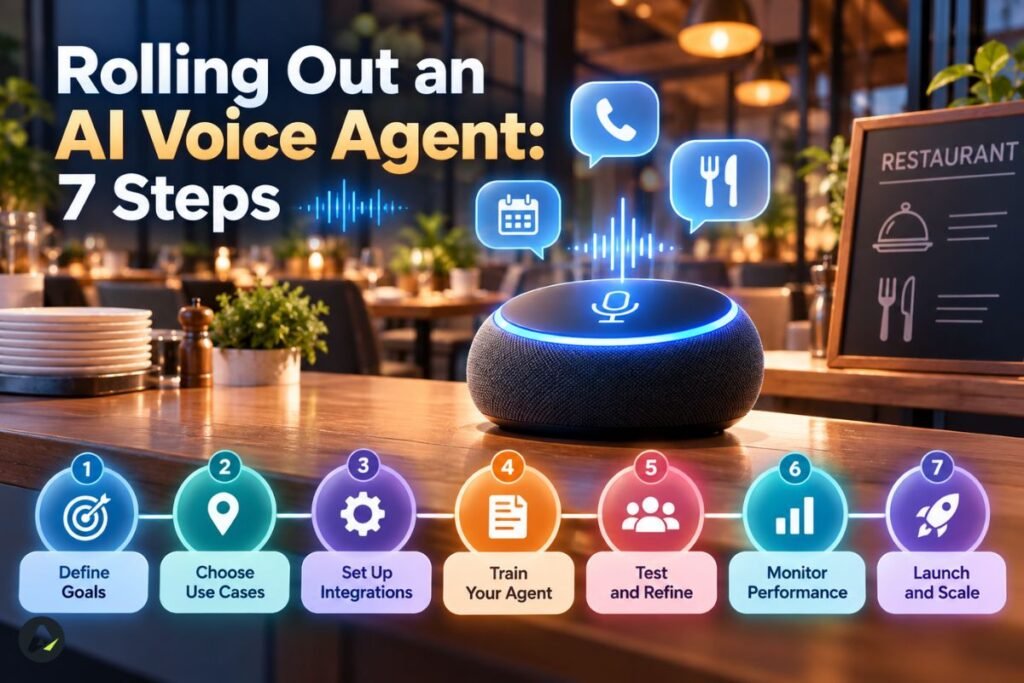
- Audit your calls. Export 30 days of logs — total calls, missed calls by hour, top five reasons people ring.
- Shortlist two or three vendors and score them with the CALLS framework on your own menu.
- Clean your venue data first — menu, modifiers, prices, hours, holiday trading, dietary info, deposit rules.
- Connect your systems and confirm orders land where the kitchen will see them.
- Write your handover rules — who gets a person: complaints, allergy concerns, large groups, VIPs, media.
- Start with overflow and after-hours only. Review transcripts daily for the first two weeks.
- Measure against your baseline and widen what the agent handles once it’s proven out.
7 Ways Restaurant Voice AI Goes Wrong
- Buying on the demo voice alone, without confirming the booking actually writes into your live system.
- Picking a booking-first tool for an order-heavy venue, or the reverse, without checking your call mix.
- Forgetting to keep the menu updated — selling a sold-out special is the fastest way to lose trust.
- Hiding that it’s AI. Guests generally accept a virtual assistant; they don’t like feeling tricked.
- No escape hatch. Every caller should be able to ask for a person and get one.
- Ignoring the overage rate — a cheap base plan can cost more than a pricier flat plan in a busy month once you’re past the included minutes.
- Never reviewing transcripts after setup, missing the menu confusion and FAQ gaps they reveal.
Where Restaurant Voice AI Is Heading
Booking platforms are turning into marketplaces — OpenTable Australia now lists more than ten voice-AI partners for near one-click activation. Pricing is drifting toward hybrid flat-fee-plus-usage models. And the December 2026 transparency rules will likely push vendors to be more explicit about data storage and model training, regardless of exactly where the legal threshold ends up.
Independent, peer-reviewed research on AI phone agents in Australian hospitality is still thin. Use vendor numbers as a starting point, then trust your own call logs.
Frequently Asked Questions
Q. What’s the best AI voice agent for restaurants in Australia?
It depends on your call mix. Reservation-led venues tend to look at Hey Buddy or an OpenTable voice-AI partner; takeaway-heavy venues compare Otto, Aisyst and Biteperk; cafes wanting phone plus chat often prefer AIssie.
Q. Does it work with OpenTable and Seven Rooms?
Several providers integrate directly — OpenTable lists voice-AI partners that manage bookings natively, and Hey Buddy publishes integrations with both SevenRooms and OpenTable. Ask each to show it working inside your own account.
Q. Can it take payments, not just orders?
Ordering-focused agents typically text a payment link after the order, so it’s paid before the kitchen starts on it.
Q. Is recording restaurant calls with AI legal in Australia?
Generally yes, with care — consent rules differ by state, so use a clear notice at the start of every call and have your specific setup checked rather than relying on the notice alone.
Q. Will guests know they’re talking to AI?
They should, because the greeting tells them. Most Australia-focused providers train their voices on Australian English, but confirm it yourself with fast talkers, noise, and strong accents rather than trusting the demo.
Related: AI Agent Rules of Engagement Must Come Before Credentials
| Disclaimer: This guide is independently researched and is not affiliated with or sponsored by any provider mentioned. Pricing, features, integrations, and availability can change, so verify current details directly with each vendor before making a purchase or business decision. This article is for informational purposes only and does not constitute legal or financial advice. |

Maliha
AI is moving steadily from experimental technology into the products and workflows people rely on every day. Maliha Irfan is a technology writer covering artificial intelligence, automation, and emerging software. Her work focuses on the practical side of AI agents, exploring how these systems are being used, what they can realistically accomplish, and the limitations that matter when businesses and individuals adopt them.
More from Maliha →