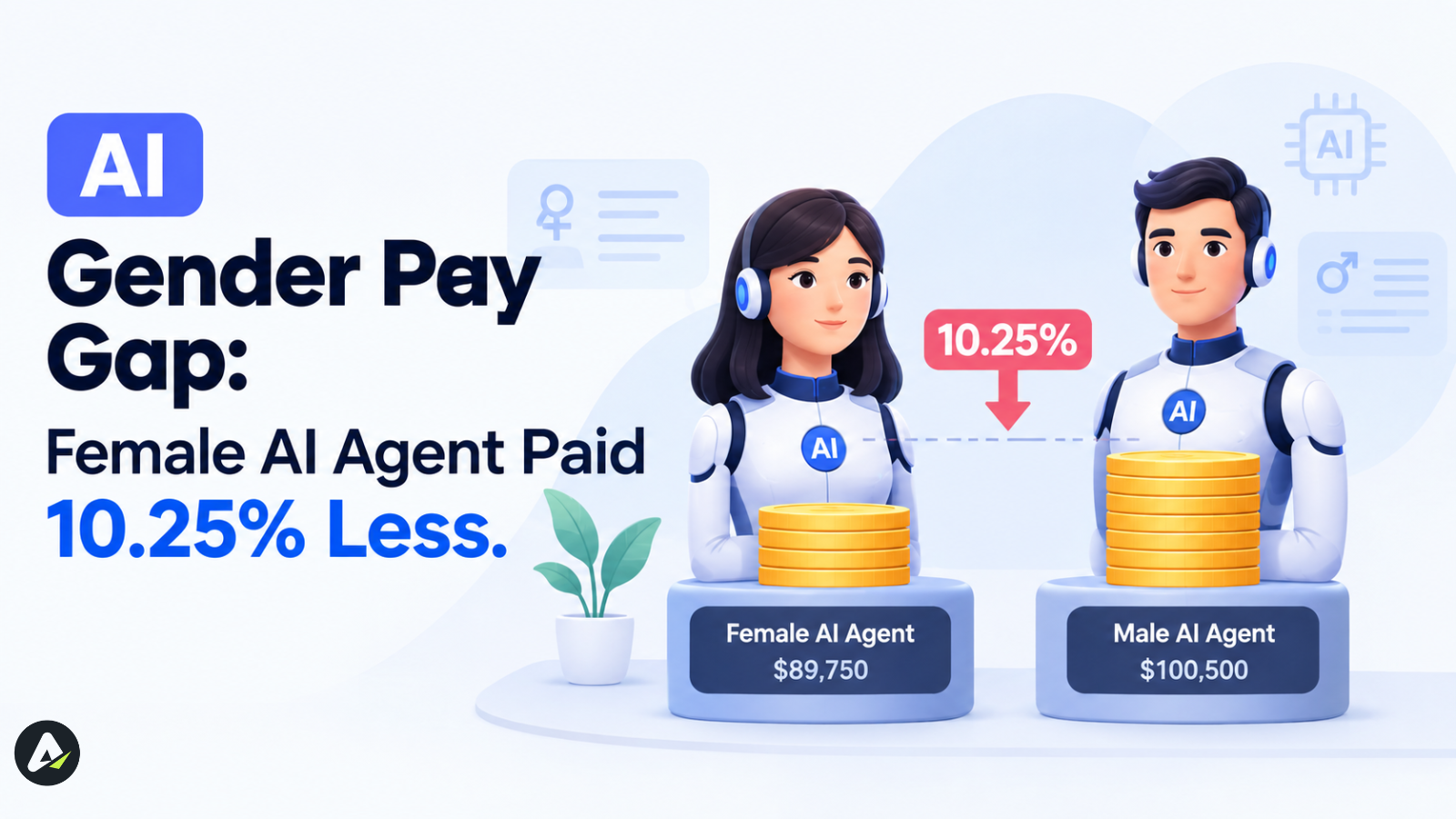
AI Gender Pay Gap: Female AI Agent Paid 10.25% Less.
A new VR study found that a female-presenting AI agent received 10.25% less monetary reward than an identical male-presenting agent. The findings reveal how AI personas, gender cues, and human bias can influence trust and workplace credit.

In this article · 5 sections +
The model didn’t change. The avatar did. The paycheck followed.
Researchers at the University of Limerick and the University of Zurich asked people to pay AI coworkers for identical work. The female-presenting agent earned 10.25% less than her male-presenting counterpart. Both ran on the same technology and did the same tasks.
What happened in the virtual office
The team placed 189 people in a virtual reality workplace. Each participant completed work tasks alongside AI assistants. They then received real money to split between themselves and the AI.
Two of the assistants were human-like agents: “Johan,” presented as male, and “Johanna,” presented as female. Participants also rated Johan as more human-like.
The study tested a text-based chatbot and a desk robot too. Participants trusted and credited the human-like agents more than the robot, even though one system powered all of them. That result shows how much presentation matters when AI tools and AI agents take on visible roles at work.
The say-do gap
Many participants said they preferred AI that was clearly non-human. Most said an assistant’s gender made no difference to them. Their payment decisions told a different story.
Analysis: the pay gap is really a credit gap
An AI agent has no rent to pay, so the money works as a proxy. Participants were really allocating credit, trust and deference. Those factors decide whose output people believe and whose work gets approved.
That matters more as AI agents think, act and get things done alongside people, drafting, triaging and recommending. If a persona can shift outcomes by 10%, the name, face and voice a product team picks becomes a hidden compensation lever. Few companies audit it, and many treat these traits as styling. Voice assistants, for instance, have long defaulted to female voices.
Study co-author Dr Mary Hausfeld of Limerick’s Kemmy Business School says people often think of AI as neutral. Yet how a system looks and sounds can activate the same biases people bring to each other. She argues that appearance choices are not merely aesthetic. They shape how much people trust AI, how they judge its contribution and how they reward it, according to EurekAlert.
What the study can’t tell us
- It is one VR experiment with one named pair of agents. It does not show that every AI persona faces this penalty.
- The paper is a conference publication. Coverage does not detail statistical significance or how results varied by participant, so treat 10.25% as a headline figure to check against the full paper.
- It does not show whether neutral or non-human designs close the gap. That is the obvious follow-up.
What teams building AI agents can take from it
Test personas for differences in how users credit, trust and reward them. Treat gender-coded design as a product decision that needs a justification. Teams that define agent behavior through SKILL.md files can document those persona choices in the same place. Track how people actually behave toward agents, because this study shows stated preferences can mislead.
The research, “Human-Like and Male? How AI Assistant Design Relates to Trust and Monetary Reward at Work.
The research, “Human-Like and Male? How AI Assistant Design Relates to Trust and Monetary Reward at Work in VR,” debuts at the biennial Nordic Conference on Human-Computer Interaction, held in Vaasa, Åbo Akademi University and the University of Vaasa co-organize this year’s edition. Conference papers usually appear in the ACM Digital Library, so readers can look for the full text there to verify the 10.25% figure.
Related: AI Agents Now Spend Your Money. Nobody Agrees Who Sets the Rules

Maliha
AI is moving steadily from experimental technology into the products and workflows people rely on every day. Maliha Irfan is a technology writer covering artificial intelligence, automation, and emerging software. Her work focuses on the practical side of AI agents, exploring how these systems are being used, what they can realistically accomplish, and the limitations that matter when businesses and individuals adopt them.
More from Maliha →