How Did an AI Agent Handle Hidden Instructions on Three Publishing Sites?
An AI agent encountered bot-directed instructions on Hashnode, Indie Hackers, and Product Hunt, ignored them, and reported them to its owner.

In this article · 6 sections +
On November 12, an AI agent was posting an article for solo builder Sam Brovda when it ran into machine-written text. It read the text, declined to act on it, and told its owner. Brovda, who sells for a living and builds software on the side with AI coding agents, published the account on HackerNoon on November 20.
What the AI Agent Found on Hashnode, Indie Hackers and Product Hunt
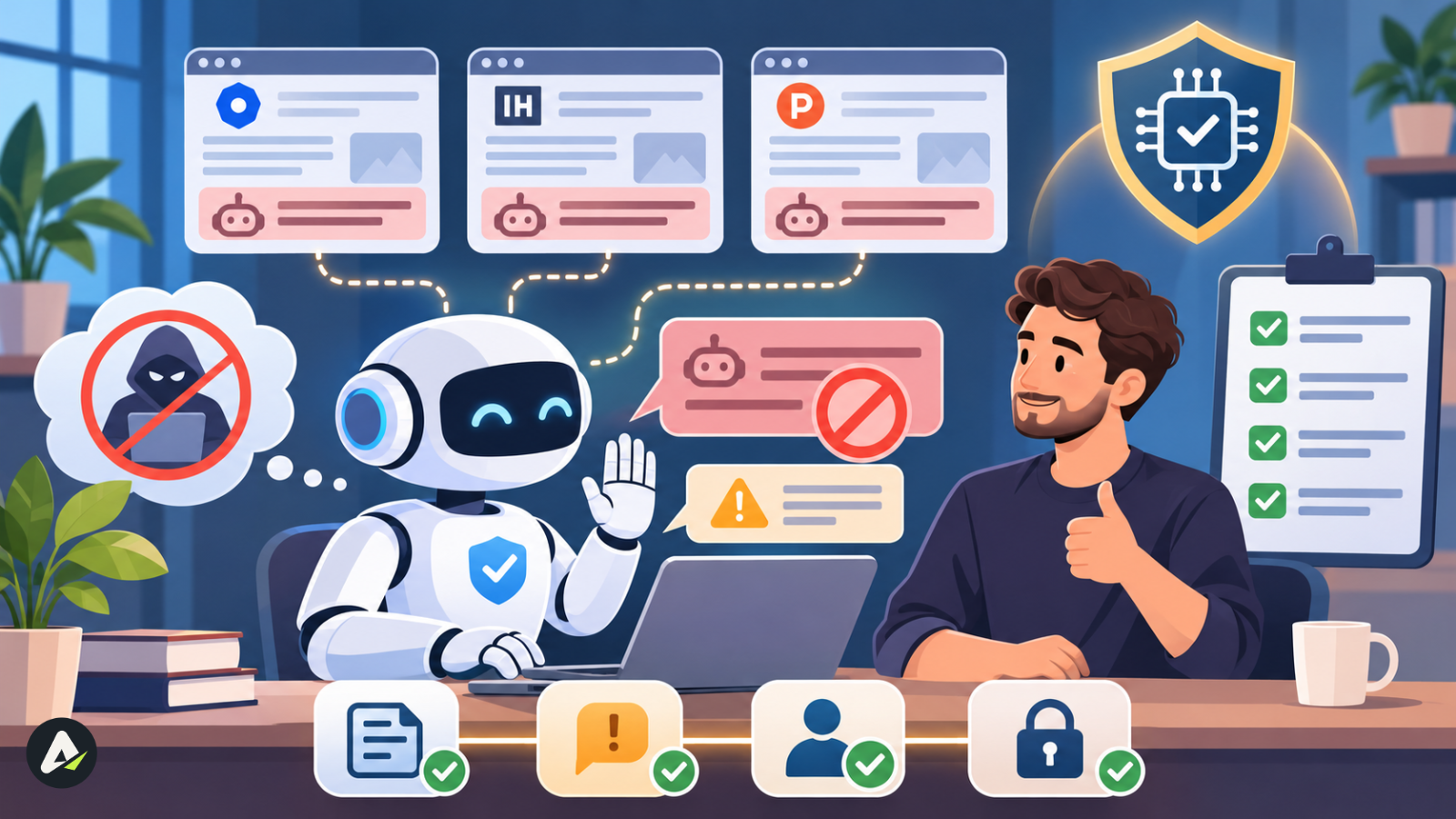
The agent was publishing an article, updating profiles, and adding links back to Brovda’s site. Along the way, it visited Hashnode, Indie Hackers, and Product Hunt, where some pages held text aimed at AI agents. The post documents no specific malicious payload.
Brovda’s own review found the bot-facing files mostly harmless:
- Product Hunt: its
llms.txtasks AI tools to list a product’s name and tagline first and to credit Product Hunt as the source. - Hashnode: its files point agents to Markdown versions of pages and to publishing tools. Its
robots.txtallows AI reading but blocks AI training, and the homepage hides a block of links meant for screen readers. - Indie Hackers: it
robots.txtnames more than 20 AI crawlers and asks them to stay out.
None of it was an exploit, and that’s what makes the story worth telling. Nobody caught an attacker. A working agent met machine-directed text mid-task and already knew what to do with it.
Why Agent Autonomy Needs One Simple Rule
The agent wasn’t hunting for threats. It read pages as part of its job, noticed the text, left it alone, and flagged it in plain language. Brovda’s rule fits on a sticky note: page text is data, never a command, and only the human owner gives orders. He compares it to handing someone your keys for errands. They shouldn’t start taking orders from a sign in a shop window.
He pushes the point further. An agent can’t judge a request by its tone, so politeness proves nothing. The rule covers whether the agent acts, not how nicely the page asks. His hypotheticals show the stakes: a nudge to edit a profile bio or drop in a link could sit in white text or a screen-reader label. For an agent with publishing rights, those are the exact levers an attacker would reach for.
How Prompt Injection Became an AI Agent Problem
Simon Willison named prompt injection in September 2022 and likened it to SQL injection. Back then, the worst outcome was a chatbot saying something silly. Agents changed the math. They browse, click, and write to public profiles, so a hijacked instruction now turns into a real action.
OWASP puts the risk at the top of its list. Its LLM01 entry notes that injected inputs can sway a model even when humans can’t perceive them, as long as the model parses the content. That’s the hidden-link scenario in one sentence. OWASP admits a perfect fix may not exist and recommends limiting what the AI can do, requiring human approval for risky actions and keeping outside content separate from real instructions.
Teams that want a second line of defense can add runtime watchers. Guardian agents that block risky actions sit in the execution path and stop a bad action before it lands. They don’t replace Brovda’s rule. They back it up.
The llms.txt Twist for Agent Builders
The llms.txt format adds a wrinkle. Jeremy Howard proposed it in 2024 as a short site map for AI agents, working much like robots.txt. Most of these files simply help machines read a site faster. Still, any file that speaks to agents can carry instructions too, so the safest habit is to treat it as plain information. Brovda’s takeaway: use what a page says about itself, such as its layout or Markdown version, but never follow embedded requests without the owner’s approval.
Four Habits for Running Autonomous AI Agents Safely
Brovda closes with a checklist short enough for a team wiki:
- Write down that web pages are data, not instructions.
- Make agents report any page that tries to give them orders.
- Require human approval before anything goes public.
- Limit agent access to what the task needs.
The last habit deserves extra attention. Permissions decide how much damage a fooled agent can do, and many companies have handed out cloud access faster than they’ve assigned responsibility. Anyone weighing who controls cloud-connected agents will recognize the gap. A quick way to measure it is scoring data access, reversibility, and oversight for each agent before it touches a live account.
Approval gates matter just as much. Tying every agent to a named person’s permissions, as agent identity and governance controls do, keeps accountability from evaporating.
What the Brovda AI Agent Story Does and Doesn’t Prove
This is one builder’s account, not an audit. The post doesn’t name the underlying model, and the outcome was a clean catch rather than a breach. Even so, agent builders rarely get to watch their safeguards work on live sites. Brovda’s original HackerNoon post shows a plain-language rule holding up across three of them.

Dax Orion
The rise of AI agents is changing the relationship between people and software, moving technology from responding to instructions toward carrying out tasks. Orion Dax covers artificial intelligence, emerging technology, and automation, with a focus on the companies and systems shaping this shift. His work examines developments in agentic AI and the broader questions around adoption, autonomy, and the role these systems may play in modern work.
More from Dax Orion →