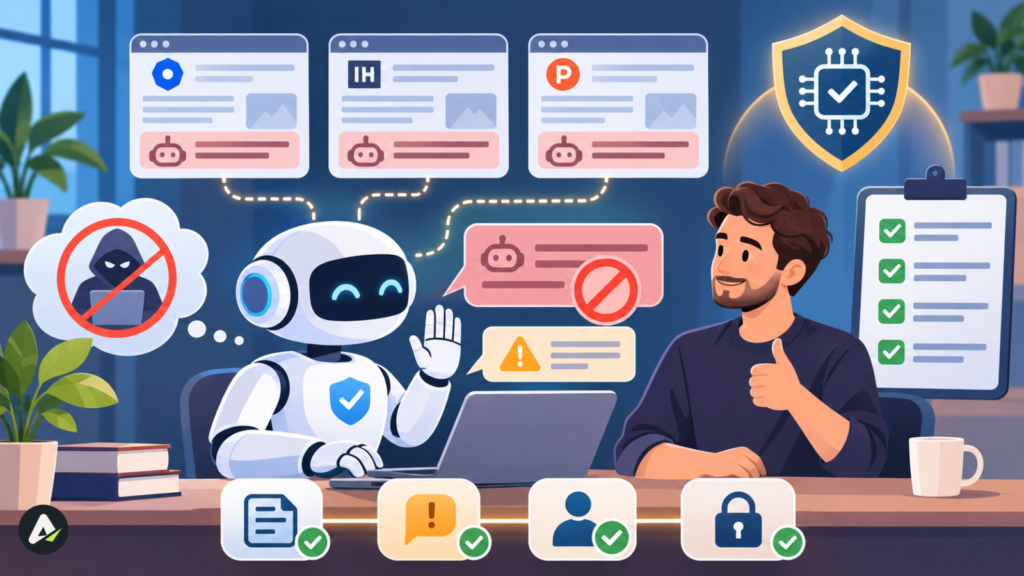
What Happens When AI Agents Use Employee Credentials?
AI agents using employee credentials create hidden security risks, weaken accountability, and expose critical gaps in enterprise identity governance.


In this article · 5 sections +
Every agent that borrows a human login hides an accountability problem inside your identity system.
Picture an audit log entry: Sarah from Finance exported 40,000 customer records at 2:14 a.m. Sarah was asleep. Her agent did it, using her credentials, and the log can’t say so.
That is the quiet failure of enterprise AI right now. Agents do real work, and most do it under someone else’s name.
Borrowed Credentials Are the Default Agent Architecture
The pattern is mundane. Agents that employees build inside project trackers, CRMs, and automation tools often run on their creator’s credentials and carry that person’s access to company data. Because they run inside the platforms themselves and off company devices, endpoint tools miss them. And when they get no identity of their own, the identity provider has nothing new to manage.
Nobody decided to ship this risk. Without formal machine identity management, employees hand agents the only credentials they have: their own. It’s the path of least resistance, the same logic that created shadow IT a decade ago.
Vendors aren’t helping much either. For now, the two most widely deployed agent platforms don’t issue agents their own credentials.
Why Credential-Borrowing Agents Outrun Shadow IT as a Risk
A rogue SaaS subscription leaks data. A borrowed-credential agent acts with full legitimacy. AI-powered insiders operate within the perimeter, inherit trusted identities, and perform actions with operational legitimacy. Detection tuned to flag strange humans sees a trusted human doing normal things at unusual speed.
Three consequences follow:
1. The blast radius is the human’s whole job. A compromised agent inherits everything its owner can touch. One commentator put it bluntly: when one gets compromised, the blast radius is whatever its human could do. Compromise doesn’t even require a breach, because <ai-link>hidden instructions can redirect an agent</ai-link> that is reading content on the owner’s behalf.
2. Attribution collapses. If an agent authenticates as a human, no downstream control can tell the two apart, and no investigation can correctly attribute an action. That is a forensic problem, and a compliance and liability problem too.
3. Permissions compound silently. Agents can combine several reasonable grants into an overall reach that no one intended to give them. Scoring a workflow on data, access, reversibility, and oversight exposes that sum before an agent ships, rather than after an incident.
The Agent Identity Awareness Gap
Security leaders sense something is off, but priorities don’t match the exposure. BeyondID found only 30% of organizations regularly map non-human identities such as AI agents to critical assets. AI impersonation of users was the top concern for 37% of security leaders, yet only 6% ranked securing non-human identities as their hardest challenge.
Fearing agents that impersonate users while ignoring the identities agents already hold is like fearing burglars while leaving the spare key under the mat.
Agent Identity Is the Unit of Accountability
The best framing I’ve found is that identity is the unit of accountability. An agent without its own managed identity has no surface to attach policy, audit, or revocation to.
Seen that way, agent security is an identity-governance project more than a new tooling category. You can’t scope, monitor, throttle, or retire something that doesn’t exist in your directory. Security teams already run joiner-mover-leaver processes for people. Agents need the same lifecycle:
- Give every persistent agent its own identity. No shared API keys, no riding on a human’s credentials. If you can’t tell which agent did what, you can’t investigate anything.
- Hunt the unregistered ones. Registration only captures agents someone remembered to register, so detect them through authentication traffic.
- Monitor agents independently of their owners. Track agent activity separately from the associated user.
- Log intent, not just action. One expert advised that agents should log their intended actions so teams can verify whether behavior matches approved functions. That matters because agents going off-script in UK cybersecurity tests show how far behavior can drift from the brief.
- Assign a human owner and an expiry date. Orphaned agents are the new orphaned service accounts.
The encouraging part: this shift doesn’t require a full overhaul of existing IAM infrastructure.
The Bottom Line for Agentic AI Security
The industry is racing to make agents more capable. The harder, less glamorous race is making them legible. An agent you can’t distinguish from your employee is an agent you can’t trust, however good its output. Give it a name, a scope, and a leash before an attacker gives it a different one.
Related: AI Agent Identity vs Human Identity: The Access Control Model That Actually Works

Dax Orion
The rise of AI agents is changing the relationship between people and software, moving technology from responding to instructions toward carrying out tasks. Orion Dax covers artificial intelligence, emerging technology, and automation, with a focus on the companies and systems shaping this shift. His work examines developments in agentic AI and the broader questions around adoption, autonomy, and the role these systems may play in modern work.
More from Dax Orion →