OpenHands vs Devin vs Manus: Best AI Agent in 2026
Ninety percent of professional developers used an AI coding agent at work at least weekly in May–July 2026, per JetBrains' Developer Ecosystem Survey of 15,000+ professional developers. Adoption is growing fast. Adoption alone doesn't establish ROI, and the…

In this article · 18 sections +
- The 60-Second Comparison
- OpenHands: Open-Source AI Coding Agents You Host Yourself
- Devin: The Managed Autonomous Software Engineer
- Manus: A General-Purpose Research and Deliverable Agent
- Features Compared Side by Side
- Verified the Pricing: What Each AI Agent Actually Costs
- Security, Compliance, and Data Control
- Data Training, and the Real Cost of Self-Hosting
- How Tasks Reach Each Agent
- The Review Bottleneck
- Vendor Continuity and Jurisdiction Risk
- Where Cursor, Claude Code, and IDE-Native Agents Fit
- What Benchmarks Do and Don’t Tell You
- The CONTROL Checklist
- Four Mistakes Worth Avoiding
- Should You Run Two?
- Two Shifts to Watch
- FAQs
Ninety percent of professional developers used an AI coding agent at work at least weekly in May–July 2026, per JetBrains’ Developer Ecosystem Survey of 15,000+ professional developers. Adoption is growing fast. Adoption alone doesn’t establish ROI, and the harder question is which agent fits which job.
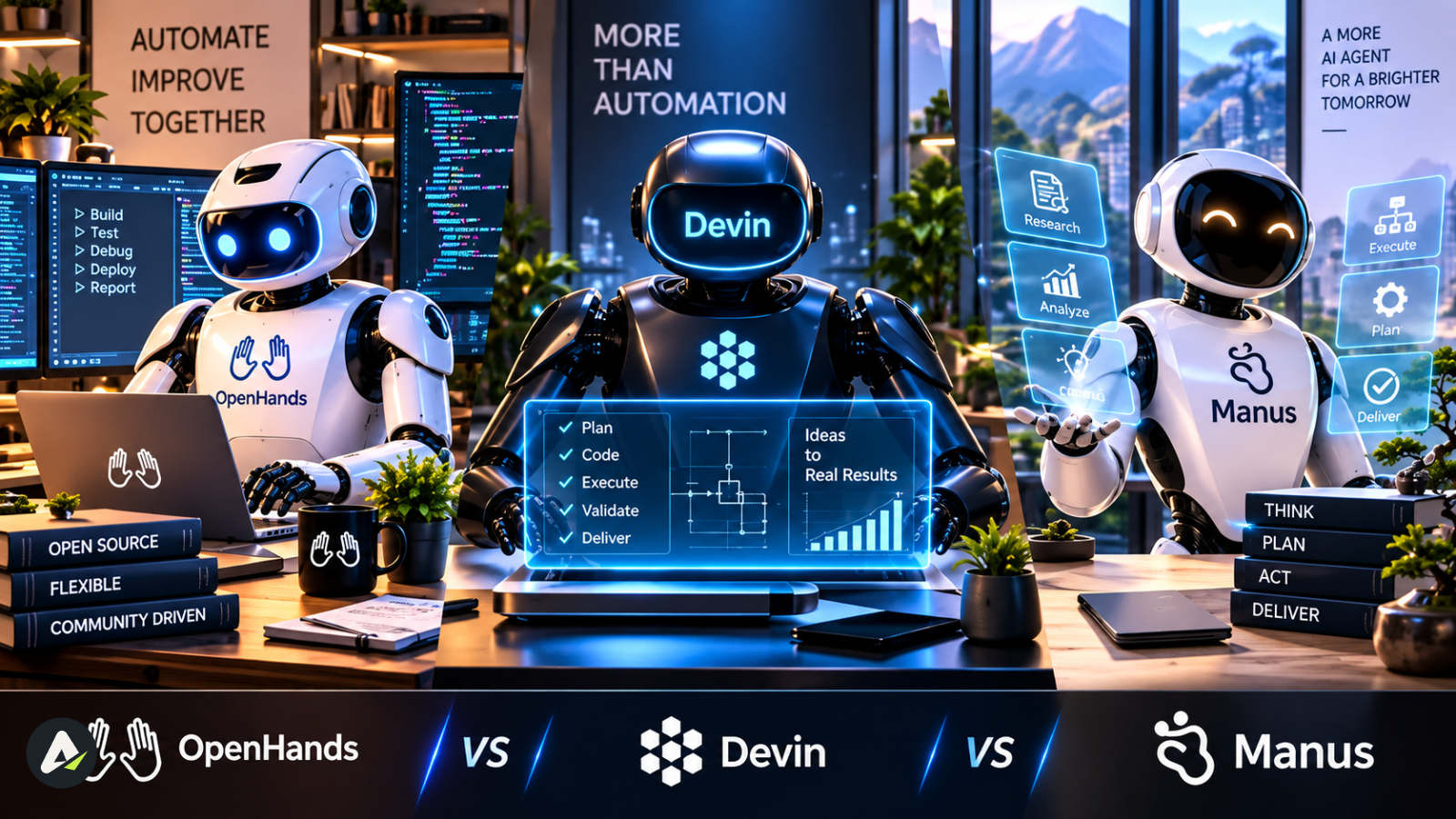
When you compare OpenHands AI agent features vs. Devin vs. Manus, it’s easy to treat them as three alternatives for the same job. But that’s not quite how they work. OpenHands and Devin are built around software engineering, while Manus takes a broader approach to web research, automation, and delivering finished work. It can handle coding tasks too, but it isn’t primarily a dedicated software engineering agent.
If you’re new to AI agents, start with what AI agents are and how they act.
This comparison focuses on what matters when choosing between them: pricing, security, data-training policies, how tasks reach each agent, and the human review time that often gets overlooked. It also covers where IDE tools like Cursor fit and when they might make more sense for your workflow.
The 60-Second Comparison
| OpenHands | Devin | Manus | |
|---|---|---|---|
| Category | Open-source agent platform | Managed coding SaaS | General-purpose web agent |
| Vendor | All Hands AI | Cognition | Butterfly Effect |
| Deployment | Local, SaaS, or self-hosted VPC | Cloud SaaS; VPC on Enterprise | Managed cloud only |
| Model choice | Model-agnostic, BYO key | Frontier models from multiple providers on paid tiers | Manus 1.6 family only |
| License | MIT core | Proprietary | Proprietary |
| Free tier | Yes — local OSS and hosted Individual | Yes — light quota, limited models | Yes — 300 daily credits |
| Paid entry | Enterprise only (custom) | $20/mo | $20/mo |
| Independent cert | Vanta trust center; Enterprise controls | SOC 2 Type II since Sept 2024 | Conflicting public reports (see below) |
| Strongest at | Data and model control | Hands-off ticket-to-PR delegation | Research, decks, reports |
| Weakest at | Operational burden falls on you | Cost forecasting | Engineering depth; vendor continuity |
Autonomous agent, defined once: an agent plans a multi-step task, executes it against real systems — files, shells, browsers, APIs — and iterates on its own failures without turn-by-turn prompting. An assistant suggests; an agent acts. That’s a different risk profile from completion tools, and AI tools and AI agents fail in different ways. Every section below assumes this baseline.
OpenHands: Open-Source AI Coding Agents You Host Yourself
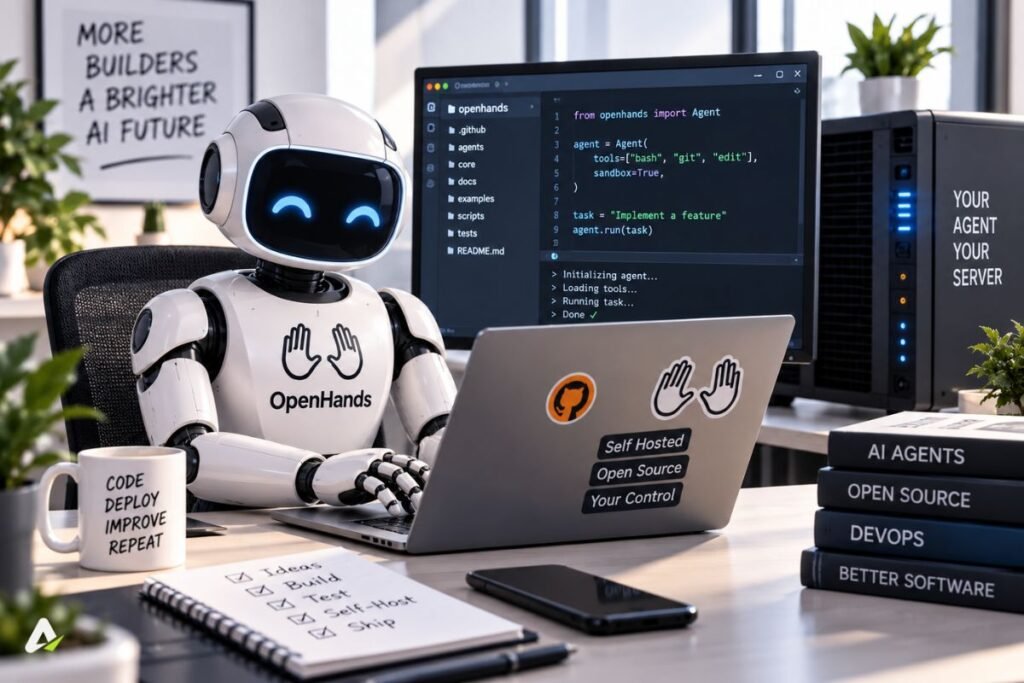
OpenHands is an MIT-licensed open-source agent platform for engineering teams that need to run coding agents inside infrastructure they control.
It began in early 2024 as OpenDevin, a community response to Devin’s announcement, then renamed under All Hands AI. The project’s site displays 88.2K GitHub stars as of September 2026, and describes itself as building an open standard for autonomous software development.
What it does:
- Runs an observe-think-act loop inside a sandboxed container — reading files, executing shell commands, browsing, calling APIs — with actions logged for review.
- Stays model-agnostic. Every tier supports bringing your own LLM key, or using the OpenHands provider at cost with no markup.
- Ships three surfaces: web GUI, CLI, and a Software Agent SDK, with MCP support across all tiers.
- Offers a public extensions registry with reusable capabilities — Linear queries, Jira polling automations, Slack digests. Teams writing their own should understand how SKILL.md files work and where they go wrong.
- Integrates with GitHub, GitLab, and Bitbucket, plus Jira and Slack, on all three plan tiers.
Constraints: the hosted Individual tier supports one user and caps at 10 daily conversations. Multi-user RBAC, SAML/SSO, and centralized billing require the Enterprise plan. Output quality depends on the model you connect, and self-hosting transfers infrastructure work to you.
Devin: The Managed Autonomous Software Engineer
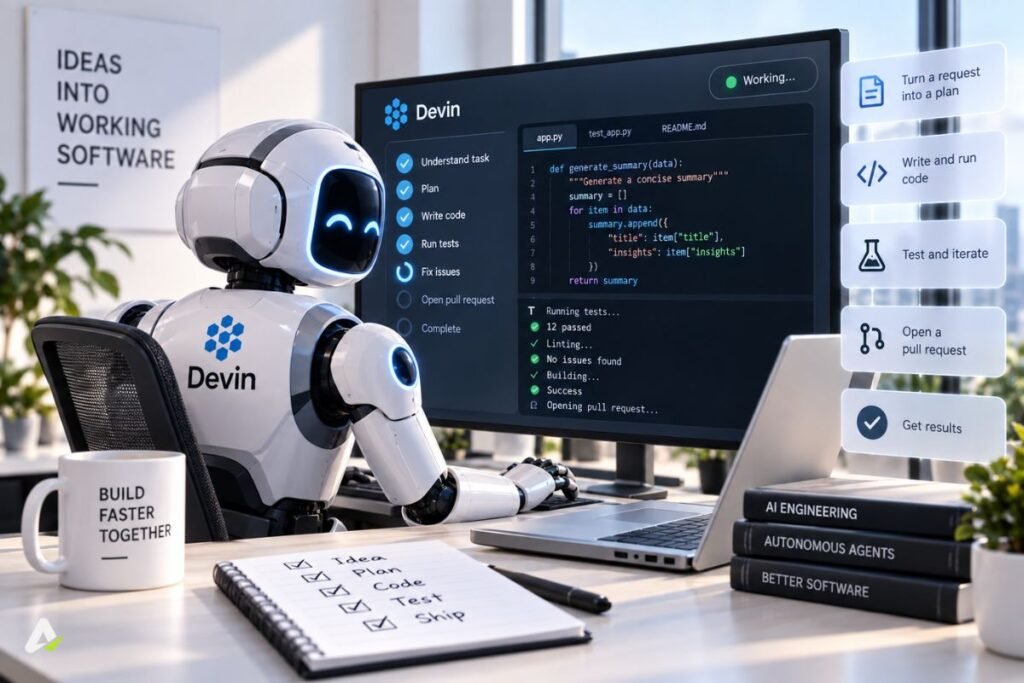
Devin is a proprietary cloud agent from Cognition for engineering teams that want to delegate scoped tickets and receive finished pull requests without managing infrastructure.
Cognition positions it for multi-repo, multi-week work: PR review and visual QA, code migrations across repos in parallel, documentation generation via DeepWiki, incident triage from Datadog and Slack, and scheduled chores like release notes.
What it does:
- Assigns work through tickets, chat, API, or automations rather than a chat box you babysit.
- Spins up a team of Devins for large tasks, and improves over time by reading past session trajectories.
- Runs SWE-2, Cognition’s current model, alongside frontier models from OpenAI, Anthropic, Google, and leading open-source models on paid tiers.
- Supports up to 10 concurrent sessions on individual paid plans, unlimited on Team and Enterprise.
Constraints: usage is quota-based rather than seat-based, so the bill tracks how much the agent runs. Cognition states cost per message varies with model, task size, and complexity, and reasoning required — which is honest, and also why forecasting is hard.
Manus: A General-Purpose Research and Deliverable Agent

Manus is a managed cloud agent from Butterfly Effect for analysts, researchers, and operators who need finished deliverables rather than code commits.
It runs a planner-executor architecture inside an isolated Linux VM with scoped browser sessions and per-task credentials, closer to general workflow-automation agents like Lindy than to anything in your IDE.
What it does:
- Wide Research runs multiple agents in parallel across sources instead of crawling sequentially.
- Generates slides, deploys websites, and produces advanced research reports as first-class outputs.
- Supports 20 concurrent tasks and 20 scheduled tasks on Pro, versus 1 and 2 on Free.
- Offers Chat Mode plus three Agent Mode models (1.6 Lite, 1.6, 1.6 Max), with Free limited to 1.6 Lite.
Constraints: engineering depth and continuity — covered in its own section below.
Features Compared Side by Side
| Dimension | OpenHands | Devin | Manus |
|---|---|---|---|
| Code stays in your infrastructure | Yes, self-hosted | Enterprise VPC deployment | No |
| Bring your own model key | Yes, all tiers | No | No |
| Self-host | Yes, MIT core | Enterprise dedicated deployment | No |
| Git provider integration | GitHub, GitLab, Bitbucket | GitHub, GitLab, Bitbucket, custom | Limited |
| Ticketing integration | Jira | Linear and Jira | None documented |
| Chat integration | Slack | Slack and Teams | None documented |
| Slide/report generation | No | No | Yes |
| Concurrent work | Unlimited on Enterprise | 10 individual/unlimited Team | 20 on Pro |
| SSO | Enterprise SAML/SSO | SAML/OIDC on Enterprise | Team plan |
| Setup effort | Hours to days if self-hosted | Minutes | Seconds |
OpenHands and Devin overlap on most rows and differ mainly on who carries operational responsibility. Manus differs substantially in primary workflow and engineering capability.
Verified the Pricing: What Each AI Agent Actually Costs
| OpenHands | Devin | Manus | |
|---|---|---|---|
| Free | Open Source: local, 1 user, unlimited daily conversations, BYO key | $0: light agent quota, limited models, unlimited inline edits and Tab | $0: 300 daily refresh credits, 1 concurrent task, 2 scheduled tasks, 1.6 Lite only |
| Individual | Individual (SaaS): free, 1 user, 10 daily conversations, BYOK or OpenHands models at cost | Pro $20/mo: full model availability, Devin Cloud, DeepWiki, API, Ask Devin | Pro from $20/mo: from 4,000 monthly credits, Wide Research, slides, site deployment |
| Higher individual | — | Max $200/mo: significantly higher quotas | Pro from $40/mo: from 8,000 monthly credits, 7-day free trial |
| Team | Enterprise (custom) | Teams $80/mo + $40/mo per full dev seat | Team from $20 per seat/mo: SSO, access control, usage analytics, training opt-out |
| Enterprise | Custom: self-hosted VPC, SAML/SSO, unlimited concurrency, Large Codebase SDK, named engineer | Custom: VPC deployment, SAML/OIDC SSO, teamspace isolation, dedicated account team | Contact sales |
| Overage | Your own token spend | Extra usage at API pricing | Credit top-up packs |
| Annual discount | n/a | Not published | 17% |
Security, Compliance, and Data Control
| OpenHands | Devin | Manus | |
|---|---|---|---|
| Public trust center | Yes, hosted on Vanta | Yes | Couldn’t find one |
| SOC 2 Type II | Available through Enterprise; self-hosting takes the vendor out of scope entirely | Certified since September 2024 | Sources contradict each other |
| Trains on your code? | Nobody’s in the path when you self-host | Paid plans reportedly allow it by default, with an opt-out in Data Controls. Enterprise reportedly carries a no-training commitment | Opt-out is documented, but only on the Team plan |
| Zero data retention | Comes free with self-hosting | Reportedly kicks in with model providers once you opt out of training | Not documented |
| Named data regions | Wherever you deploy it | VPC in your own cloud, but the docs don’t name specific regions | Not documented |
| SSO | Enterprise SAML/SSO | SAML/OIDC on Enterprise | Team plan |
Check the training settings before you run anything real. This one catches people out. On Manus, the opt-out sits on the Team tier, so if you’re on an individual Pro plan, you shouldn’t assume you have it. On Devin, the terms are reported as opt-out rather than opt-in for paid plans, which means the default isn’t the safe setting. Either way, a quick pilot on a free or freshly-created account with your actual codebase is the one thing you don’t want to do. Spend ten minutes in the data controls first. It’s the cheapest risk reduction available to you.
And a word on self-hosting, because it gets oversold. Running OpenHands on your own infrastructure does something real: it takes the vendor out of your data path, so their terms stop mattering to you. That’s a genuine advantage, and it’s why regulated teams keep landing there.
But it doesn’t make the risk disappear. It moves it. Sandbox isolation, secret handling, access scoping, audit logging, patching, incident response — all of that becomes your job, done by your people, on your budget. Some teams are glad to own it. Others discover halfway through that they’d rather have paid someone else. Worth knowing which kind of team you are before you commit.
How Tasks Reach Each Agent
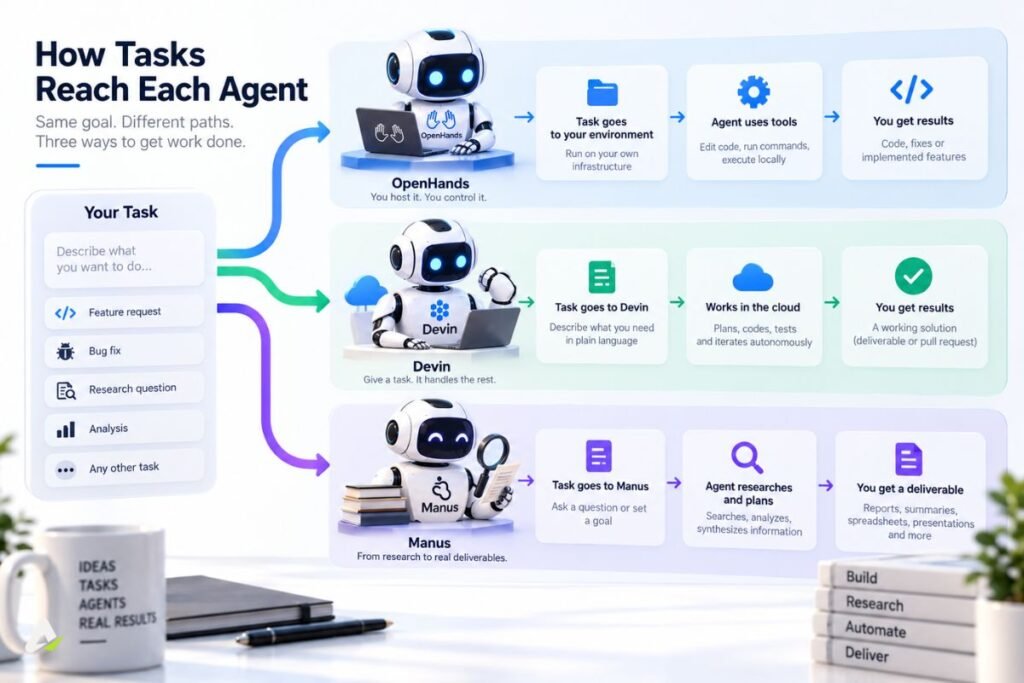
Integration decides adoption more reliably than capability does. An agent your team has to copy-paste into gets used twice and abandoned.
Devin connects to GitHub, GitLab, Bitbucket, and custom git providers, plus Linear, Jira, Slack, and Teams across paid tiers. Assign a ticket to Devin in Linear or add a Devin label, and it picks the work up; tag it in Slack to turn a discussion into a PR. Sessions can also be created through the Devin API and Automations, and the default platform is honored across Slack, Linear, Jira, API, and automation triggers. For Jira, a dedicated service account keeps agent comments separable from human ones in the audit trail.
OpenHands lists Jira and Slack integrations plus Cloud APIs on all plan tiers, with Git provider support for GitHub, GitLab, and Bitbucket. Enterprise adds Azure DevOps, Bitbucket Data Center, and Jira Data Center, and organization admins can now configure Jira Cloud once for all users rather than per person. Mentioning @openhands or adding the openhands label starts an issue-to-PR workflow.
Manus has no documented ticketing integration. Work arrives through the interface, scheduled tasks, or the API.
If your team runs Jira Data Center or Azure DevOps behind a firewall, OpenHands Enterprise is the only one of the three that meets you there.
The Review Bottleneck
Throughput on autonomous coding is capped by human review capacity, not agent capability.
A senior engineer can often write a 300-line change faster than they can review one written by something else. Reading unfamiliar code for correctness and hidden assumptions is slower than writing familiar code. Increase agent output without increasing review capacity and you get a longer queue at your most expensive person, not a faster team.
The METR randomized controlled trial (2025) found experienced open-source developers were 19% slower when using AI tools, despite estimating they had been roughly 20% faster — a gap between perceived and measured productivity that any evaluation should account for. Separately, reported multi-agent incidents have shown agents propagating a shared incorrect premise without any individual component failing, which is worth reading about in detail before granting broad autonomy; this documented case is a useful example.
Scope limitation is a design choice, not a compromise:
- Bounded work — dependency bumps, test coverage, lint fixes, small bug fixes, mechanical refactors — reviews in minutes and is where per-task economics work best.
- Ambiguous tickets produce the least reviewable output for the most consumption, on every metered platform.
- Three reviewable PRs beat one large PR that sits for four days.
- Measure cost per merged PR and reviewer minutes per PR, not tasks attempted.
Vendor Continuity and Jurisdiction Risk
Ownership and regulatory exposure now belong in agent evaluations, and Manus is the documented case.
Meta announced a $2 billion acquisition of Manus in December 2025. China’s National Development and Reform Commission blocked the transaction on 27 April 2026, requiring the parties to withdraw it. In August 2026, Manus said it would resume operating as an independent company and told some users they would need to back up data generated on or after 29 December 2025 as part of the separation.
That last detail is the transferable lesson: a regulatory action elsewhere produced a data-migration obligation for customers who had no part in it.
Ask any agent vendor: who owns the entity and under which jurisdiction; where data is processed and whether regions are named; what happens to customer data in an acquisition or forced unwind; and whether an export path exists if service stops.
Where Cursor, Claude Code, and IDE-Native Agents Fit
Some teams comparing these three are on the wrong axis entirely. The real split is supervision: IDE-native tools run under your eye; background agents hand back a finished artifact.
Both categories now do agentic work — Cursor ships background agents on cloud VMs, Claude Code runs headless with parallel sessions — so “IDE versus terminal” no longer describes the difference.
Reasons to stay in the editor: you want to approve each diff; the task needs judgment mid-flight; you need second-level iteration; or cost matters and you’d rather pay a flat subscription. Cursor lists Pro at $20/mo, Pro+ at $60, and Ultra at $200, and one 2026 index placed its Composer 2.5 model third behind Claude Opus 4.7 in Claude Code and GPT-5.5 in Codex while running at substantially lower cost per task.
Reasons to delegate to the background: parallelism and attention. Ticket queues, dependency sweeps, and test backfills shouldn’t occupy a human’s foreground. Open-source IDE agents like Cline and Roo Code cover the same slot for teams that need inspectable code with step-by-step approval.
By mid-2026, the common pattern among experienced engineers was running both and routing by task.
What Benchmarks Do and Don’t Tell You
Treat every number in this section as directional.
Company-reported GAIA scores. Manus has reported roughly 86.5% / 70.1% / 57.7% across GAIA Levels 1–3, against OpenAI Deep Research at 74.3% / 69.1% / 47.6%. These are vendor-reported figures tied to a specific version, not independently reproduced, and an April 2026 audit reportedly demonstrated that GAIA tasks can be passed without solving the underlying problem.
SWE-bench Verified. Leaderboard toppers in 2026 cluster around 75–80%, but the same model under a different harness commonly moves 10–15 points, and models above 80% on Verified have scored far lower on contamination-resistant variants. OpenAI has published that it no longer treats Verified as a frontier capability measure.
What to do instead: run your own ten tickets. The protocol below is reproducible in two days.
The CONTROL Checklist
Seven gates that eliminate unsuitable agents before feature comparison.
| Gate | Question | Eliminates |
|---|---|---|
| C — Code sensitivity | Can source code leave your infrastructure? | If no: Devin outside Enterprise VPC, Manus |
| O — Ownership of models | Do you need to choose or swap models? | If yes: Manus |
| N — Nature of task | Repo-bound engineering or open-web knowledge work? | Engineering: Manus. Research: the other two |
| T — Team capability | Can someone run containers, Kubernetes, and secrets? | If no: OpenHands self-hosted |
| R — Runway model | Do you need a fixed, forecastable monthly figure? | Quota overage and credit burn both fail |
| O — Oversight | Do you need action-level logs and a no-training term? | Verify training defaults on Devin; verify certification on Manus |
| L — Lock-in tolerance | What does a vendor disruption cost you? | Weigh jurisdiction and continuity |
Four Mistakes Worth Avoiding
1. Comparing the wrong category. If you want supervised in-editor work, you’re shopping for Cursor, Claude Code, or Cline.
2. Piloting on a free tier with proprietary code. Training defaults and opt-out availability differ by plan on both Devin and Manus.
3. Selecting on benchmark scores. Harness choice moves results more than model choice, and most published figures are vendor-reported.
4. Scaling autonomy before scaling review. Output you can’t verify isn’t throughput.
Should You Run Two?
A split stack is increasingly common: a coding agent for repository work, a general agent for research and deliverables upstream of it. At entry tiers, that combination lands around $40/month, and the two tools rarely contend for the same task.
Multi-tool stacks are also normal inside the coding category. OpenHands positions itself around standardizing how agent workflows run without standardizing on one agent or model, and its Agent Canvas can drive third-party agents including Claude Code and Codex.
Two Shifts to Watch
Governance is becoming the gate. Security is now widely cited as the leading barrier to scaling agentic AI, which pushes audit logging, credential scoping, and contractual no-training terms ahead of benchmark scores in procurement. It also raises an organizational question worth settling early, because treating an agent like an employee rather than a system creates accountability gaps.
Review tooling is the next value layer. If human verification is the constraint, the gains come from smaller diffs, better provenance, and automated pre-review — not faster agents.
FAQs
Q. How much does Devin cost in 2026?
Free ($0, light quota, limited models), Pro $20/month, Max $200/month, Teams $80/month plus $40/month per full developer seat, and custom Enterprise. Paid plans include usage allowances that refresh daily and weekly; extra usage is purchased at API pricing. Verified on Devin’s pricing page, 17 September 2026.
Q. How much does Manus cost in 2026?
Free is $0 with 300 daily refresh credits, one concurrent task, and 1.6 Lite only. Pro starts at $20/month from 4,000 monthly credits, with a second Pro tier from $40/month with 8,000 credits and a 7-day trial. Team starts at $20 per seat/month. Annual billing saves 17%. Verified against Manus’s help center, 17 September 2026.
Q. Is OpenHands free?
Yes, in two ways. The open-source version is MIT-licensed, runs locally for one user with unlimited daily conversations, and works with your own LLM key. The hosted Individual tier is also free but caps at one user and 10 daily conversations. Enterprise is custom-priced.
Q. Does Devin train on your code?
Cognition’s published terms are reported to permit using customer data for model training on paid plans by default, with an opt-out in Data Controls, and Enterprise customers reported as covered by a no-training-without-consent commitment. Confirm current terms in Cognition’s Trust Center and platform terms before piloting with proprietary code.
Q. Is Manus certified for enterprise use?
Public reporting conflicts. Sources in 2026 variously state that SOC 2 claims lacked published audits, that Manus was not yet SOC 2 certified, and that it holds SOC 2 Type II plus ISO 27001. Request documentation directly rather than relying on third-party summaries. The documented training opt-out sits on the Team plan.
Q. Who are Devin’s main competitors?
OpenHands is the closest alternative and began as an open-source response to Devin. Others include Claude Code, Cursor, Codex, Cline, Aider, and Augment Code, though several of those are supervised editor tools rather than background agents.
Q. Can Devin work directly from Jira or Linear tickets?
Yes. Assigning a ticket to Devin or adding a Devin label starts a session, and tagging Devin in Slack or Teams can turn a conversation into a PR. Use a dedicated Jira service account so agent activity stays distinguishable in the audit trail.
Q. Should I use Cursor instead of Devin or OpenHands?
Use an editor-native tool when you want to approve every diff or the task needs judgment while it runs. Use a background agent for bounded, queued work you’d rather not supervise. Many engineering teams run both and route by task type.
Related: Devin AI Review 2026: Pricing, Features & Hidden Limits
| Disclaimer: AI agent pricing, features, and safety claims change fast. This comparison uses publicly reported 2026 information, but figures and forecasts may shift. Verify critical details before you decide to buy. |

Maliha
AI is moving steadily from experimental technology into the products and workflows people rely on every day. Maliha Irfan is a technology writer covering artificial intelligence, automation, and emerging software. Her work focuses on the practical side of AI agents, exploring how these systems are being used, what they can realistically accomplish, and the limitations that matter when businesses and individuals adopt them.
More from Maliha →