Lendflow AI Agents: How Lending Automation Works in 2026
Sixty percent of small employer firms applied for financing in the year leading up to the Federal Reserve's most recent Small Business Credit Survey. Forty-two percent received the full amount, 36% received some or most, and 22% received…

In this article · 18 sections +
- Lendflow Automate at a glance
- What is Lendflow Automate?
- Agents vs. workflows: why the distinction matters
- Automate vs. Connect vs. Intelligence
- Which AI agents you get
- Why SMB lending resists automation
- Performance: what the numbers mean
- Pricing and the break-even math
- A four-tier agent rollout framework
- Pre-deployment checklist
- How Lendflow’s MCP server works
- Automate vs. in-house vs. point solutions vs. decision engines
- Building vs. Buying: Where Agentic AI Fits in Credit Workflows
- Five mistakes lenders make
- Who should use it, and who shouldn’t
- What to watch in 2026
- Is Lendflow Automate worth it?
- Frequently asked questions
Sixty percent of small employer firms applied for financing in the year leading up to the Federal Reserve’s most recent Small Business Credit Survey. Forty-two percent received the full amount, 36% received some or most, and 22% received nothing. A meaningful share of that friction has nothing to do with credit quality. It comes from bank statements sitting unopened for three days, a missing voided check nobody chased, and an underwriter rekeying tax return figures into a decision engine.
Lendflow Automate targets that operational layer. This review covers what the agents do, what they cost, where the platform’s limits sit, how it compares against building in-house or buying a decision engine, and a four-tier framework for sequencing deployment by risk rather than by savings.
Lendflow Automate at a glance
| What it is | AI agent layer for lending operations inside Lendflow’s embedded credit platform |
| Launched | August 11, 2025, at AI4 in Las Vegas |
| Best for | SMB and B2B lenders, brokers, and vertical SaaS platforms with document-intake bottlenecks |
| Pricing | Per agent; Doc Analyzer published at $2.00/match, or $1.50/match plus $2,500 monthly |
| Strongest agent | Doc Analyzer, with reported accuracy up to 95% identification and 90% extraction |
| Main limitation | Headline efficiency figures are unaudited vendor claims, and Lendflow’s pages contradict each other on language support |
| Verdict | Worth piloting if manual document handling caps your throughput; skip it if your constraint is lead volume |
What is Lendflow Automate?
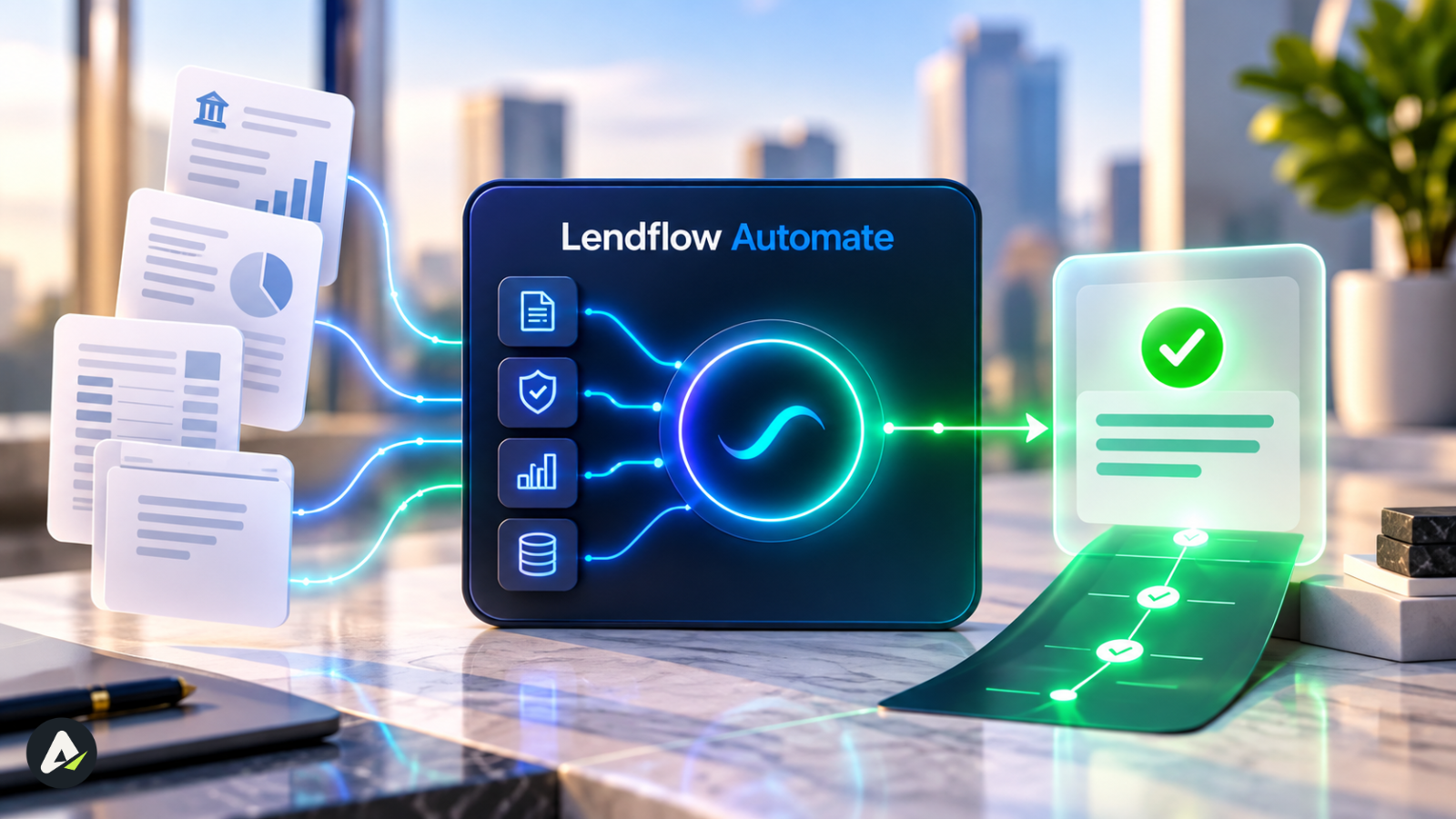
Lendflow Automate is an AI agent layer for lending operations that brings lending automation into the day-to-day loan workflow. Its AI agents handle tasks such as document processing, borrower communication, business classification, and risk scoring across the loan lifecycle. The platform sits inside Lendflow’s embedded credit infrastructure and connects to existing systems through APIs or pre-built connectors.
Lendflow described more than 50 context-aware agents in production at launch, giving Automate a broader role than a single-purpose document or communication tool. Instead, its lending automation approach assigns specialized agents to different operational steps.
One boundary defines the product. Lendflow Automate is an execution layer, not a decisioning engine. Its Trust Score agent can generate a risk signal and route applicants toward a suitable product. Still, final credit decisioning remains within Lendflow Intelligence, subject to human or rules-engine gates. In other words, the AI agents can score and route an applicant, while the actual credit decision remains a separate step.
Agents vs. workflows: why the distinction matters
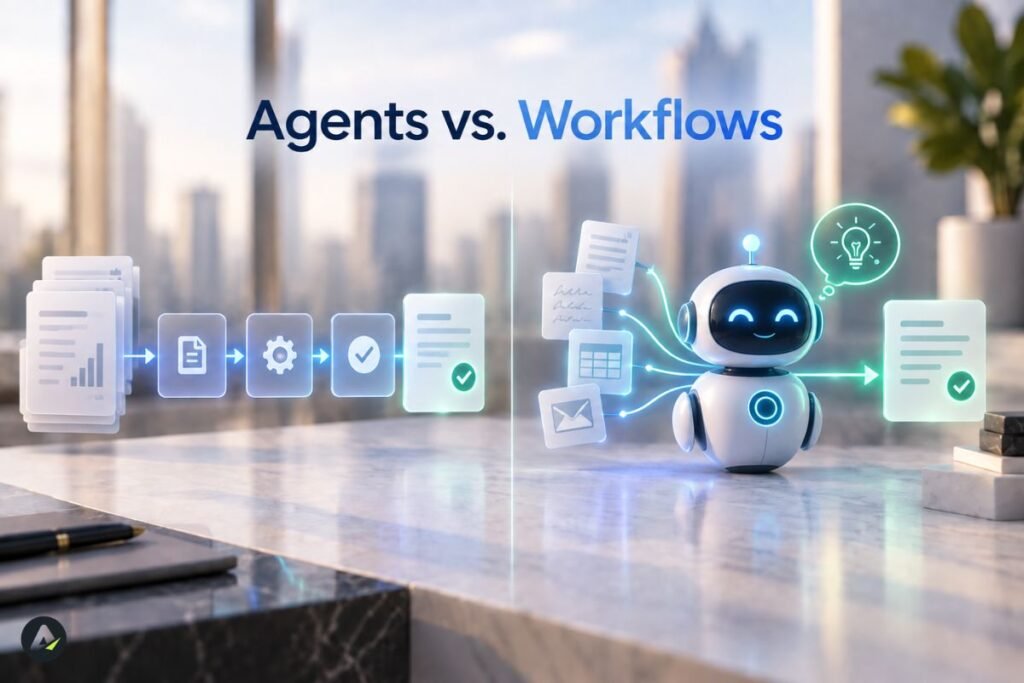
A workflow engine moves data from A to B on fixed boolean logic. An AI agent interprets unstructured input and makes a localized judgment before passing structured output downstream.
The difference shows up in a messy P&L. A webhook either finds the field it expects or fails. An agent decides whether the document is legible enough to parse, whether it needs secondary extraction, and what to hand off. Each Automate agent fires on a trigger, such as a status change or a missing document, and returns a JSON result to the next step or your CRM.
That distinction is worth holding onto during vendor evaluation, because plenty of products labeled agentic are rules engines with better marketing. The practical test, covered in more depth in this breakdown of how AI agents work, is whether the system handles input it wasn’t explicitly configured for.
Automate vs. Connect vs. Intelligence
Lendflow sells three products: Connect handles acquisition and lender distribution, Intelligence handles data and credit decisioning, and Automate handles the agents executing work between them. Each is priced separately.
| Product | What it does | Question it answers |
|---|---|---|
| Lendflow Connect | Embedded widgets, landing pages, borrower portal, marketplace linking 75+ specialty and bank lenders | “Where do applications come from, and who funds them?” |
| Lendflow Intelligence | Credit data procurement, orchestration, waterfall decisioning, analytics | “How do I decide, and with what data?” |
| Lendflow Automate | Document extraction, voice and chat outreach, NAICS/SIC classification, Trust Score | “Who does the repetitive work?” |
Intelligence governs the mathematical outcome. Automate handles the mechanical labor feeding it. If applications aren’t arriving yet, Connect solves the earlier problem and no amount of agent deployment will substitute.
Which AI agents you get
Automate’s documented agents cover document identification and extraction, industry classification, risk scoring, voice, chat, and email inbox handling. Naming varies across Lendflow’s own pages, where the document agent appears as Doc Analyzer, Data Extraction Agent, Document Identification Agent, and Doc ICE. Same capability set.
| Agent | What it produces | Channels and capabilities |
|---|---|---|
| Doc Analyzer / Data Extraction | Structured JSON from tax returns, bank statements, invoices, P&Ls, IDs | Secure API upload, bulk processing of thousands of pages, classification and extraction in one pass |
| Industry Map | NAICS and SIC codes assigned automatically | Bulk upload, compliance segmentation, risk-model alignment |
| Trust Score | Risk signal merging bureau reports, banking flows, alternative data | Visible factor weightings, custom thresholds, automatic product routing |
| Voice AI | Two-way inbound and outbound calls | Triggered outbound, inbound routing, voicemail drops, calls recorded and transcribed to the deal page |
| Chatbot | In-app borrower guidance | Live loan status, upload validation, document prep tips, auto-booked advisor handoff with chat context |
| AI Email Inbox | Triaged inbox with deals created automatically | Sender identification, classification, attachment download |
Two agents publish accuracy data. Lendflow reports customer completion rates reaching 95% for document identification and 90% for both classification and extraction, varying by document type. Lightbox Lending improved NAICS mapping from 60% to 94% after migrating to Industry Map.
Those ceilings tell you more than percentage-improvement claims do.
Why SMB lending resists automation
Small business underwriting resists automation because the source documents are unstandardized, the opposite of the conditions that made consumer lending automation work. A consumer mortgage file has predictable components. A merchant cash advance file might hold four months of statements from a regional credit union, a handwritten P&L, and a tax return formatted the way one accountant prefers.
That variability shaped the product. Lendflow targets term loans, merchant cash advances, invoice factoring, equipment financing, lines of credit, and SBA products rather than consumer mortgage servicing. Agents must read diverse formats and route dynamically.
Reading is the bottleneck. Deciding usually isn’t. That single fact explains most of what follows in this review.
Performance: what the numbers mean
Lendflow Automate AI Agents Lending Automation is positioned around measurable improvements in lending operations. Lendflow publishes four headline metrics: 80% faster document review, 42% quicker funding cycles, 65% faster time-to-decision, and up to 40% lower processing spend. All appear on Lendflow’s own pages. None are independently audited, and no sample, baseline, or measurement window is disclosed.
Lendflow says its document agents return structured data in seconds. Real savings still depend on document type, workflow, and how much review you retain. Treat the numbers as shortlisting signals, then build your own baseline during a pilot.
Two claims carry more weight than the percentages. Lendflow reports saving over 500 hours of weekly talk-time after deploying communication agents internally. Faster Funding, a named customer, reports 65% more completed loan applications after deploying Voice AI and marketplace agents.
The counterweight comes from the Federal Reserve. In its 2025 survey data, 46% of small firms reported using AI, but only 7% of those users had fully integrated it, while about half were still experimenting. The most common problem among AI users was accuracy, cited by 46%.
Agentic automation in lending is real. Full integration is still rare.
Pricing and the break-even math
Lendflow does not publish a platform-wide price for Automate, but individual agents now carry published rates. Doc Analyzer lists three tiers: pay-as-you-go at $2.00 per match with variable monthly cost, Growth at $1.50 per match plus $2,500 monthly, and Lendflow Network at no per-match cost with monthly pricing on request.
Platform-wide, Automate prices per agent under pay-as-you-go or bundled terms. Both offer volume discounts and per-agent credit pricing. Bundled adds credit bundles and rollover credits and bills through pre-payment; pay-as-you-go bills monthly.
Growth breaks even around 5,000 matches monthly. Below that, the $2,500 platform fee outweighs the $0.50 per-match saving. Run that arithmetic before a salesperson runs it for you.
Rollover credits exist only on bundled terms. Seasonal volume strands unused capacity on pay-as-you-go.
Cost scales with agent count, not deal count. Per-agent pricing also means activating all 50-plus agents at once buys overhead, not leverage. Isolate one bottleneck first.
Connect and Intelligence price separately, as revenue share or transaction fee and per-module software fee, so a full-platform quote won’t resemble an Automate-only quote.
A four-tier agent rollout framework
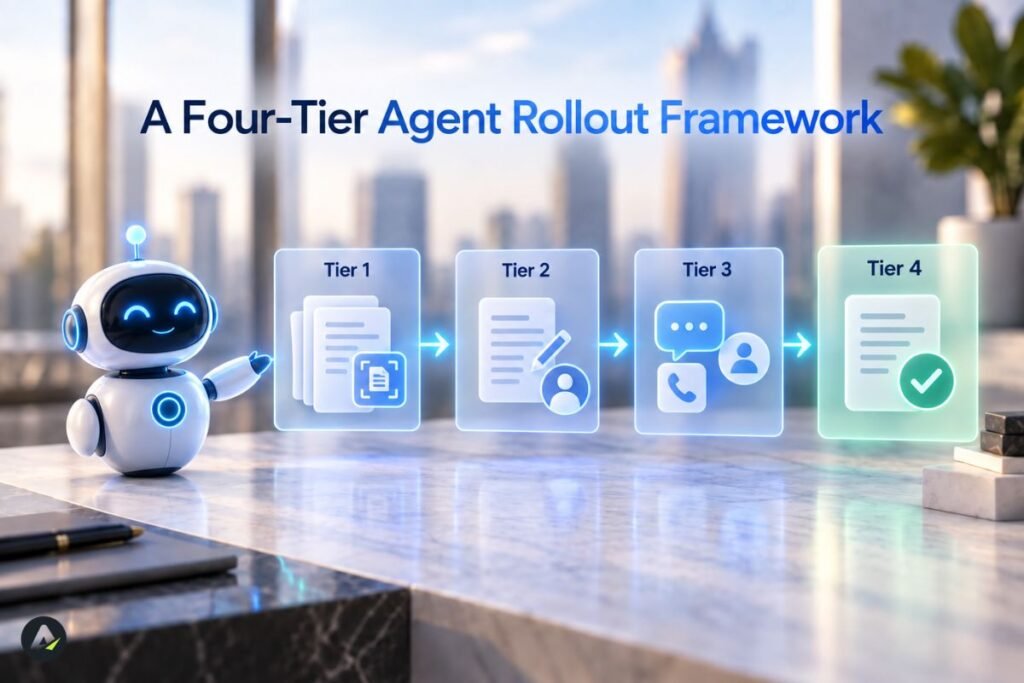
Most deployment advice sequences agents by expected savings. Sequence them by how easily a mistake can be reversed.
Tier 1 — Read-only. Document extraction and classification. A misread statement produces a bad field a human corrects before anything happens. Treat this tier as your sandbox.
Tier 2 — Draft and review. Trust Score generation, summary drafting, stipulation lists. The agent produces output a human approves. Risk is contained to wasted review time.
Tier 3 — Contact. Voice, chat, email, renewal outreach. The agent now speaks in your name, turning a data-quality error into a compliance question. Don’t promote agents here until extraction error rates hold below your threshold across a 30-day pilot. Lendflow’s own guidance follows similar logic, describing deployments that begin with low-risk use cases such as document collection and scheduling.
Tier 4 — Commit. Autonomous pre-qualification, automated declines, routing without a human gate. Deploy only where you can reconstruct any single decision and defend it to a regulator.
Tier 3 is also where credentialing stops being optional. Once an agent calls and emails under your brand, it needs its own permissions and audit identity rather than an employee’s login. The case for separating agent credentials applies directly to lending, where “which rep sent this?” is a question compliance eventually asks.
Pre-deployment checklist
- Baseline first: touches per file, hours to funding, cost per funded deal
- Pilot one agent on one deal type
- Define the human escalation trigger explicitly
- Confirm every agent action writes to an audit trail compliance can read, including natural-language commands issued through MCP
- Set a kill criterion and accuracy floor in advance
- Re-measure at 30 and 90 days
How Lendflow’s MCP server works
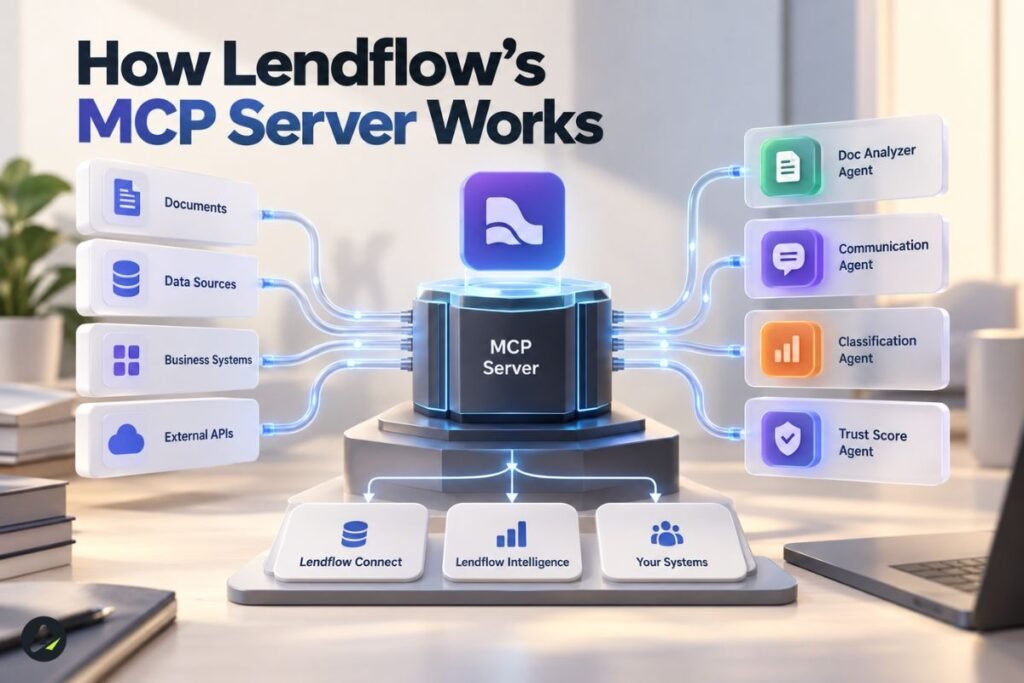
Lendflow operates a hosted Model Context Protocol server, letting external AI assistants access Lendflow data and trigger lending workflows through natural language.
MCP is an open standard, published by Anthropic and now maintained as an open-source specification, that standardizes how AI applications connect to external tools. It works across clients including Claude and ChatGPT, so developers build one integration instead of one per model.
This is becoming a competitive dimension rather than a novelty. Blend shipped an Autopilot MCP server in 2026, letting lenders bring their own agents into loan workflows, with lender authorization required for sensitive actions such as rate locks and credit pulls. Different market, same architectural bet.
For a rep, this replaces clicking through four screens with asking for a deal’s missing stipulations in plain language.
Automate vs. in-house vs. point solutions vs. decision engines
Four paths exist: an integrated agent suite, assembled point solutions, an in-house build, or a decision-first platform. They solve different bottlenecks, and two of them aren’t really competitors.
| Lendflow Automate | Point solutions | In-house build | Decision engines (Taktile, Alloy) | |
|---|---|---|---|---|
| Primary focus | Operational friction: docs, outreach, classification | Task-level execution | Whatever you build | Risk decisioning, fraud, KYB, rules logic |
| Document edge cases | Trained on lending documents | Generic OCR, needs tuning | High failure rate on irregular layouts | Generally out of scope |
| Integration overhead | Low; modular connectors and API triggers | High; gluing N vendor APIs | Highest | Moderate; data mapping into decision nodes |
| Typical failure mode | Misrouted document data, tone mismatch in outreach | Broken webhooks, dropped payloads | Parser breaks after a form change | Rigid rules, no extraction layer underneath |
| Explainability | Trust Score exposes factor weightings | Varies | Custom middleware required | Strong; built for regulated decisioning |
| Best deployed by | SMB lenders with document-intake bottlenecks | Teams with one narrow gap | Teams whose credit model is the product | Risk-heavy operations needing complex policy logic |
Taktile and Alloy belong in the evaluation but not in the same slot. Taktile automates risk decisions across underwriting, onboarding, and monitoring through a decision engine with pre-built bureau integrations, while Alloy unifies KYC/KYB, fraud, and credit decisioning on one platform. Neither reads a messy bank statement for you. Several lenders end up running an extraction layer beneath a decision engine rather than choosing between them.
Building vs. Buying: Where Agentic AI Fits in Credit Workflows
In-house builds fail in three predictable places: parsing breaks whenever a bank changes statement formatting, audit trails get built last, and orchestration consumes more time than the model work. Teams evaluating agentic AI frameworks usually discover the framework choice matters less than the integration surface beneath it. Building still wins with a dedicated ML team, a genuinely proprietary credit model, or data sovereignty rules blocking multi-tenant infrastructure.
One caution on off-the-shelf autonomy: the general-purpose agents now available are built for software tasks, and the tradeoffs visible in comparisons of autonomous coding agents don’t transfer cleanly to regulated document work.
Five mistakes lenders make
The most common failure isn’t a bad agent. It’s deploying agents onto a process that was already broken.
- Automating a bad process. If your stipulation list changes depending on who reviews the file, agents will chase inconsistent documents faster. Standardize first.
- Starting with outreach. The tier sequence above explains why voice agents, however good the demo, shouldn’t be your first target.
- Skipping the baseline. Without a measured “before,” the vendor’s “after” is unevaluable.
- Treating explainability as optional. Adverse action notices need defensible reasoning, which is why Trust Score exposes factor weightings at all.
- Ignoring the borrower cost signal. Sixty percent of firms borrowing from online lenders reported higher costs than expected, against 37% and 32% at small and large banks. Faster funding doesn’t repair a trust problem.
Who should use it, and who shouldn’t
Strong fit:
- SMB lenders funding MCAs, term loans, factoring, or equipment financing at volume
- Brokers managing document collection across multiple lender submissions
- Vertical SaaS platforms embedding capital access
- Ops teams where headcount, not demand, caps throughput
Weak fit:
- Consumer mortgage shops; the platform is built for business underwriting
- Lenders below roughly 1,250 document matches monthly
- Teams whose constraint is lead volume
- Organizations without a compliance owner who can approve agent-initiated borrower contact
What to watch in 2026
Agent memory is becoming the differentiator. Lendflow says the next generation of agents will carry persistent memory across application data, third-party sources, and deal statuses. Whether that measurably improves conversion remains unproven publicly.
Configuration is shifting from code to written instruction. As vendors let buyers define agent behavior in plain language, the failure modes described in work on how agent skills work start applying to lending ops: instructions that quietly conflict, or that nobody re-reads after a policy change.
Fintech application share keeps climbing. The share of small business applicants seeking financing at online fintech lenders rose from 17% in the 2020 survey to 29% in the 2025 survey, up five consecutive years.
Is Lendflow Automate worth it?
Pros: genuine lending-document training rather than generic OCR, published per-agent pricing on at least one agent, explainable risk scoring with visible factor weightings, MCP access, and a modular structure that lets you buy one agent instead of a platform. Lendflow Automate AI Agents Lending Automation brings these capabilities together through specialized agents designed for individual lending operations.
Limitations: the headline efficiency figures are unaudited and undocumented as to method, agent-level pricing beyond Doc Analyzer isn’t public, and Lendflow’s own pages contradict each other on language coverage. None of those are disqualifying. All of them are things to resolve in writing before signing.
The take: Automate earns its place when manual document handling is what caps your throughput, and it earns nothing when your problem sits upstream in acquisition or downstream in credit policy. The distinction is cheap to test. Measure touches per file and hours-to-funding for 30 days. If documents dominate, a Tier 1 pilot on Doc Analyzer will tell you more than any vendor demo.
Frequently asked questions
Q. What is Lendflow Automate?
Lendflow’s AI-agent layer for lending operations, covering document processing, borrower communication, business classification, and risk-scoring inputs. It works alongside Lendflow Connect and Lendflow Intelligence and is sold separately from both.
Q. How much does Lendflow Automate cost?
Pricing is per agent under pay-as-you-go monthly billing or bundled pre-payment terms, both with volume discounts. Doc Analyzer publishes concrete rates: $2.00 per match pay-as-you-go, $1.50 per match plus $2,500 monthly on Growth, and no per-match fee on Lendflow Network with monthly cost on request.
Q. How many AI agents does Lendflow Automate have?
More than 50 were in production at launch. Six are documented as named products: Doc Analyzer, Industry Map, Trust Score, Voice AI, Chatbot, and AI Email Inbox.
Q. Does Lendflow Automate replace underwriters?
No. Trust Score produces a risk signal and can route applicants, but final credit decisioning runs through Lendflow Intelligence behind human or rules-engine gates.
Q. How accurate is Lendflow’s document AI?
Lendflow reports customer completion rates reaching 95% for identification and 90% for classification and extraction, varying by document type. Lightbox Lending improved NAICS mapping from 60% to 94% using Industry Map.
Q. What languages do Lendflow’s AI agents support?
Lendflow’s pages conflict. The Automate page lists English, Spanish, Mandarin, Arabic, and Hindi, while the AI Communications page states English and Spanish across all communication tools. Confirm current coverage before planning a multilingual rollout.
Q. Is Lendflow compliant with TCPA and SOC 2?
Lendflow states SOC 2 Type II compliance and says AI Communications complies with TCPA and GDPR, with SMS and email recorded and Voice AI calls recorded and transcribed to the deal page. Request the current SOC 2 report during diligence.
Q. How does Lendflow Automate compare to Taktile or Alloy?
They address different layers. Taktile and Alloy are decisioning platforms for credit policy, fraud, and identity. Automate handles document extraction and borrower communication, feeding those decisions. Lenders frequently run both rather than choosing.
Q. Can I connect Lendflow to ChatGPT or Claude?
Lendflow operates a hosted Model Context Protocol server. MCP is supported across AI clients including Claude and ChatGPT, letting an assistant query Lendflow data and trigger workflows in natural language, subject to your access controls.
Related: How Lindy AI Agents Think, Work & Automate Tasks
| Disclaimer: This article is based on publicly available information and our own research and testing where applicable. Lendflow’s features, pricing, availability, and capabilities may change over time. This review is for informational purposes only and should not be considered financial, lending, or legal advice. Always verify current details with Lendflow before making a business or purchasing decision. |

Maliha
AI is moving steadily from experimental technology into the products and workflows people rely on every day. Maliha Irfan is a technology writer covering artificial intelligence, automation, and emerging software. Her work focuses on the practical side of AI agents, exploring how these systems are being used, what they can realistically accomplish, and the limitations that matter when businesses and individuals adopt them.
More from Maliha →