Agentic AI Frameworks Explained: How to Choose the Right One
Gartner expects more than 40% of agentic AI projects to be canceled by the end of 2027, citing escalating costs, unclear business value, and inadequate risk controls. Model capability isn't on that list. Most teams that stall picked…

In this article · 16 sections +
- What an Agentic AI Framework Actually Is
- Agent, Workflow, or Chatbot? How to Tell Which One You Need
- The Five Layers Inside an Agentic AI Framework
- The 8 Agentic AI Frameworks Worth Shortlisting in 2026
- Coordination Model, License, and Fit
- Production Readiness Compared
- Framework vs SDK vs Platform vs Protocol
- How to Choose: The STAKE Test
- One Job, Two Architectures: A Support-Triage Example
- What Does an Agentic AI System Cost?
- Security: Prompt Injection and Excessive Agency
- Common Mistakes in Agentic AI Projects
- What Changed in 2026: MCP, A2A, and Consolidation
- Pre-Build Checklist
- Start With a Thin Slice, Not a Shortlist
- FAQs
Gartner expects more than 40% of agentic AI projects to be canceled by the end of 2027, citing escalating costs, unclear business value, and inadequate risk controls. Model capability isn’t on that list.
Most teams that stall picked their tooling before they understood the job.
This guide covers what agentic AI frameworks do, how the eight leading options compare, what it costs to run one, the security risk most roundups skip, and a five-question test to narrow the field.
What an Agentic AI Framework Actually Is
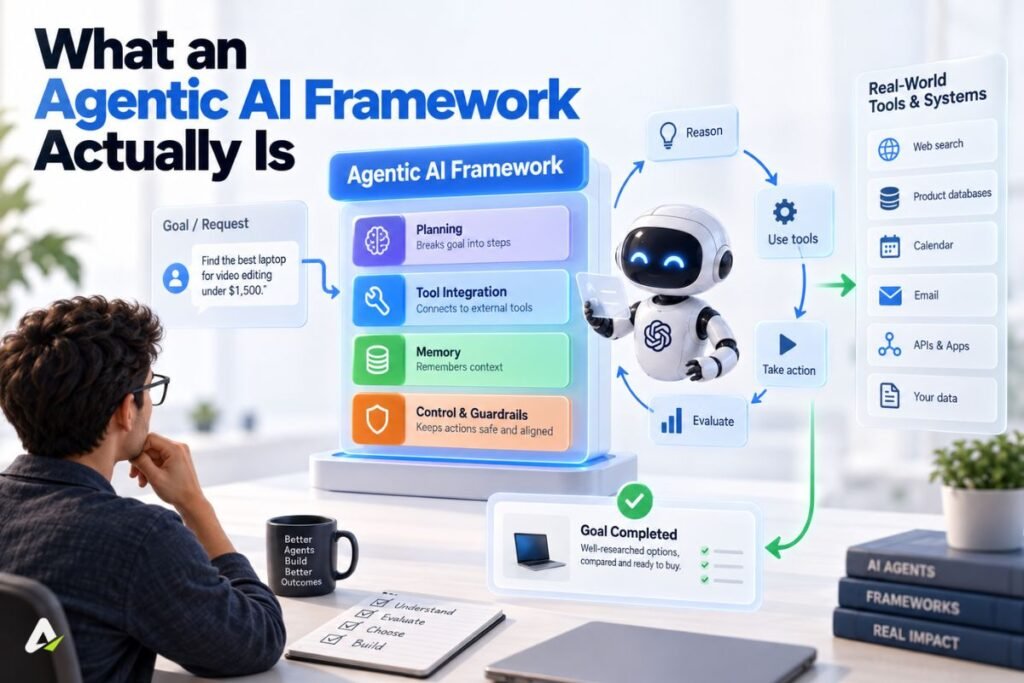
An agentic AI framework is a software toolkit for building autonomous, goal-driven AI systems. It handles planning, tool use, memory, multi-step execution, and coordination between agents so you do not build that plumbing yourself.
Strip away the marketing, and an AI agent is essentially a loop: it receives a goal, reasons about the next step, uses a tool when necessary, observes the result, and continues until the task is complete. Once you understand how AI agents work at this level, it becomes much easier to see what an agentic AI framework actually contributes. You can build that basic loop in roughly fifty lines of Python without a framework; the real complexity starts when you need reliable state, retries, parallel execution, observability, and persistence in production.
Agent, Workflow, or Chatbot? How to Tell Which One You Need
An agentic AI framework differs from a workflow tool in one specific way. In a workflow, you predetermine the sequence of steps. In an agentic system, the model picks the path at runtime based on what it observes.
| Chatbot / LLM wrapper | Workflow (LLM pipeline) | Agentic framework | |
|---|---|---|---|
| Who picks the next step | The user | You, at design time | The model, at runtime |
| State | Conversation history | Passed between fixed steps | Persistent, often checkpointed |
| Predictability | High | High | Low by design |
| Cost profile | Cheap, bounded | Predictable | Variable, can spike |
| Debuggability | Easy | Easy | Hard without tracing |
| Best fit | Q&A, drafting | Extraction, routing, ETL with an LLM step | Open-ended research, triage, multi-tool operations |
My editorial position, offered as an argument rather than a finding: many systems marketed as agents would run better as workflows. Anthropic’s guidance makes a related point, separating predetermined sequences from model-directed loops and recommending the simpler pattern first.
Use this test. If you can draw the entire flow on a whiteboard before seeing the input, you have a pipeline with a model in it. Pipelines cost less, run faster, and test more easily.
Fixed ETL with a normalization step, document extraction against a known schema, and routing to one of five handlers are all pipelines. The distinction between AI tools and agents follows the same logic.
Everything below assumes you have answered this question and the answer was “agent.”
The Five Layers Inside an Agentic AI Framework
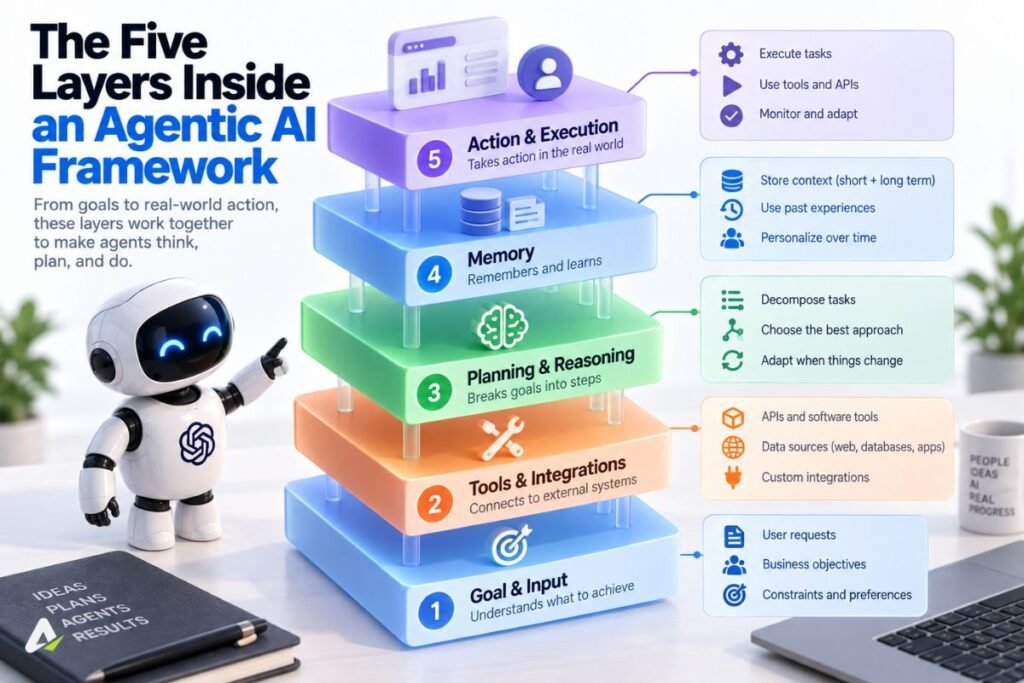
Most agentic AI frameworks combine five functional layers. Few implement all five as first-class features, and lightweight SDKs skip several on purpose.
- Orchestration and planning. Structures how the model gets prompted each turn so it reasons predictably and selects the right tool. ReAct loops, planner-executor patterns, and graph routing live here.
- Tool and API integration. Connects the model to databases, SaaS APIs, file systems, and code execution. Capability definitions sit at this layer too, including agent skills declared in structured files.
- Memory management. Pairs the short-term context window with longer-term storage. That storage can be a vector database, a relational or key-value store, plain files, or rolling summaries.
- Multi-agent coordination. Manages handoffs, shared state, and turn-taking. Sequential, hierarchical, and group-chat patterns are the usual shapes.
- Human-in-the-loop controls. Adds approval gates, checkpoints, and interrupts before consequential actions execute.
A sixth layer is becoming standard: durable execution. Checkpointing lets a long-running agent crash, resume, and be replayed for audit. LangGraph once treated this as a differentiator. In 2026, it reads more like a requirement, and it appears as a column in the readiness table below.
The 8 Agentic AI Frameworks Worth Shortlisting in 2026
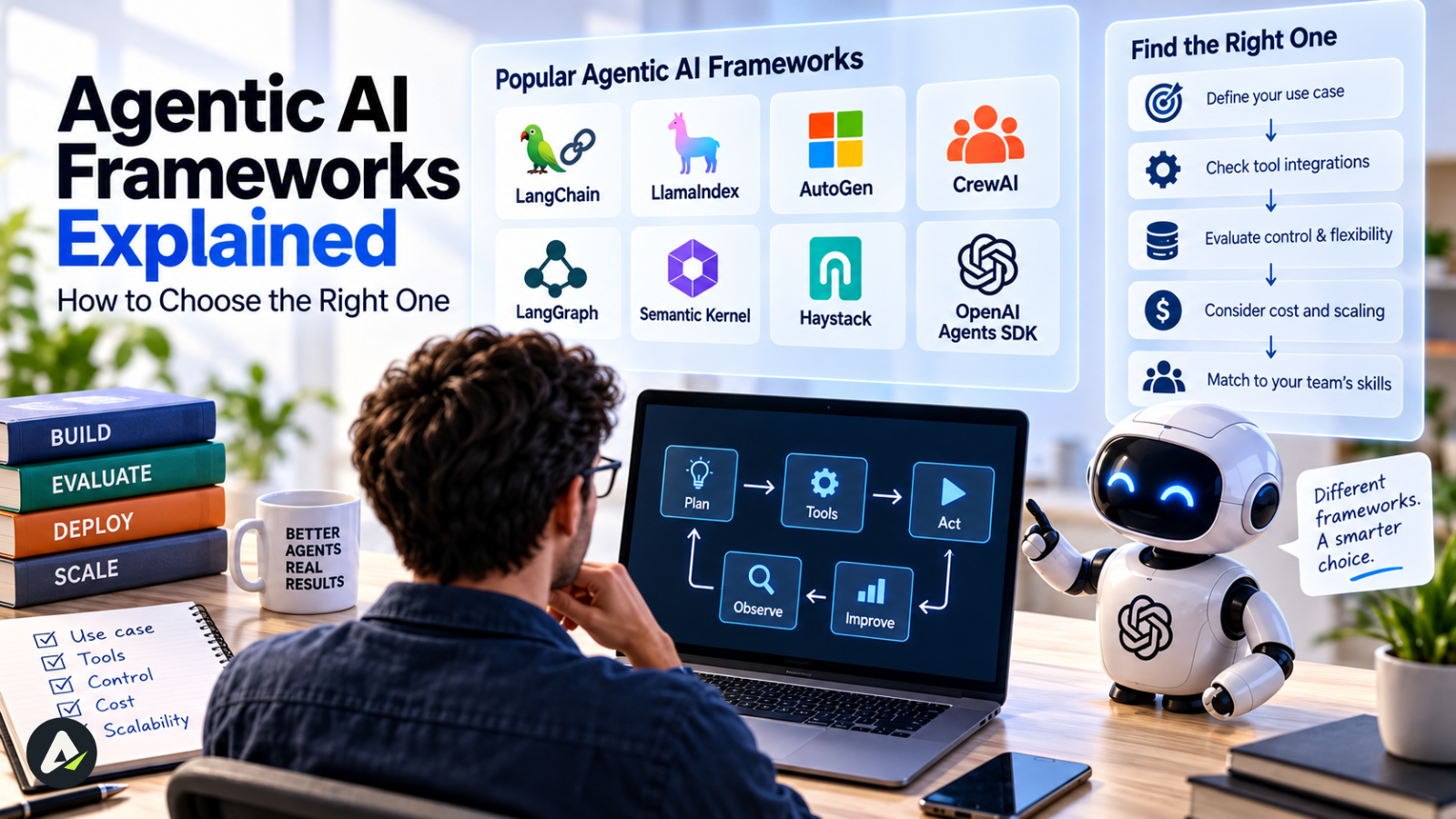
The leading options in 2026 are LangGraph, CrewAI, Microsoft Agent Framework, OpenAI Agents SDK, Google ADK, LlamaIndex Workflows, Pydantic AI, and Mastra. Each is organized around a different coordination model rather than a different feature list.
One correction first. Microsoft Agent Framework 1.0 shipped on April 3, 2026, unifying capabilities from Semantic Kernel and AutoGen into one SDK with stable APIs and long-term support. Microsoft’s documentation describes it as the direct successor to both, built by the same teams. Semantic Kernel still receives bug fixes and security patches, but new feature work happens in Agent Framework.
Any guide recommending AutoGen for a new project has not been updated this year.
Coordination Model, License, and Fit
| Option | Coordination model | Language | License* | Choose it when | Avoid it if |
|---|---|---|---|---|---|
| LangGraph | Directed graph, conditional edges, checkpoints | Python, TS | MIT | You need approval gates and replay for audit | You want a working prototype in two days |
| CrewAI | Role-based crew with personas and goals | Python | MIT | You want a multi-role prototype running this week | You need fine-grained control over agent-to-agent messaging |
| Microsoft Agent Framework | Graph workflows plus agent abstractions | .NET, Python | MIT | Your team ships C# on Azure | You need a long track record rather than a new 1.0 |
| OpenAI Agents SDK | Handoffs and guardrails, minimal abstraction | Python, TS | MIT | You are OpenAI-centric and want a thin layer | You need checkpointing or model-provider flexibility |
| Google ADK | Template workflow agents plus routing | Python, Java | Apache 2.0 | A multimodal agent deploys to GCP | You want to stay cloud-neutral |
| LlamaIndex Workflows | Event-driven steps over an indexing layer | Python, TS | MIT | Retrieval quality is the hard problem | Your agent is tool-heavy and document-light |
| Pydantic AI | Type-safe agent layer | Python | MIT | You want schema validation at every tool boundary | You need durable state or a large plugin ecosystem |
| Mastra | TypeScript-native agents and workflows | TypeScript | Apache 2.0, some components separately licensed | Your product is already a TypeScript app | Your team works primarily in Python |
Licenses as reported across vendor repositories in 2026. Some projects mix licenses across packages, so confirm terms per component before shipping.
Production Readiness Compared
| Option | Maturity | Durable execution | Native human approval | Built-in observability | Managed service |
|---|---|---|---|---|---|
| LangGraph | High | Yes | Yes | Via LangSmith | LangGraph Platform |
| CrewAI | Medium-high | Limited | Partial | Basic | CrewAI Enterprise |
| Microsoft Agent Framework | New 1.0, LTS commitment | Yes | Yes | Telemetry hooks | Azure AI Foundry Agent Service |
| OpenAI Agents SDK | Medium | No | Via guardrails | Tracing included | OpenAI platform |
| Google ADK | Medium | Partial | Yes | Cloud-native tracing | Vertex AI Agent Engine |
| LlamaIndex Workflows | Medium-high | Partial | Manual | Basic | LlamaCloud |
| Pydantic AI | Medium | No | Manual | Via Logfire | None first-party |
| Mastra | Medium (v1.0, January 2026) | Yes | Yes | Local dev studio | Mastra Cloud |
Two figures dominate LangGraph vs. CrewAI comparisons, and both deserve caution. An April 2026 Medium analysis reported LangGraph passing CrewAI in GitHub stars during early 2026, crediting enterprise adoption and the graph model’s fit with audit trails. Intuz separately cited multiple benchmarks showing LangGraph running roughly 2.2× faster than CrewAI on identical tasks, with LangChain consuming the most tokens because it re-sends fuller history each step.
Both figures come from third parties whose methodology you cannot fully inspect, so treat them as directional rather than definitive. If CrewAI is on your shortlist, a closer look at CrewAI gives more context on its pricing, features, and alternatives than a single comparison-table row can provide.
Framework vs SDK vs Platform vs Protocol
In the agentic AI stack, a framework is a library you code against, an SDK is a provider-specific client, a platform is a hosted environment that handles deployment, and a protocol is an open interoperability standard no vendor owns.
Confusing these four layers wastes evaluation time on products that do not compete with each other.
| Layer | What it is | Examples | Decide here when |
|---|---|---|---|
| Model provider | The LLM itself | OpenAI, Anthropic, Google, Mistral | You are choosing capability and cost per token |
| SDK | Client library tied to one provider | OpenAI Agents SDK, Claude Agent SDK | You have standardized on one provider |
| Framework | Library you install and deploy yourself | LangGraph, CrewAI, Microsoft Agent Framework, Mastra | You need custom logic and control of the loop |
| Agent platform | Hosted build-and-deploy environment | LangGraph Platform, CrewAI Enterprise, Azure AI Foundry, Vertex AI | Managed infrastructure matters more than control |
| Packaged agent | A finished product you buy | Devin, OpenHands, Manus | Someone has already solved your job |
| Protocol | An open interoperability specification | MCP, A2A | Always, since protocols sit beneath everything above |
Most teams combine layers: a library for custom logic, a platform for deployment, protocols underneath both.
The packaged-agent row deserves attention before you commit engineering months. For software development, buying has matured fast. The question is whether a packaged agent already handles enough of the work to justify buying rather than building. Devin’s capabilities and limitations, and the differences between OpenHands, Devin, and Manus, make that trade-off easier to assess before you commit to a framework.
How to Choose: The STAKE Test
The STAKE test is a five-question selection method covering State, Topology, Autonomy, Knowledge stack, and Evidence. It matches capabilities to your workload shape instead of to feature checklists, and it takes about ten minutes.
S — State. How long does your agent run, and what happens if it dies mid-task? Lost work on a crash means you need checkpointing and durable execution, which eliminates roughly half the options above.
T — Topology. How many agents does the job require? A single agent running discover, plan, execute, and verify handles more than most teams expect. Do not buy a graph runtime for a one-node problem.
A — Autonomy. How many decisions can the model make before a human sees output? Score it as full autonomy, approval on write actions, or approval on every step. Anything short of full autonomy turns native approval support into a hard filter.
K — Knowledge stack. Which language and cloud does your team write daily? This is the least interesting criterion and the best predictor of whether the project ships.
E — Evidence. When the agent misbehaves overnight, can you reconstruct what happened? You need traces, token accounting, tool-call logs, and replay. This question is only partly about the library you pick, since most teams add a separate observability layer, and that pairing drives reliability more than the library does.
One Job, Two Architectures: A Support-Triage Example
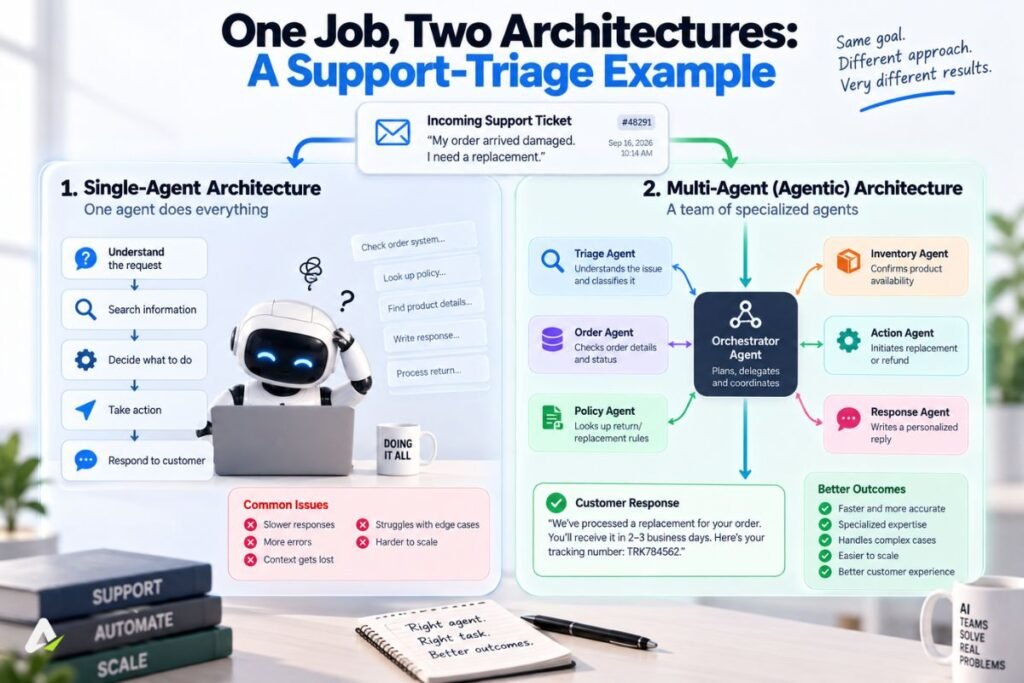
The following is a composite drawn from common deployment patterns. It is illustrative, not a tested benchmark.
A 40-person SaaS company builds four role-based agents to triage support tickets: classifier, researcher, drafter, and escalation reviewer. The demo lands well. In production, the classifier and researcher sometimes disagree, the crew loops, and token spend on certain tickets runs several times the estimate. Nobody reproduces the failure because the control flow sits inside the abstraction.
The rebuild uses one agent, four tools, a loop budget of six iterations, a checkpoint before any customer-facing send, and full tracing. Outcomes hold on the tickets that matter, and costs become predictable.
The useful question is not whether you can split work into specialists. It is whether splitting reduces how much you have to reason about.
What Does an Agentic AI System Cost?
The libraries themselves are free. Costs come from model tokens, managed platform fees, observability tooling, memory storage, hosting, and human review time.
| Cost line | Driver | What catches teams out |
|---|---|---|
| Framework license | $0 for all eight options above | Nothing, though component licenses vary |
| Model and API tokens | Iterations × context size × calls | A stuck loop multiplies spend silently. Usually the largest line by a wide margin |
| Managed platform | Consumption or seats | Azure AI Foundry Agent Service bills on consumption with scale-to-zero pricing, so idle agents cost nothing. Seat-based platforms charge regardless of use |
| Observability and evals | Traces retained, eval runs | Full-fidelity retention gets expensive at volume |
| Memory and vector storage | Embeddings stored, queries run | Re-embedding after every schema change |
| Compute and hosting | Runtime, egress | Long-running agents hold resources between tool calls |
| Human review time | Approval gates × volume | Rarely budgeted, and at scale it can exceed infrastructure spend |
A practical approach: estimate token cost per task, multiply by your worst-case iteration ceiling rather than the average, then double the result for the first quarter while prompts stabilize.
Security: Prompt Injection and Excessive Agency
Prompt injection ranks first in the OWASP Top 10 for LLM Applications, and agentic systems amplify it. A single poisoned input can hijack an agent’s plan and trigger privileged tool calls across connected systems.
Indirect prompt injection hides instructions inside content the model later reads, such as a document, a webpage, or an email. When the agent processes that content, it may follow those instructions as if you had written them.
Security analysis of the OWASP Top 10 for Agentic Applications describes how manipulated output can hijack planning, execute privileged tool calls, persist malicious instructions in memory, and spread across connected systems.
No patch fixes this, because prompt injection exploits how language models process text. OWASP’s guidance points toward defense in depth:
- Treat every retrieved input as untrusted, including web pages, PDFs, emails, RAG results, and output from other agents.
- Treat model output as untrusted too. Parameterize database queries, encode output by context, and never pipe raw model text into a shell.
- Grant tools minimum privilege. Excessive agency is a separate OWASP entry. An agent with read access cannot drop a production table.
- Sandbox code execution without exception.
- Require human approval on high-impact actions such as payments, deletions, and external sends.
- Give agents their own credentials. An agent borrowing a human login inherits that person’s full permission set, which makes least privilege unenforceable and audit trails meaningless. This separate agent identity model addresses the problem directly.
Common Mistakes in Agentic AI Projects
Most failures trace back to process and governance decisions rather than model limitations:
- No loop or tool budget. One stuck reasoning chain becomes a four-figure API bill.
- Swallowing tool errors. Catch the error, format it as a tool result, and hand it back. Models read errors well and change course.
- Deferring observability past launch. You cannot debug what you cannot replay.
- Choosing for résumé value. GitHub stars are a poor substitute for team fluency.
- Leaving ownership undefined. Pilots stall when integration, data access, and accountability have no named owner.
- Skipping the eval harness. Without a measurement baseline, prompt changes are guesswork.
- Shipping without an exit plan. Decide in advance what failure rate or cost ceiling triggers a rollback.
What Changed in 2026: MCP, A2A, and Consolidation
Interoperability moved to the protocol layer in 2026. MCP standardizes agent-to-tool connections, A2A standardizes agent-to-agent communication, and together they lower the cost of choosing the wrong library.
Anthropic created the Model Context Protocol and donated it to the Linux Foundation’s Agentic AI Foundation in December 2025. By February 2026, MCP had crossed 97 million monthly SDK downloads across Python and TypeScript, with adoption at Anthropic, OpenAI, Google, Microsoft, and Amazon.
For the Agent2Agent protocol, the Linux Foundation reported more than 150 supporting organizations at the one-year mark in April 2026, plus integration across Google, Microsoft, and AWS and production deployments in supply chain, financial services, insurance, and IT operations.
One caveat belongs here. Supporting a protocol and depending on it daily are different things, and protocol ecosystems look larger in press releases than they feel in engineering work.
Consolidation is real. Microsoft folded two overlapping products into one successor, and more consolidation will follow. The genuine lock-in risk is betting on a project with an unclear maintenance story.
The graph-versus-loop argument settled quietly. A loop is one node, a graph is several, and your job is counting how many nodes your problem has. Escalate to a graph when distinct specialist skills, parallel branches, or defined approval gates appear.
Market position. Gartner’s 2026 Hype Cycle places agentic AI at the Peak of Inflated Expectations. Coverage of that research reports 17% of organizations having deployed AI agents so far, against more than 60% expecting to within two years. A separate June 2025 Gartner forecast projects at least 15% of day-to-day work decisions being made autonomously by 2028, and 33% of enterprise applications including agentic AI, up from under 1% in 2024.
Pre-Build Checklist
- Confirmed the task cannot be drawn as a deterministic flowchart
- Defined the stopping condition, not just a token limit
- Set a loop budget and a tool-call budget
- Decided which actions require human approval
- Classified every data source as trusted or untrusted
- Given the agent its own credentials and least-privilege permissions
- Chosen where traces, token counts, and tool calls get logged
- Picked a memory strategy: context only, external store, or both
- Estimated token cost at worst-case iterations
- Run the STAKE test and shortlisted no more than two options
- Matched the language to your team’s daily stack
- Checked MCP and A2A support
- Defined three success metrics a non-engineer would recognize
- Named one person who owns agent behavior in production
- Built a small eval set before writing production prompts
Fewer than four boxes ticked means you are not ready to choose. Learning that now costs far less than learning it in month six.
Start With a Thin Slice, Not a Shortlist
Every option here carries the same limitations. None solves prompt injection, none guarantees cost control, and the 2026 consolidation shows that today’s safe pick can enter maintenance mode within a year. The protocol layer reduces that exposure without removing it.
Run the STAKE test against your highest-value use case this week. If two candidates survive, build the same thin slice in both and keep the one your team reads faster.
Versions, licenses, and adoption figures reflect 2026 sources and change quickly. Verify current status before committing.
FAQs
Q. Is ChatGPT an agentic AI?
Partly. Standard ChatGPT conversation is reactive, while its agent and tool-use modes add planning, browsing, and multi-step execution. A full agentic system pursues a goal autonomously with tool access and persistent memory.
Q. What are the four types of agentic AI?
Modern taxonomies use reactive, deliberative or planning, collaborative multi-agent, and self-improving agents. Classical AI literature uses a different set — simple reflex, model-based, goal-based, and utility-based — so check which framing a source means.
Q. Do I need a framework to build an AI agent?
No. Many production systems run on a controlled loop with explicit tool handling. A framework earns its place when you need durable state, checkpointing, multi-agent handoffs, or native approval gates.
Q. What is the difference between an AI agent and an agentic AI framework?
The AI agent is the system that pursues a goal. The framework is the toolkit used to build it. One toolkit produces many different agents.
Q. Are agentic AI frameworks free and open source?
The major ones are under MIT or Apache 2.0 licenses. Costs come from model tokens, managed platforms, observability, and storage, and some projects mix licenses across packages.
Q. How much does an agentic AI system cost to run?
Model tokens usually account for most of the bill and scale with loop iterations. Managed platforms, observability, storage, and human review time make up the remainder.
Q. Are agentic AI frameworks secure?
They provide hooks rather than guarantees. Prompt injection tops the OWASP LLM risk list, so the protective work comes from least-privilege tools, sandboxed execution, separate agent credentials, and human approval on high-impact actions.
Q. Which agentic AI framework should a small team start with?
It depends on the trade-off you prefer. CrewAI reaches a working multi-agent prototype fastest but abstracts control flow, while LangGraph takes longer to learn and gives you checkpointing and replay from the start. Teams that expect production use within a quarter often accept the steeper curve.
Q. Is LangChain the same as LangGraph?
No. LangChain is a broad toolkit for LLM applications, while LangGraph is a lower-level orchestration runtime built on stateful graphs with checkpoints. Moving between them means redesigning agent logic rather than swapping imports.
Related: How Lindy AI Agents Think, Work & Automate Tasks
| Disclaimer: AI frameworks, pricing, licenses, and production features change quickly. This guide reflects information available at publication and should be verified against current documentation before making a technical or business decision. |

Maliha
AI is moving steadily from experimental technology into the products and workflows people rely on every day. Maliha Irfan is a technology writer covering artificial intelligence, automation, and emerging software. Her work focuses on the practical side of AI agents, exploring how these systems are being used, what they can realistically accomplish, and the limitations that matter when businesses and individuals adopt them.
More from Maliha →