AI Agents Are Becoming Digital Employees. That’s Changing How We Work
A new wave of "digital employees" is entering offices with names, avatars, and job titles. Early research suggests that human framing may be weakening oversight. AI agents are moving from software menus onto company org charts. Hundreds of…

In this article · 7 sections +
A new wave of “digital employees” is entering offices with names, avatars, and job titles. Early research suggests that human framing may be weakening oversight.
AI agents are moving from software menus onto company org charts.
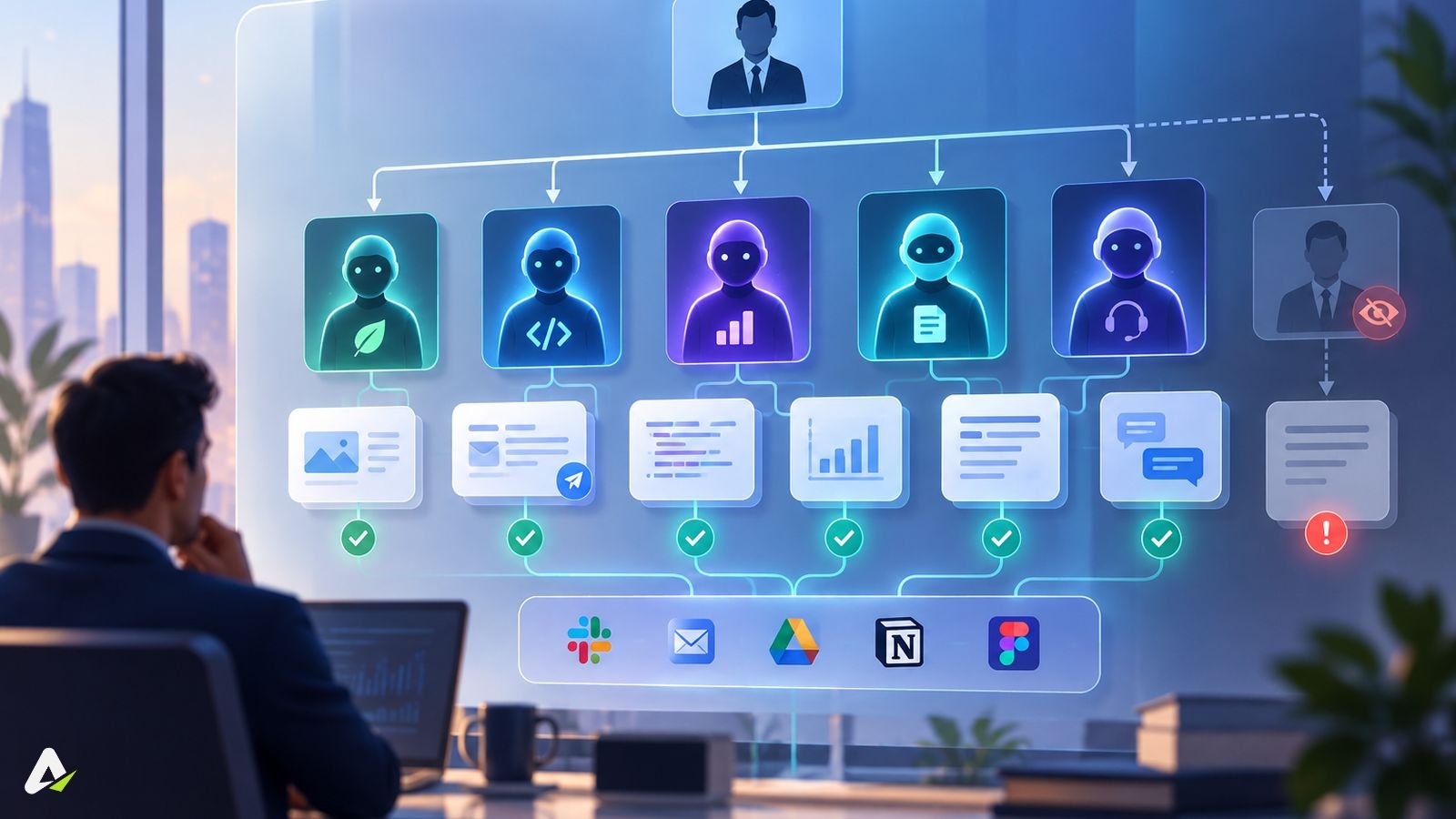
Hundreds of thousands of AI agents are entering workplaces as named digital employees, and a January BCG survey of 1,261 managers found that 22% of organizations had already placed them on corporate org charts, according to reporting by Wired.
The development marks a clear break from the first generation of workplace AI. Tools launched in 2023, such as Microsoft Copilot and Google Gemini, were pitched as aids for employees, while newer products such as Microsoft’s Scout, launched in June, and startups like Skydive are selling autonomous agents that schedule meetings, draft emails, and monitor systems around the clock
From tools to teammates
The first wave of workplace AI looked very different. Tools launched in 2023, such as Microsoft Copilot and Google Gemini, were pitched as aids for employees.
Newer products take a more independent role. Microsoft’s Scout, launched in June, and startups like Skydive sell autonomous agents that schedule meetings, draft emails, and monitor systems around the clock.
The key difference: a tool waits for instructions, while an agent pursues a goal on its own. Is that gap explained further in AI Tools vs. AI Agents: What’s the Difference and Which Wins?
The same shift is reaching customer-facing products, including Meta’s AI business agent, which handles conversations on behalf of companies.
Names, roles, and Slack accounts
Inside early-adopting companies, the change is already showing up in everyday language.
Staff at Pronto Housing and other early adopters increasingly say they work with agents on projects.
The software learns coworkers’ communication styles and appears in Slack, email, and other channels with its own name, role, and avatar.
The oversight problem
The most striking finding concerns how humans review agent work.
BCG found that managers caught 18% fewer errors when told the work came from an “AI employee” rather than an “AI tool.”
The output was the same. Only the label changed.
That raises hard questions about accountability. If an agent holds a role on the org chart, someone must own its actions and control what systems it can access.
Security teams increasingly argue that agents need their own credentials rather than borrowing a human’s. That approach is covered in AI Agent Identity vs. Human Identity: The Access Control Model That Actually Works.
Reliability remains an open issue as well. Earlier this year, a Mercor benchmark called APEX-Agents found that while some systems showed flashes of promise, none consistently demonstrated the reliability or judgment needed to operate without human supervision in roles such as analysts, lawyers, and consultants, as Built In reported. Combined with the BCG data, that points to a difficult mix: agents that still need checking, and humans who may be checking them less
Reliability is still in question
Agents are not yet ready to work unsupervised. Earlier this year, a Mercor benchmark called APEX-Agents tested them on roles such as analysts, lawyers, and consultants,
Some systems showed promise, but none proved consistently reliable without human oversight.
Put together with the BCG data, the picture is uncomfortable: agents still need checking, and humans may be checking them less.
Emotional and job concerns
Not everyone welcomes the humanlike approach.
HR software CEO Sarah Franklin warned that humanlike AI colleagues could hook workers emotionally.
The trend is also fueling wider fears about how agents behave, who is accountable, and whether the real goal is replacing people.
Companies admit they aren’t ready
Adoption is running ahead of preparation, according to Deloitte’s 2026 research, reported by IT Brief.
74% of leaders expect nearly half their business processes to be rebuilt around agents within four years.
Yet only 25% say their workforce is prepared, and just 21% say the same about their processes.
What comes next
For now, the rollout is moving ahead of the rules. Companies placing agents on their org charts will likely face pressure to define who supervises each one, how their output is labeled and reviewed, and what access they are granted. The BCG findings suggest one counterintuitive step some firms may consider: making agents look less like coworkers in settings where mistakes are costly.
In my view, the real story here isn’t the technology. It’s the label.
Giving an agent a name, a face, and a spot on the org chart is a smart adoption strategy. People trust coworkers more easily than software. But that is exactly the problem.
The BCG finding should be a wake-up call. If calling an agent an “employee” makes managers miss nearly one in five more errors, then companies are trading safety for comfort without realizing it.
I’m not against AI agents at work. Used well, they can take repetitive tasks off people’s plates and free teams to focus on higher-value work.
But an agent is not a colleague. It doesn’t carry responsibility, it can’t be held accountable, and it won’t lose its job if something goes wrong. A human will.
That’s why every agent should have a clearly named human owner, its own access controls, and outputs that are always labeled as AI-generated.
Companies that treat agents as powerful tools under strong supervision will likely get the benefits. Those that treat them as teammates who need no checking may learn the hard way.

Kavin Reed
As AI agents move from experimental demos into everyday workflows, the questions around how they work, where they fit, and what happens when they fail are becoming harder to ignore. Kavin Reed writes about AI agents, automation, and the systems behind them, with a focus on practical adoption and real-world impact. His work examines the ideas, trends, and technical developments shaping how businesses and people use increasingly capable AI systems.
More from Kavin Reed →