Oracle Fusion AI Agents 2026: What They Can Actually Do, Cost & Risks
Oracle Fusion AI Agents are moving beyond simple chat to handling real business tasks across ERP, HCM, SCM, EPM, and CX. This 2026 guide breaks down the agents, pricing, security, testing, AI Agent Studio, and key alternatives.

In this article · 20 sections +
- What Are Oracle Fusion Cloud AI Agents?
- How much of this is verified?
- How Oracle Fusion AI Agents Work
- Oracle Fusion AI Agents by Module
- Which agent should you start with?
- Fusion Agentic Applications and Fusion Claw
- Oracle AI Agent Studio and Marketplace
- How Much Do Oracle Fusion AI Agents Cost?
- Security, Data Privacy and Autonomy
- A practical autonomy model
- How to Test and Monitor Fusion AI Agents
- After go-live: watching for drift
- Oracle vs. SAP Joule vs. Microsoft Dynamics 365
- How to Implement Fusion AI Agents: The 5-R Framework
- Prerequisites checklist
- The 5-R rollout
- Vendor Demo: Procure-to-Pay With Document IO
- Limitations and Common Mistakes
- Oracle Fusion AI Agents vs. EBS AI Agents
- FAQs
Your finance team wants the Payables Agent live by quarter-end. Your security lead wants to know what it can touch. Procurement wants a number, and nobody is sure the thing is even switched on in your tenant.
That’s how most conversations about Oracle Fusion Cloud AI Agents actually start in 2026. Oracle says it now delivers more than 1,000 AI agents through Fusion Applications, and it announced 26 agentic applications this year alone. The catch? The details you need to plan around are spread across press releases, readiness notes, and licensing pages.
This guide puts them in one place, from agents and pricing to security and rivals. Oracle’s claims are labeled as claims.
What Are Oracle Fusion Cloud AI Agents?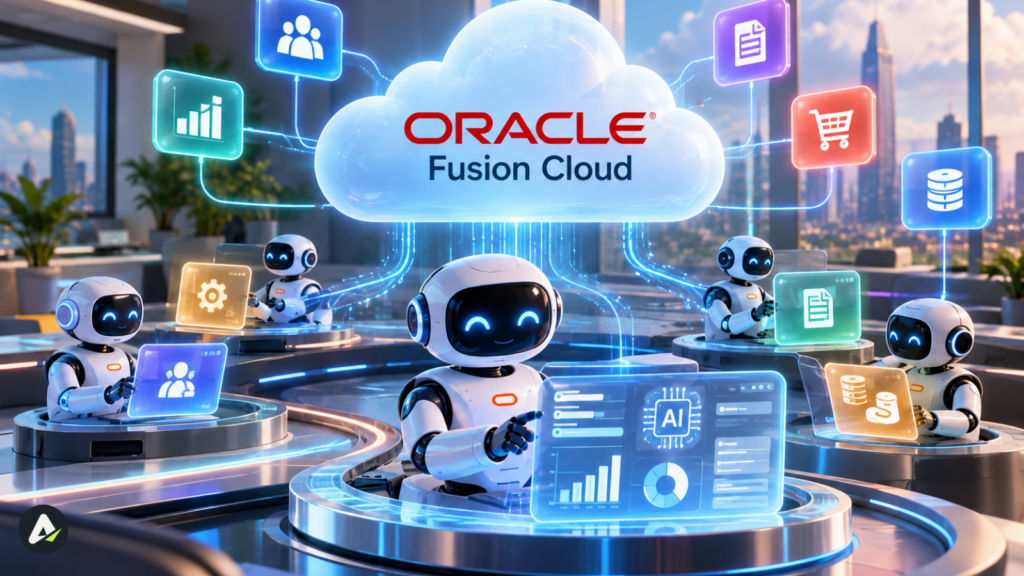
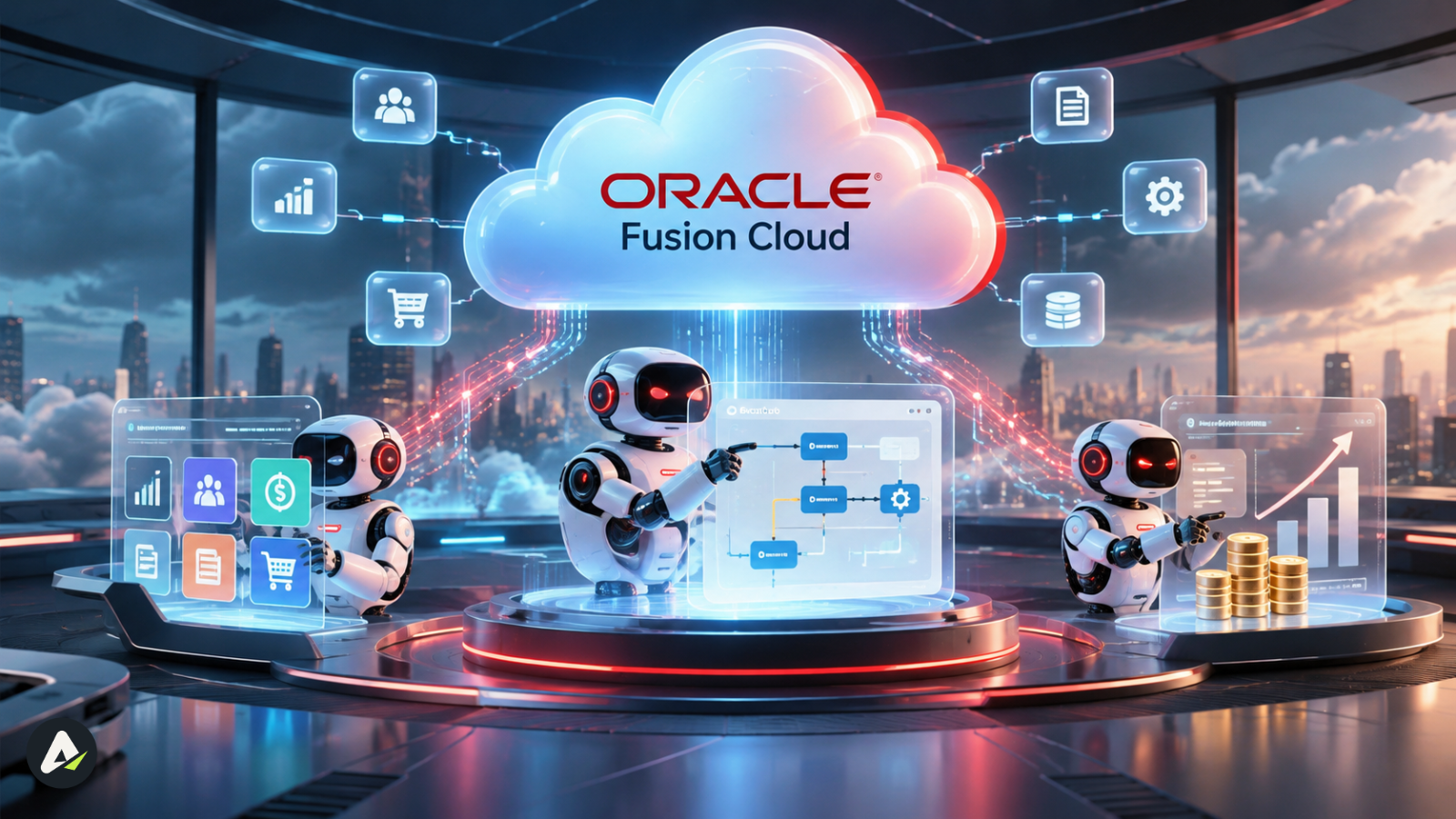
Oracle Fusion Cloud AI Agents are prebuilt and customizable AI agents built into Oracle Fusion Cloud Applications. They answer questions, draft content, and complete multi-step tasks across ERP, EPM, SCM, HCM, and CX, using Fusion’s own data, security roles, and approval rules.
A chatbot replies. An agent can reason through a goal, plan steps, and act on them. That’s why a Fusion agent can create a purchase requisition for you instead of explaining how to make one.
Oracle’s naming gets confusing, much like the wider difference between AI tools and AI agents. Here’s the short version:
| Term | What it is | Example |
|---|---|---|
| AI agent | Acts toward a defined task | Document IO agent creating a requisition |
| Agentic application | Several agents working toward an outcome | Collectors Workspace reducing overdue receivables |
| AI Agent Studio | The tool you use to build and extend agents | Not an agent itself |
| Custom AI | The license you need once you build or change agents | Not a product you use |
How much of this is verified?
| Status | Examples |
|---|---|
| Oracle price list or documentation | AI Unit price, agentic-app subscription price, role-based access, ATLAS testing |
| Oracle’s own claims | 1,000+ agents, 75 agentic apps, customer data not used for model training |
| Third-party analyst reports | The 20,000 free monthly AI Units |
| Only your tenant can answer | Which agents are live, your entitlements, real accuracy and ROI |
How Oracle Fusion AI Agents Work
Oracle Fusion AI agents pair a large language model with live Fusion data, a set of tools and your approval workflow. The model reads the request. Fusion data grounds the answer. Tools like business objects, REST services, and MCP servers do the work, and the workflow decides what needs a human.
You choose the thresholds. A $40 office-supply invoice can sail straight through, while a $400,000 supplier payment still lands on a manager’s desk.
Oracle Fusion AI Agents by Module
Oracle ships role-based agents for every Fusion pillar, and new ones arrive with each quarterly update.
Take that 1,000+ number with a grain of salt. It’s Oracle’s portfolio count, not 1,000 autonomous agents waiting in every tenant. It blends agents, templates and simpler assistants, and it includes industry apps. What matters is whether the agent you need is live on your release and covered by your contract.
| Area | Example agents | What they can change |
|---|---|---|
| ERP | Payables, Ledger, Payments, Document IO | Capture invoices, flag account issues, prepare payments |
| EPM | Planning Agent, Profitability and Cost Management Agent | Explain variances, build cost models |
| SCM | Planning Cycle, Component Replacement | Coordinate planning tasks, manage product changes |
| HCM | Workforce Staffing, Workforce Operations | Answer HR questions, build staffing plans |
| CX | Marketing, sales and service agents | Plan territories, support sales and service teams |
Availability changes from release to release. Before you plan around any agent, find it in your release’s readiness notes on My Oracle Support.
Which agent should you start with?
| Your problem | Starting point |
|---|---|
| Manual invoice entry | Payables Agent |
| Documents keyed in by hand | Document IO agent |
| The same expense questions every week | Expense Policy Agent |
| Slow variance analysis | Ledger or Planning Agent |
| A whole outcome, like overdue receivables | An agentic application |
In practice, agents that only answer or draft make the safest first pilots. Don’t put the cart before the horse. Save the ones that act for round two.
Fusion Agentic Applications and Fusion Claw
Fusion Agentic Applications are goal-based workspaces. You set an objective, and a team of specialized agents plans, decides, and acts toward it, passing trade-offs back to people.
Oracle launched 22 in March 2026. On September 29, it added Fusion Claw, a governed runtime for long-running work, plus 25 Claw-powered apps such as Ledger, Workforce Staffing and Shipping Consolidation.
Claw splits the job in two. A frontier model from Google or OpenAI plans, then deterministic Fusion computation does the work, which Oracle says keeps AI cost to the steps that need it. Each run leaves an “Outcome Receipt” audit record, and you choose how far automation goes.
Claw apps come with Oracle’s separate Agentic Applications subscription, according to TechTarget, not with base Fusion. Until your own pilot backs up Oracle’s cost and autonomy claims, the jury’s still out.
Oracle AI Agent Studio and Marketplace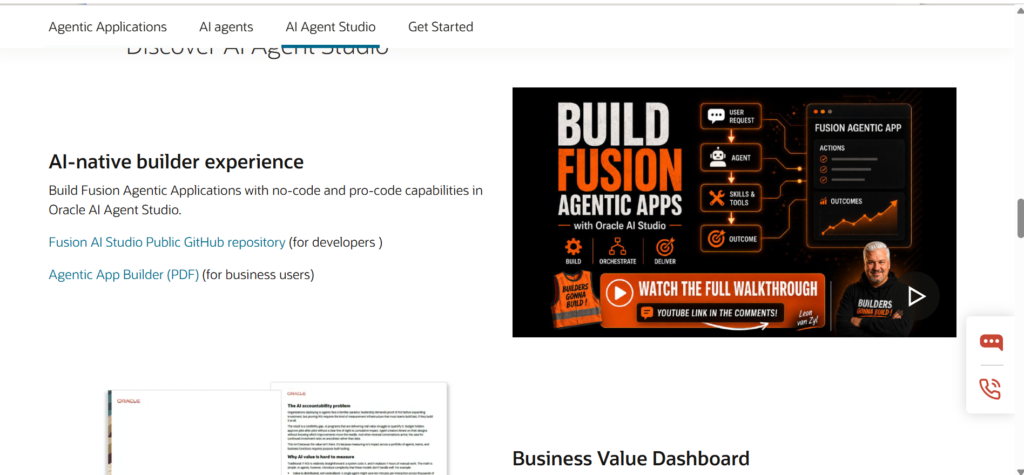
Oracle AI Agent Studio is the platform inside Fusion where you build, extend, test, and monitor agents and agentic applications.
A July 2026 update opened it up to three kinds of builders:
- Business users describe the app they want in plain language
- Admins configure agents, tools and workflows visually
- Developers work in VS Code, OpenAI Codex, Claude Code, CLIs, and Git
That developer path runs on a new AI Studio Skill. It works a lot like agent skills that package instructions for coding agents, and anything built with it still inherits Fusion’s security and audit trails.
Studio reaches outside systems through REST, MCP, and A2A, and supports models from OpenAI, Google Gemini, and Anthropic. Its Marketplace adds Oracle-reviewed partner templates, but read the fine print on each partner’s licensing first.
How Much Do Oracle Fusion AI Agents Cost?
Oracle’s embedded agents and AI Agent Studio are included with a Fusion subscription. Costs start when you build custom agents, consume AI Units beyond your allowance, or run agentic applications in production.
Oracle’s Fusion Cloud price list dated September 10, 2026 shows the list prices:
| Item | Part number | List price |
|---|---|---|
| Fusion Agentic Applications Cloud Service | B112535 | $500,000 per year |
| Fusion AI Units (100,000 pooled units) | B112536 | $1,000, or about one cent per unit |
| Fusion AI Agents Cloud Service | B112537 | $150 per named user per month, 50-user minimum |
| Fusion AI Agents Cloud Service | B112538 | $5 per employee per month, 500-employee minimum |
The same document defines a Custom AI Agent as any agent “created with, or resulting from modification of Oracle delivered agents.” In other words, tinkering with Oracle’s agents can quietly tip you into paid territory. The license isn’t the meter. Your subscription decides what you’re allowed to build and run. AI Units measure how much AI work you consume. Agentic applications add a third commercial layer on top.
AI Units are pooled, and Oracle ties their consumption to the type of action and model in its AI Unit Actions Table. Licensing analysts at Redress Compliance report that every customer also gets 20,000 free AI Units a month, though that allowance doesn’t appear in the price list.
These are list prices, and big enterprise deals rarely pay sticker price. Pricing can change between releases, so check your Oracle master agreement, order forms and current My Oracle Support documents before you commit spend.
Security, Data Privacy and Autonomy
Security for Fusion agents comes down to four questions: what can the agent see, does your data train the model, where does processing happen, and how much can it do alone?
- Access: agents work within Fusion’s roles, privileges, and data-security rules, and admins can limit custom agents to specific objects and fields. Test the full permission chain before granting any action.
- Audit: agent actions flow through Fusion’s approvals and audit trails, and Claw runs add an Outcome Receipt.
- Training: Oracle says Fusion customer data isn’t used to train the underlying models.
- Residency: Claw and bring-your-own models send reasoning to providers like Google or OpenAI. Check their processing regions and terms against GDPR or your sector’s rules.
Apply least privilege at the agent, tool, and data levels. It’s the same thinking behind treating agent identity separately from human identity.
A practical autonomy model
This isn’t Oracle’s official classification, just a working scale for deciding how much rope an agent gets.
| Level | What the agent does | Good fit for |
|---|---|---|
| 1. Recommend | Suggests an answer | Policy questions, variance analysis |
| 2. Draft | Prepares a transaction for review | Requisitions, journal entries |
| 3. Act with approval | Executes once someone approves | Invoices above a threshold |
| 4. Act within guardrails | Executes on its own | Low-value, well-tested tasks |
Payments, payroll, and supplier bank details belong at level 1 or 2 until the agent has proven its worth.
How to Test and Monitor Fusion AI Agents
Testing an agent means replaying real scenarios to check it routes correctly, grounds answers in the right data, and stays inside cost limits.
Oracle’s tool for this is ATLAS, which shipped in Release 26D on September 30, 2026. You record a scenario once, then replay it whenever a prompt, model, or workflow changes. It also compares models on quality, AI Units, and speed.
Why bother? A chatbot’s wrong answer wastes a minute. An acting agent’s wrong answer can release a purchase order.
After go-live: watching for drift
Testing doesn’t stop at launch. Studio has built-in monitoring for agent quality and behavior, and you’ll want a routine before any agent moves past level 2:
- Review a sample of agent actions and tool calls each week
- Flag answers that don’t match the source record
- Rerun your ATLAS tests after every quarterly update or model change
- Drop an agent back a level if its error rate climbs
Oracle vs. SAP Joule vs. Microsoft Dynamics 365
All three suites now embed agents and offer a builder. Where they differ is the kind of data each one knows best.
| Factor | Oracle Fusion | SAP Joule | Microsoft Dynamics 365 |
|---|---|---|---|
| Data strength | Structured ERP, HCM and SCM transactions | SAP business process context | Workplace data in Outlook, Teams and SharePoint |
| Build tools | AI Agent Studio | Joule Studio | Copilot Studio |
| Cross-vendor governance | MCP, A2A, Oracle Integration | AI Agent Hub | Agent 365 |
That split often shows up inside one workflow. Approvers live in Outlook and Teams, while the ledger lives in Fusion. Oracle’s bridge is MCP, A2A, and Oracle Integration.
Don’t pick the agent platform first. Pick the ecosystem where your transaction data already lives.
Embedded isn’t automatically better, mind you. General-purpose tools like Lindy, which chain tasks across email, calendars, and CRMs, can handle processes that hop between apps more easily than an agent tied to one ERP.
How to Implement Fusion AI Agents: The 5-R Framework
Prerequisites checklist
- An active Fusion Cloud subscription for the module the agent serves
- Release 25C or later, when AI Agent Studio became generally available (some embedded agents shipped earlier)
- AI Agent Studio roles for the people who build and manage agents
- The agent listed as available in your release’s readiness notes
- The right subscription for custom agents or agentic apps, if you’ll run them in production
- An account with any external model provider you plan to use
The 5-R rollout
- Rank use cases by volume and pain. Invoice entry is low-hanging fruit compared with forecasting.
- Ready your data. Stale supplier records produce confident wrong answers.
- Restrict autonomy to level 1 or 2 and limit what the agent can touch.
- Run a pilot with ATLAS tests, a baseline, and a named business owner.
- Review results and AI Unit usage, then scale.
Vendor Demo: Procure-to-Pay With Document IO
In Oracle’s product tour, an employee emails a photo of a handwritten supplier quote to the Document IO agent, which creates a purchase requisition and codes the accounts. It’s Oracle’s demo, not an independent result, but the pattern rings true: the agent removes the typing, and people keep the decisions.
Limitations and Common Mistakes
Fusion agents shine when your finance, HR, or supply chain work already runs in Fusion. Outside that, a few problems come up again and again:
- Release lag: a feature announced on stage can take a quarter or more to reach your pod.
- Data quality: an agent is only as good as your master data.
- Finance failure modes: duplicate invoices, wrong supplier bank details and miscoded journals need human checks.
- Cost creep: AI Unit usage quietly climbs when nobody is minding the store.
Most rollout mistakes boil down to that list, from biting off a flashy first use case to handing over the keys before testing.
Oracle Fusion AI Agents vs. EBS AI Agents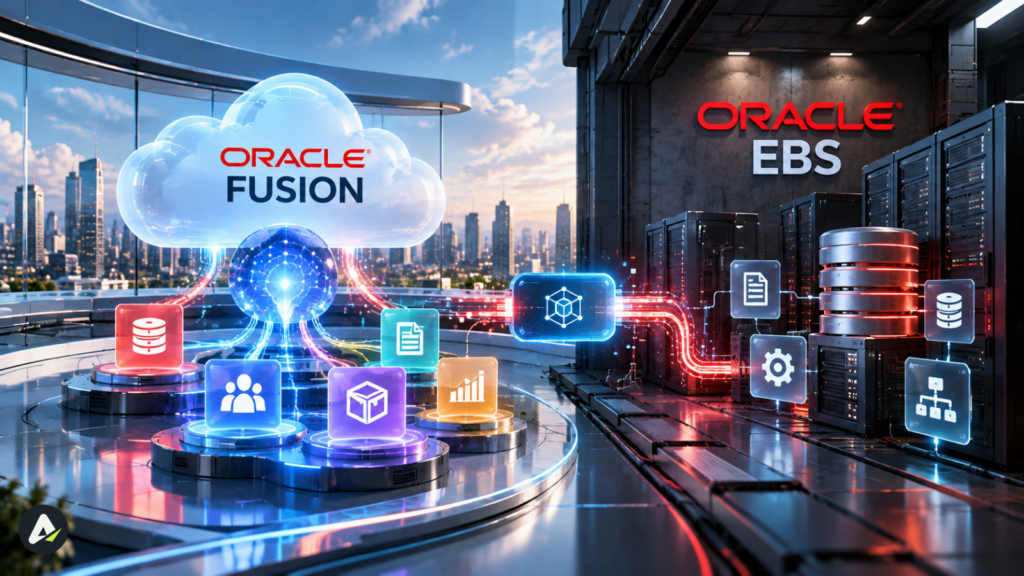
Fusion agents and E-Business Suite (EBS) agents are separate products with separate data paths and security reviews. Oracle has said the Fusion agents aren’t coming to EBS. In August 2026, though, it introduced a different set of EBS agents built on Oracle AI Data Platform.
For EBS teams, it all comes down to timing. Do you add agents on EBS now, or wait and use Fusion’s native ones after you migrate?
FAQs
Q. What AI agents are available in Oracle Fusion?
Oracle reports more than 1,000, including the Payables, Ledger and Document IO agents in ERP and the Planning Agent in EPM. What’s available to you depends on your release.
Q. Is Oracle AI Agent Studio free?
Studio and Oracle’s embedded agents are included with Fusion. Fully custom agents in production, AI Unit usage, and external models can add cost.
Q.What’s the difference between an Oracle AI agent and an agentic application?
An agent handles a task, such as processing an invoice. An agentic application coordinates several agents to reach an outcome.
Q.What are the 7 types of AI agents?
The textbook list is simple reflex, model-based, goal-based, utility-based, learning, hierarchical, and multi-agent. Oracle groups Fusion agents differently, as answering, authoring, and acting agents.
Q. Does Oracle use my Fusion data to train AI models?
Oracle says no. Any external model you connect follows its own provider’s terms.
Q. Can an Oracle AI agent do more than its user?
No. Embedded agents inherit the user’s access, and admins can restrict custom agents even further.
Q.Does Oracle AI Agent Studio support external LLMs?
Yes. You can bring models from providers like OpenAI, Google Gemini, and Anthropic, managing the credentials and paying the provider directly.
Q.Are Oracle Fusion AI agents available for E-Business Suite?
Not the Fusion agents. EBS customers can use a separate set of agents built on Oracle AI Data Platform.
Related: Best AI Agent Development Services in 2026
| Disclaimer: Oracle Fusion AI Agents, pricing, availability, and capabilities can vary by release, contract, and tenant. This guide separates Oracle’s claims from independently verified information and third-party estimates. |

Maliha
AI is moving steadily from experimental technology into the products and workflows people rely on every day. Maliha Irfan is a technology writer covering artificial intelligence, automation, and emerging software. Her work focuses on the practical side of AI agents, exploring how these systems are being used, what they can realistically accomplish, and the limitations that matter when businesses and individuals adopt them.
More from Maliha →