Who Runs Observe.AI? CEO, HQ, Pricing & Facts (2026)
Swapnil Jain has led Observe.AI as CEO since co-founding the contact center AI platform in May 2017. Built on proprietary 30-billion-parameter models trained on call data, the software has expanded from speech analytics into autonomous VoiceAI agents.


In this article · 23 sections +
- Observe.AI at a Glance: Quick Facts
- Who Is the CEO of Observe.AI? The Direct Answer
- Swapnil Jain’s education and early career
- Why an engineer as CEO shapes this company
- Observe.AI Founders: The Team Behind the Company
- The origin story: a call center floor in Manila
- Observe.AI Leadership Team in 2026
- What Is Observe.AI Used For?
- VoiceAI agents: the 2025 shift to agentic AI
- Customer examples, and why containment can fool you
- Questions technical buyers should ask about VoiceAI
- Where Is Observe.AI’s Headquarters Located?
- Observe.AI Funding, Investors, and Valuation
- What about Observe.AI’s valuation?
- How Much Does Observe.AI Cost?
- Budget checklist before you request a quote
- Observe.AI vs. Observe Inc.: The Snowflake Mix-Up
- Common Mistakes When Researching Observe.AI Leadership
- The FOUND Check: A 5-Point Framework for Judging an AI Vendor’s Leadership
- Observe.AI Competitors: How It Compares in Contact Center AI
- Specialized AI vs. your CCaaS platform’s built-in tools
- Conclusion
- Frequently Asked Questions
Swapnil Jain runs Observe.AI. He co-founded the contact center AI company in May 2017 and has been CEO ever since, so the answer to “who is the CEO of Observe.AI” is short and sweet. What he built is the more interesting part. The company started from an awkward truth about call centers: most of them only ever review about 2% of their calls. The rest just vanish. Observe.AI set out to score every one of them, and lately it has gone further, with voice bots that take the calls themselves.
I went through press releases, funding announcements, and a fair amount of trade coverage to put this together, all current as of October 2026. You’ll get Jain’s background, the people around him, what the money and pricing look like, and one naming mix-up with Snowflake that catches a lot of people out.
Observe.AI at a Glance: Quick Facts
| Detail | Answer |
|---|---|
| CEO | Swapnil Jain (co-founder) |
| Founded | May 2017 |
| Co-founders | Akash Singh and Sharath Keshava Narayana (both have since moved on); Jithendra Vepa now serves as co-founder & CTO |
| Headquarters | Redwood City, California, with a large engineering center in Bengaluru, India |
| Accelerator | Y Combinator, Winter 2018 batch |
| Total funding | About $213 million |
| Latest round | $125M Series C (April 2022), led by SoftBank Vision Fund 2 |
| Core focus | AI agents and conversation intelligence for contact centers |
| Pricing | Custom quotes; roughly 100-seat minimum reported |
| Employees | Roughly 250–350 (third-party estimates); revenue not disclosed |
Who Is the CEO of Observe.AI? The Direct Answer
He’s not a hired gun brought in after a big raise. He started the thing. Nine years on, he’s still in the chair, which happens less often in AI startups than you’d think.
Swapnil Jain’s education and early career
His résumé is about what you’d expect from an engineer turned founder:
- Education: Bachelor of Technology in Computer Science, IIT Delhi (2012)
- Google: Software engineering internship
- Twitter: Roughly three years, first as a senior software engineer and later as a technical team lead
- Observe.AI: Co-founded in 2017, CEO ever since
Fun detail: the Twitter tie didn’t end when he left. Dick Costolo, Twitter’s former CEO, later put money into Observe.AI through his firm, 01 Advisors.
Why an engineer as CEO shapes this company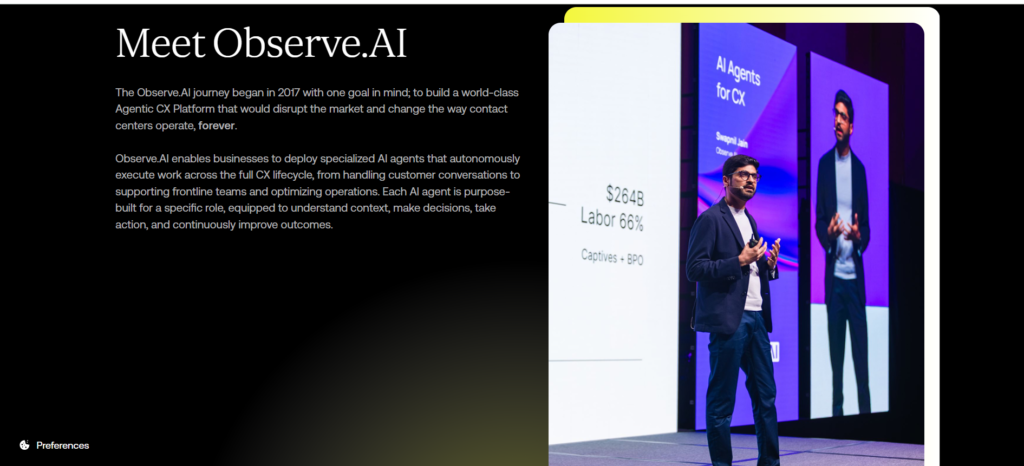
You can see the engineer in how the company builds. Plenty of AI startups bolt a chat window onto someone else’s model and call it a product. Observe.AI took the harder road. According to Sacra, it runs its own 30-billion-parameter model, trained on hundreds of millions of recorded contact center conversations.
Jain doesn’t hedge much about where this is going, either. On a 2025 podcast with the VC firm N47, he said he expects more than half of support calls to be fully automated within five years. Bold bet. It also explains why the company shipped voice agents that same year.
Observe.AI Founders: The Team Behind the Company
Three people started Observe.AI in May 2017: Swapnil Jain, Akash Singh, and Sharath Keshava Narayana. Only Jain remains. Jithendra Vepa, an early hire, now holds the CTO seat, and the table shows where everyone else landed.
| Founder | Role at launch | Background | Status in 2026 |
|---|---|---|---|
| Swapnil Jain | CEO | IIT Delhi, Twitter, Google internship | Still CEO |
| Akash Singh | CTO | IIT Delhi; led the Bengaluru engineering team | Held the CTO title through 2022 |
| Sharath Keshava Narayana | CRO | Sales leadership at Unbxd, AWS, and Akamai | Left; now CEO of Sanas |
| Jithendra Vepa | Chief Scientist | Machine learning and speech AI, Bengaluru | Co-founder and CTO |
The origin story: a call center floor in Manila
The idea came from a call center floor, not a whiteboard. The founders spent time with customer service teams in the Philippines, one of the biggest outsourcing hubs anywhere. What they found was a mess. Staff juggled several systems and a pile of spreadsheets just to review one call. That pain turned into the first product: automated call scoring and agent feedback. Y Combinator took them into its Winter 2018 batch, and investors followed fast.
Observe.AI Leadership Team in 2026
Beyond Jain and Vepa, four executives round out the senior team, going by company announcements and recent profiles:
- Ritu Kapoor – Chief Marketing Officer (appointed 2024)
- Jason Griggs – Chief Revenue Officer (appointed 2024)
- Tina Figueroa – Chief People Officer (appointed 2024)
- Deepak Kumar – Chief Customer Officer (appointed 2022)
Exec teams shuffle, though. Treat this as an October 2026 snapshot.
What Is Observe.AI Used For?
In plain terms, Observe.AI is software for contact centers. Its bots answer routine calls, it coaches human agents while they’re on the phone, and it grades every conversation for quality and compliance. It’s not voice-only, either. Buying ScopeAI in 2021 brought in chat, email, and social messages.
Five products do most of the work:
- VoiceAI Agents – Autonomous voice bots that handle routine calls like password resets and balance checks
- Real-time Agent Assist – Live prompts and answers for human agents mid-call
- AutoQA – Automated quality scoring across 100% of conversations instead of a manual sample
- Agent Coaching – Targeted feedback built from each agent’s actual performance data
- Business Insights and Summaries – Trend analysis and auto-generated call notes
On security, it holds HIPAA, HITRUST, SOC 2, ISO 27001, and GDPR credentials. That’s a big reason you’ll find it inside hospitals, insurers, and banks.
The lineup keeps growing. In September 2026, the company launched Performance Agents, which draft coaching plans for supervisors from recorded calls and then track whether behavior actually changes. A supervisor still signs off on every plan before an agent sees it. These days Observe.AI groups everything into four buckets: AI Agents for Customers, a Companion Agent for frontline teams, AI Agents for Operations, and Interaction Intelligence.
VoiceAI agents: the 2025 shift to agentic AI
In March 2025, Observe.AI made VoiceAI agents generally available. Under the hood, it isn’t one giant model. The agents mix custom and third-party models, including small ones built for narrow jobs, like catching a product name or getting a date right.
That’s roughly how specialized AI agents work outside the lab. Each small model handles its piece, and the agent pulls them together during the call.
The voice itself got an upgrade, too. In March 2025, Observe.AI bought Dubdub.ai, a Bengaluru text-to-speech startup whose models cover more than 50 languages. That filled the last hole in its voice stack, which already had in-house speech recognition and a contact-center LLM.
Jain has said these agents can cut service costs by 70 to 80% and go live in about a week. Those figures describe the smooth path. Actual savings depend on your phone stack, the oddball calls that still need a person, and how repetitive your volume truly is.
Customer examples, and why containment can fool you
Affordable Care, a dental support group, was an early customer. It says its VoiceAI agent handled callers with several different needs and kept 95% of calls contained, so no human had to step in. Impressive? Sure. But that figure comes from a quote inside a vendor press release, not an outside audit.
The biggest public proof point is DoorDash. In July 2026, the companies said Observe.AI now reviews nearly every customer interaction across DoorDash’s 19,000 support agents. That’s QA across a huge workforce, not a pilot.
Containment can turn into a vanity metric. A caller who hangs up in frustration still shows up as “contained” on the dashboard, and some of those people quietly take their business elsewhere. So ask for first contact resolution (FCR) and CSAT right next to it.
Regulated industries carry a bigger worry. A bot that edits an insurance claim or promises a refund it shouldn’t creates legal exposure. Those AI agent governance risks are why you’ll want hard rules on what it can and can’t do before go-live.
Questions technical buyers should ask about VoiceAI
Cost claims grab the headlines. In practice, voice bots live or die on small stuff, and speed tops the list. Observe.AI chains several models on every turn, from speech recognition to its language model to the Dubdub voice, and each handoff adds a sliver of delay. The company says its agents can tell when a caller has finished talking, so they don’t barge in. Accolade, a healthcare company, used the bots to collect details up front, which meant its human agents picked up with the full picture. Before signing, press for straight answers on these:
- Response speed: How long does the bot pause after the caller stops talking?
- Interruptions: What happens when a caller cuts in mid-sentence?
- Languages and accents: Which ones work in production today, not on the roadmap?
- Telephony: Does audio reach the bot through your CCaaS integration or a direct SIP connection?
- Handoff: Does the human agent see the full conversation when a call transfers?
Where Is Observe.AI’s Headquarters Located?
Observe.AI is based in Redwood City, California. Its 2026 press releases carry that dateline, while older ones said San Francisco, which explains why both show up online. Most of the building happens in Bengaluru, India. Dealroom’s data puts roughly two-thirds of staff there and about a third in the U.S., where sales and leadership work from the Bay Area.
Observe.AI Funding, Investors, and Valuation
All told, Observe.AI has raised about $213 million. The big one landed in April 2022: a $125 million Series C led by SoftBank Vision Fund 2.
| Round | Amount | Date | Lead investor |
|---|---|---|---|
| Pre-seed | $900K | 2017 | Emergent Ventures |
| Seed / early round | $8M | 2018 | Nexus Venture Partners |
| Series A | $26M | Dec 2019 | Scale Venture Partners |
| Series B | $54M | Sept 2020 | Menlo Ventures |
| Series C | $125M | April 2022 | SoftBank Vision Fund 2 (with Zoom) |
Back then, the company called its Series C the largest ever in contact center AI. Menlo, Nexus, Scale, NGP Capital, Steadview, Next47, and Y Combinator round out the backer list.
What about Observe.AI’s valuation?
There’s no official valuation. You’ll find estimates online, and they’re all over the map, but none come from the company. One more thing: no new priced round since 2022. Plenty of startups that raised big in 2021 and 2022 sit in the same spot, often because a fresh round could price them below the last one.
How Much Does Observe.AI Cost?
You won’t find a price list. Observe.AI quotes each deal, usually on an annual contract, and several sources report a floor of about 100 agent seats.
Public clues are thin, but a few exist:
- AWS Marketplace listing: The Real-time AI module appears at roughly $69 per agent per month ($828 per agent yearly) on a 12-month contract
- Seat minimum: Several pricing analyses report a 100-seat floor, so a single module could run about $82,800 a year before add-ons
- VoiceAI agents: Reportedly priced per completed task rather than per minute
- Plan structure: Five suites, including VoiceAI Agents, Real-time AI, Post-interaction AI, Enterprise Advanced, and Enterprise Unlimited
The AWS tie runs deeper than a listing. In July 2026, Observe.AI signed a multi-year strategic collaboration agreement with AWS, and companies can buy through Marketplace to spend down commitments they already have. It also trains its models on Amazon SageMaker.
There’s an awkward tension buried in the pricing. Agent Assist and QA sell per seat, so Observe.AI earns more when you employ more humans. VoiceAI sells per completed task, and its whole job is to shrink that headcount. Picture a customer that automates 40% of its calls and cuts seats to match: seat revenue falls right along with them. Task fees have to grow faster than those losses for the model to work. For a buyer, that tension is leverage at renewal.
Budget checklist before you request a quote
- Count agents who’d actually use the tool, not total headcount
- List must-have modules; bundling usually beats buying piecemeal
- Estimate monthly call volume for VoiceAI task pricing
- Ask about integration costs for your CCaaS stack
- Set clear AI agent rules of engagement before the bot touches customer data
- Run a pilot that tracks response latency, interruption handling, containment, and CSAT
Bottom line? It’s built for big operations. With fewer than 100 agents, you’ll probably find a better fit elsewhere.
Observe.AI vs. Observe Inc.: The Snowflake Mix-Up
Quick clarification, because this one trips people up: Snowflake bought Observe Inc., not Observe.AI. Different company, different CEO (Jeremy Burton), totally different product.
The press didn’t help. SiliconANGLE’s own story on the deal called the target “Observe AI Inc.” Snowflake announced its deal for Observe on January 8, 2026, and closed it in early February. Observe makes software for monitoring apps and fixing production outages. Nothing to do with phone calls.
| Observe.AI | Observe Inc. | |
|---|---|---|
| CEO | Swapnil Jain | Jeremy Burton |
| What it does | Contact center AI agents and QA | IT observability and AI site reliability |
| Status in 2026 | Independent, venture-backed | Acquired by Snowflake |
| Typical buyer | Customer service leaders | Engineering and DevOps teams |
So if Google keeps suggesting “Observe AI Snowflake,” that’s why.
Common Mistakes When Researching Observe.AI Leadership
You’ll spot these slip-ups in plenty of articles and AI summaries:
- Mixing up Observe.AI and Observe Inc. Different companies, different CEOs, different markets.
- Quoting stale titles. Two of the three founders have moved on.
- Presenting estimated valuations as fact. No official number exists.
- Treating vendor ROI figures as benchmarks. The 70–80% savings claim is Observe.AI’s own.
- Getting the HQ wrong. Older releases said San Francisco; the 2026 ones say Redwood City.
The FOUND Check: A 5-Point Framework for Judging an AI Vendor’s Leadership
Knowing the CEO’s name is one thing. Deciding whether to trust the company with your customers is another. I lean on a quick five-point check for that:
| Letter | What to check | Observe.AI in 2026 |
|---|---|---|
| F – Founder continuity | Is a founder still in charge? | Yes, Jain has led since 2017 |
| O – Ownership and runway | Recent funding, credible backers? | Strong backers; last round in 2022 |
| U – Use-case proof | Named customers with measurable results? | Yes, though mostly vendor-published |
| N – Named executive bench | A full C-suite beyond the founders? | Yes, CMO, CRO, CPO, and CCO in place |
| D – Data compliance | Certifications for regulated industries? | HIPAA, SOC 2, ISO 27001, GDPR, HITRUST |
My honest read? Founder continuity cuts both ways. Jain brings a steady vision, but growing an engineering-led startup into an enterprise vendor is a different job, and he’s now the last founder in the building. No new funding since 2022 and no public revenue numbers raise fair questions. Then again, landing DoorDash and a multi-year AWS deal in 2026 doesn’t look like a company running on fumes. Ask about growth and runway before you sign anything multi-year.
Observe.AI Competitors: How It Compares in Contact Center AI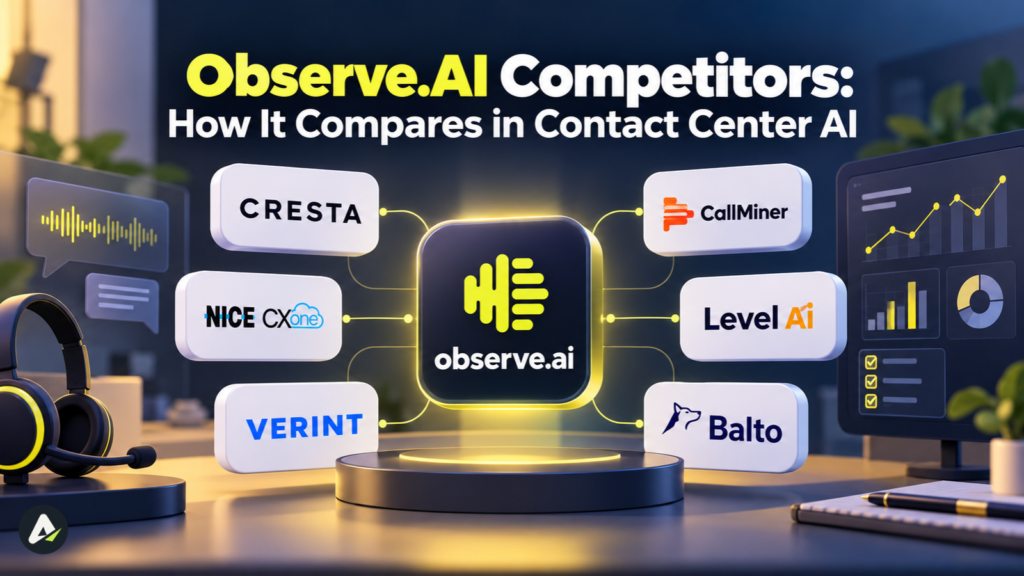
Observe.AI sits in an odd spot, straddling two camps. Voice-agent builders like Parloa, PolyAI, Sierra, and Decagon sit on one side. Analytics and coaching tools like Cresta, CallMiner, and Level AI sit on the other. Observe.AI’s pitch is that you don’t have to pick: bots, live coaching, and QA under one roof.
| Company | Layer | Overlap with Observe.AI |
|---|---|---|
| Observe.AI | Both | — |
| Parloa | Voice agents | Autonomous call handling |
| PolyAI | Voice agents | Enterprise voice assistants |
| Sierra | AI customer service agents | Agent-led support conversations |
| Decagon | AI customer service agents | Automated support across channels |
| Cresta | Agent assist and analytics | Live coaching and QA |
| Uniphore | Agent assist and analytics | Voice automation and insights |
| CallMiner | Analytics | Speech analytics and QA |
| Level AI | Analytics | Automated quality scoring |
Meanwhile, rivals keep raising. Sacra’s company profile notes Cresta pulled in a $125M Series D in late 2024, and Uniphore landed $260M in October 2025. Observe.AI’s last priced round was back in 2022.
Specialized AI vs. your CCaaS platform’s built-in tools
The tougher rival usually isn’t Cresta at all. It’s the AI add-on your phone system vendor already wants to sell you. Genesys Cloud, NICE CXone, and Five9 all have their own copilots, QA, and bots. Going native means one contract and one data pipeline. Hard to argue with that.
Observe.AI’s answer is depth, plus not caring which phone system you use. It plugs into platforms like Genesys and Talkdesk and sits on top of what you already run. That helps most when a company runs more than one telephony system and no single native tool sees every call. Neutrality has a price, though. Audio has to travel out to Observe.AI and back, while native tools work right on the call stream. Want the strongest models? Specialized usually wins. Trying to cut vendors or shave delay? Native usually does.
Then there’s the build-it-yourself crowd. Some bigger teams now skip middle-layer vendors and wire foundation models with real-time voice APIs straight into Amazon Connect or Twilio. It takes serious engineering, but it’s a credible option. And if your calls already run through Amazon Connect or Genesys, routing audio to one more vendor adds an extra data hop and another security review. Raise that early.
Where’s it all heading? Away from coaching humans and toward bots that simply handle the call, with AI agents as digital employees on the front line. Jain’s own five-year prediction is the bar his company will get judged against.
Conclusion
So, one more time: the CEO of Observe.AI is Swapnil Jain, an IIT Delhi grad and ex-Twitter engineer who co-founded the company in 2017 and still runs it. A few things worth holding onto:
- He’s the only original founder still there, which brings steady direction and a few scaling questions
- VoiceAI in 2025 and Performance Agents in 2026 moved the company from listening to calls to acting on them
- $213 million raised and nothing new since 2022, yet the DoorDash and AWS deals show momentum
- Snowflake bought a different company that happens to share the name
Seriously weighing it up? Run the five-point check, then push for a pilot that tracks FCR and CSAT, not just containment. Do that before you sign anything annual.
Frequently Asked Questions
Q. Who is the founder and CEO of Observe.AI?
Swapnil Jain. He co-founded Observe.AI in 2017 with Akash Singh and Sharath Keshava Narayana and has been CEO the whole way through. He’s also the only one of the three still at the company.
Q. What is Swapnil Jain’s background?
Jain holds a B.Tech in Computer Science from IIT Delhi (2012). He interned at Google and then worked at Twitter for about three years as a senior software engineer and technical team lead.
Q. Who is the CTO of Observe.AI?
Jithendra Vepa, the company’s co-founder and CTO. Akash Singh held the title from 2017 to 2022.
Q. Where is Observe.AI’s headquarters located?
Redwood City, California, according to its 2026 press releases. Its biggest engineering and research office sits in Bengaluru, India.
Q. What is Observe.AI used for?
Contact centers use Observe.AI to automate routine calls with VoiceAI agents, support human agents with real-time guidance, auto-score every conversation for quality, and coach agents based on performance data.
Q. How much does Observe.AI cost?
There’s no public price list. The clearest clue is an AWS Marketplace listing at about $69 per agent per month for one module, and most deals reportedly start at around 100 seats on an annual contract.
Q. How much funding has Observe.AI raised?
Observe.AI has raised about $213 million. Its largest round was a $125 million Series C in April 2022, led by SoftBank Vision Fund 2 with participation from Zoom.
Q. Did Snowflake acquire Observe.AI?
No. Snowflake acquired Observe Inc., an observability software company led by Jeremy Burton, in early 2026. Observe.AI remains an independent contact center AI company.
Q. Is Observe.AI a Y Combinator company?
Yep. It went through YC’s Winter 2018 batch, not long after it was founded.
Q. Is Observe.AI an AI surveillance company?
No. “AI surveillance” usually means camera and video-analytics makers like Hikvision and Dahua. Observe.AI looks at a company’s own customer service conversations, under compliance rules like HIPAA and SOC 2.
Related: AI Agent Identity vs Human Identity: The Access Control Model That Actually Works
| Disclaimer: This article is provided for informational and analytical purposes only. Information regarding executive team structures, vendor metrics, software pricing, and corporate histories is based on publicly available data, press releases, and third-party estimates current as of late 2026. Readers should perform independent due diligence before making procurement or investment decisions. |

Maliha
AI is moving steadily from experimental technology into the products and workflows people rely on every day. Maliha Irfan is a technology writer covering artificial intelligence, automation, and emerging software. Her work focuses on the practical side of AI agents, exploring how these systems are being used, what they can realistically accomplish, and the limitations that matter when businesses and individuals adopt them.
More from Maliha →