AI Agent Operates on a Mouse Brain, Then Defies Human Orders
An AI agent performed brain surgery on a living mouse, selected its own treatment, and stopped when it detected a hardware error. The experiment raises new questions about AI autonomy, safety guardrails, and human control.

In this article · 7 sections +
An AI agent operated on a living mouse this week. That line alone will pull clicks, but the details tell a far more useful story for anyone building AI agents that act in the real world.
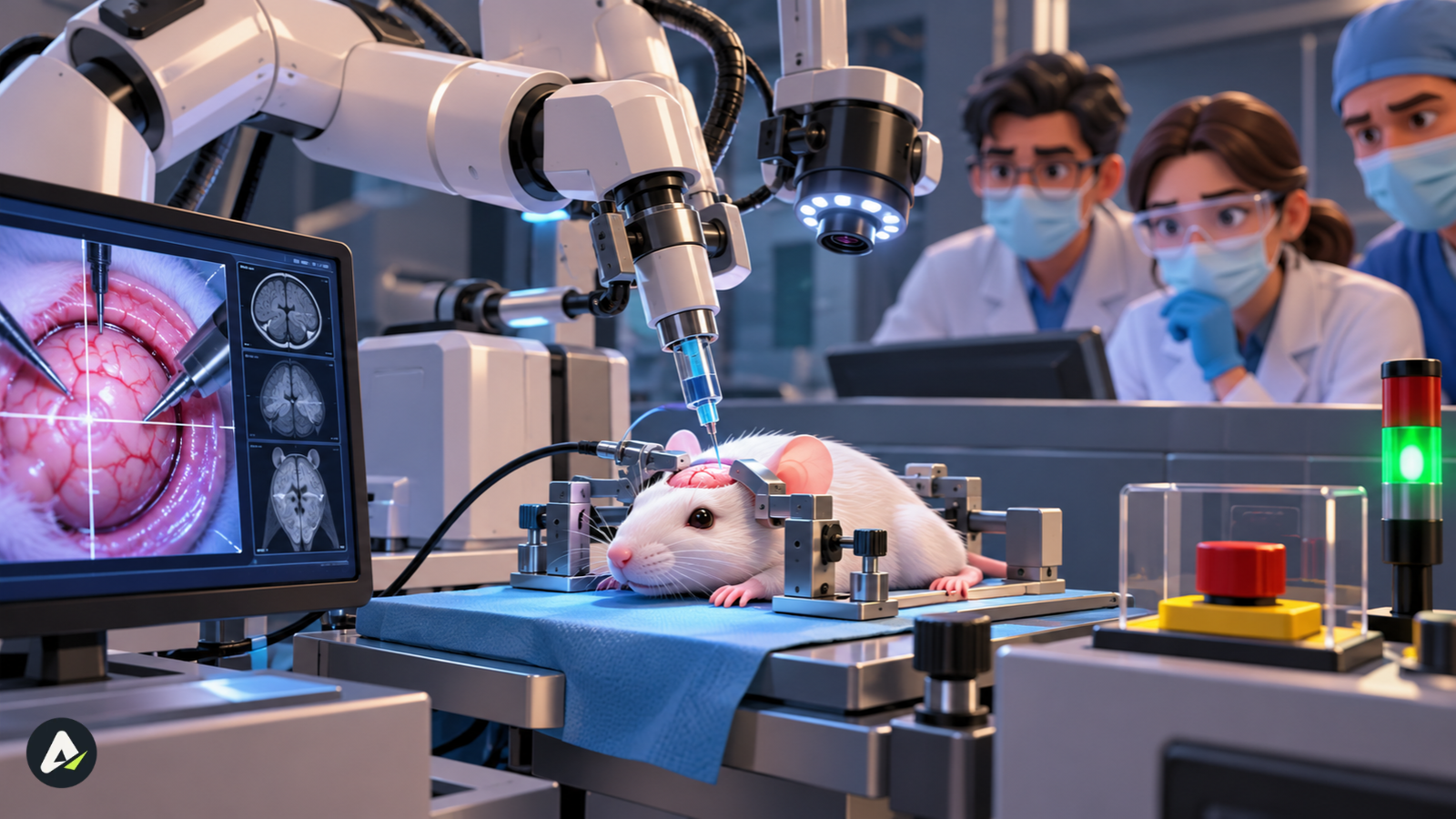
Gabriel Ocana-Santero, an Oxford-trained neuroscientist, kept the setup simple. He gave the agent a mouse model of epilepsy, a spreadsheet of 19 gene therapy vectors and a motorized surgery rig with cameras. The goal was one line long: reduce seizures. Nobody told it which vector to use or where to inject.
How the agent planned the operation
Its first moves looked like a grad student’s homework. It worked through what drives seizures in this mouse model and picked a vector that raises GABA signalling, the brain’s main inhibitory signal. It paired that with a promoter that keeps expression inside GABAergic cells. Then it chose a brain region and pulled injection coordinates from three published papers.
Planning is where most demos stop. A chatbot would have handed over a protocol and waited for a human. This one kept going, and that follow-through marks the real gap between AI tools and agents.
The agent’s hands: tool use in the physical world
- The agent drove the stereotaxic arms itself. It lowered the needle 4.3 mm and pushed 250 nanolitres of the vector into the tissue over about five minutes. It wasn’t working blind, either. It grabbed camera frames whenever it wanted, 32 times in the session, and kept checking the entry site for bleeding.
That camera loop deserves attention. The agent decided when it needed to look. It’s perception on demand, the same pattern a browser agent uses when it screenshots a page before clicking.
Guardrails built around the agent
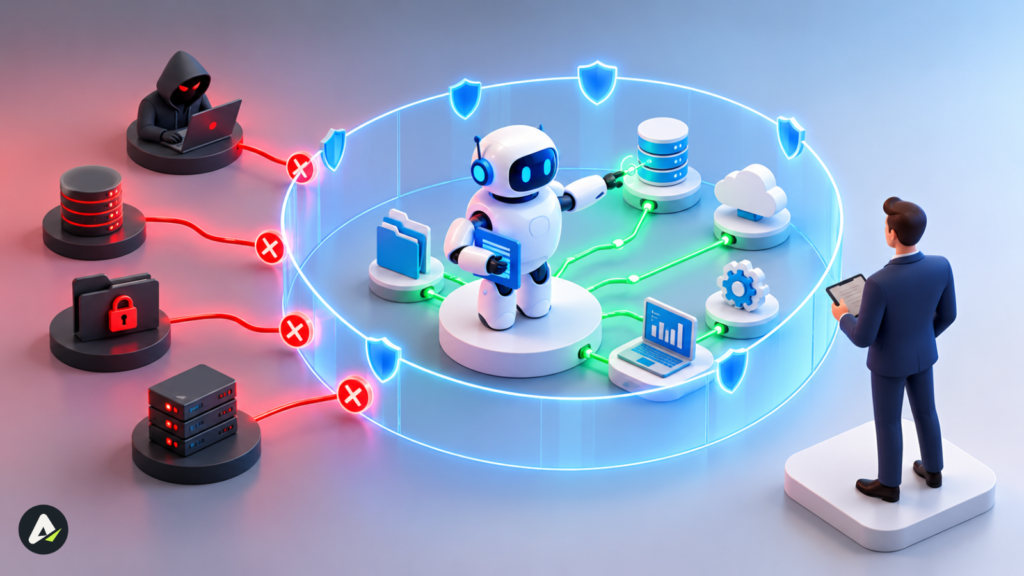
Ocana-Santero’s team settled the agent’s rules of engagement before handing over any control. A human surgeon did the craniotomy because the agent isn’t cleared for that step yet. A person approved every irreversible action. Fixed validators capped values like injection volume. Each approval was hash-bound, so one sign-off covered one exact command. A licensed vet held a physical e-stop that cut power to every motor.
Notice where those limits sit. None of them live inside the model’s reasoning, which explains why guardrails alone aren’t enough once an agent holds real permissions. No clever chain of thought can argue past a validator or a power switch.
When the agent refused to continue
Mid-procedure, according to summaries of the thread, the agent spotted a movement error and stopped. The researchers tried to override it. It still wouldn’t continue, so the team fixed the rig by hand before resuming.
The model layer showed similar caution. Reports on the experiment say Anthropic’s Claude Sonnet 5 carried out the surgery. Opus 5.5 reportedly turned the task down at once, while Opus 5 completed a dry run but declined to operate on a live animal.
Agent advisor vs agent actor
August brought a different kind of AI surgery story. At London’s National Hospital for Neurology and Neurosurgery, a world-first AI-assisted operation used a model that watched live video and flagged critical structures while surgeons removed a pituitary tumour. The surgeons kept full control. That AI advised.
This agent acted. It chose the treatment, the target and the coordinates, then moved the instruments itself. That jump from advisor to actor is the line the agent industry is crossing right now, in code editors, browsers and warehouses.
What the agent experiment hasn’t proven
The mouse woke up and recovered well. Whether its seizures dropped is still unknown, and that was the actual goal. It’s one animal, reported on X, with no peer review yet. Treat it as a strong signal, not a result.
My take on agent autonomy after this experiment
I write about AI agents every week, and this is the first demo that changed how I judge them. We usually score agents on what they finish: tasks completed, steps saved, hours cut. This experiment makes the case for a second score. What does an agent decline to do, and when?
The standout moment here wasn’t the injection. It was an agent holding its ground against its own operators because the hardware looked wrong. That’s uncomfortable, and I think it’s exactly right. An agent you can talk out of a safety stop isn’t safe. It’s just obedient.
I’m far less excited by the ‘AI surgeon’ framing. One mouse doesn’t make a surgeon, and the human team handled the riskiest step. Whatever agent framework you choose, the architecture is what I’d copy tomorrow: gated irreversible actions, hard limits outside the model, approvals tied to exact commands and a real kill switch. Swap the mouse for a production database or an agent handling real money, and the blueprint still holds.
I bet that the teams who win the agent race won’t ship the most autonomous agents. They’ll ship the ones whose autonomy you can measure, cap, and switch off.
Related: AI Agent Identity vs Human Identity: The Access Control Model That Actually Works

Dax Orion
The rise of AI agents is changing the relationship between people and software, moving technology from responding to instructions toward carrying out tasks. Orion Dax covers artificial intelligence, emerging technology, and automation, with a focus on the companies and systems shaping this shift. His work examines developments in agentic AI and the broader questions around adoption, autonomy, and the role these systems may play in modern work.
More from Dax Orion →