FancyAI Agents Review: 7 Things You Should Know Before Using Them
FancyAI doesn't sell itself as another image generator. It sells AI "employees" that link business systems to creative production. That changes the question worth asking. Not: can it generate a product photo, as plenty of software does? The…

In this article · 13 sections +
- How I Evaluated FancyAI
- What Are FancyAI Agents?
- FancyAI vs getfancy.ai: Confirm the Domain First
- The FancyAI Agent Stack: Five Layers, One Threshold
- FancyAI agents architecture runs five layers, and only the last two separate an AI employee from an AI assistant.
- FancyAI Integrations: Named Products vs Implementation Depth
- FancyAI Pricing in 2026: What Changed and What You Still Can’t Calculate
- FancyAI Output Quality and the Competitor Evidence Gap
- Five tests to run yourself before committing:
- FancyAI Alternatives: Named Products Compared
- Should You Use FancyAI Agents? A Buyer Fit Checklist
- The Verdict on FancyAI Agents
- FAQs
FancyAI doesn’t sell itself as another image generator. It sells AI “employees” that link business systems to creative production.
That changes the question worth asking. Not: can it generate a product photo, as plenty of software does? The real question: how much of the workflow can it execute without a person, and who controls what it touches?
How I Evaluated FancyAI
This is a documentation and evidence review, not a hands-on benchmark. Stating that up front matters more than pretending otherwise.
| What | Status |
|---|---|
| Paid account | Not tested |
| Pricing | Checked against official pricing page, September 2026 |
| API | Documentation reviewed |
| Integrations | Vendor-documented; implementation not independently tested |
| Agent autonomy | Vendor-described workflows analyzed; not independently verified |
| Output quality | No independent benchmark found or run |
| Security | Public documentation searched |
| Third-party ratings | Searched; results reported below |
What Are FancyAI Agents? 
FancyAI agents are role-specific AI assistants, each preloaded with domain expertise for one marketing, design, retail, or operations job. You pick the expert matching your task instead of prompting a general chatbot.
FancyAI describes them as enterprise-ready AI employees that onboard like humans and connect to existing systems.
The roster, as listed at the time of writing: Miranda (fashion video), Wesley (street photography), Wayne (virtual influencer design), Olivia (content strategy), Lila (product animation), Ryan (IT product management), Eric (software architecture), Owen (backend engineering), Chloe (e-commerce data), Sarah (livestream data), Amy and Claire (presentations).
Rosters change. Confirm your expert exists before planning around it.
The distinction that matters here isn’t cosmetic. A conventional tool waits for your context. A role-based worker holds it. Readers new to the category should get clear on the line between tools and agents first, because the label gets stretched hard.
Gartner made that point in a June 2025 press release, flagging widespread “agent washing” — rebranding assistants, RPA, and chatbots without real agentic capability. The firm estimated only around 130 of thousands of self-described agentic vendors were building something that earned the name.
FancyAI vs getfancy.ai: Confirm the Domain First
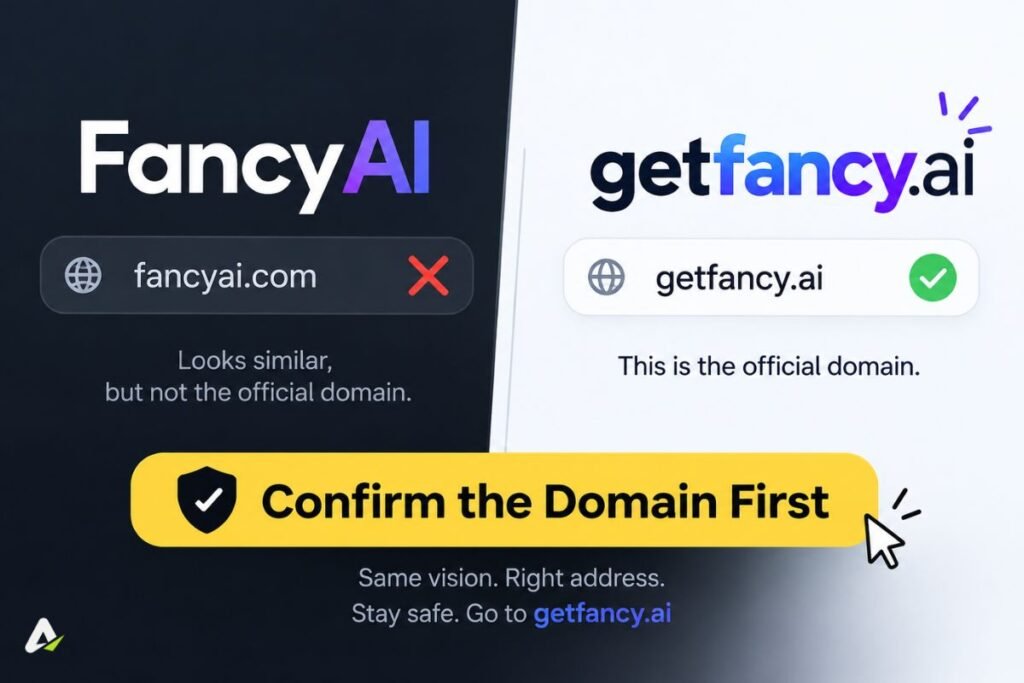
Two unrelated businesses trade under the FancyAI name.
fancyai.com is the creative product reviewed here — image and video generation, product visuals, virtual try-on, creative experts, a desktop app, an open API. A July 2026 teardown by SaaS CRM Review identifies the operator as Time Emergence Information Technology (Nanjing) Co., Ltd. G2 lists the seller as Fancytech, headquartered in China, pointing at the same site.
getfancy.ai is a separate generative-engine-optimization business. Different product, different buyer, irrelevant pricing.
A third “Fancy AI” logo-and-avatar mobile app comes from an unrelated developer. Check the domain before comparing a single figure.
The FancyAI Agent Stack: Five Layers, One Threshold

FancyAI agents architecture runs five layers, and only the last two separate an AI employee from an AI assistant.
| Layer | What it is | Replaceable? |
|---|---|---|
| Model | Generation and reasoning engines (Seedance, Kling) | Entirely — licensable anywhere |
| Skill | Repeatable capability for a recurring job | Moderately |
| Expert | Role, persona, domain context | Trivially — an interface pattern |
| Integration | Access to external systems | Hard — needs partnerships and upkeep |
| Action | Ability to change something outside FancyAI | Hard — needs permissions and controls |
Here is the argument the rest of this review tests. An AI employee becomes materially different from an AI assistant only when the final two layers are real, permissioned, and controllable. Everything above them is available from a dozen vendors.
Buyers under-inspect the skill layer badly. A skill is a reusable instruction set defining how a worker handles a recurring job —understanding how agent skills work explains why a thin library makes capable software feel hollow by month three.
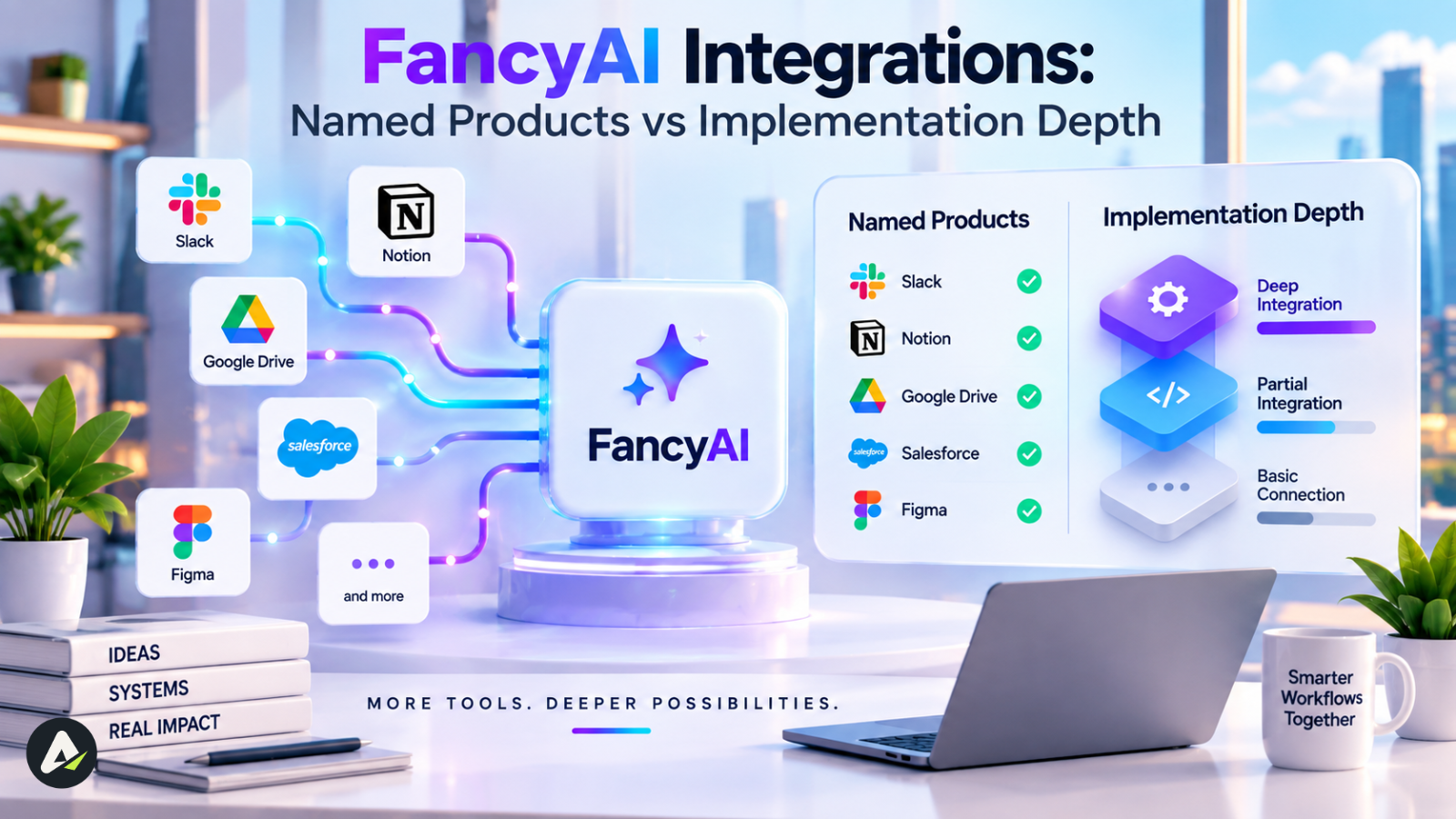
FancyAI Integrations: Named Products vs Implementation Depth
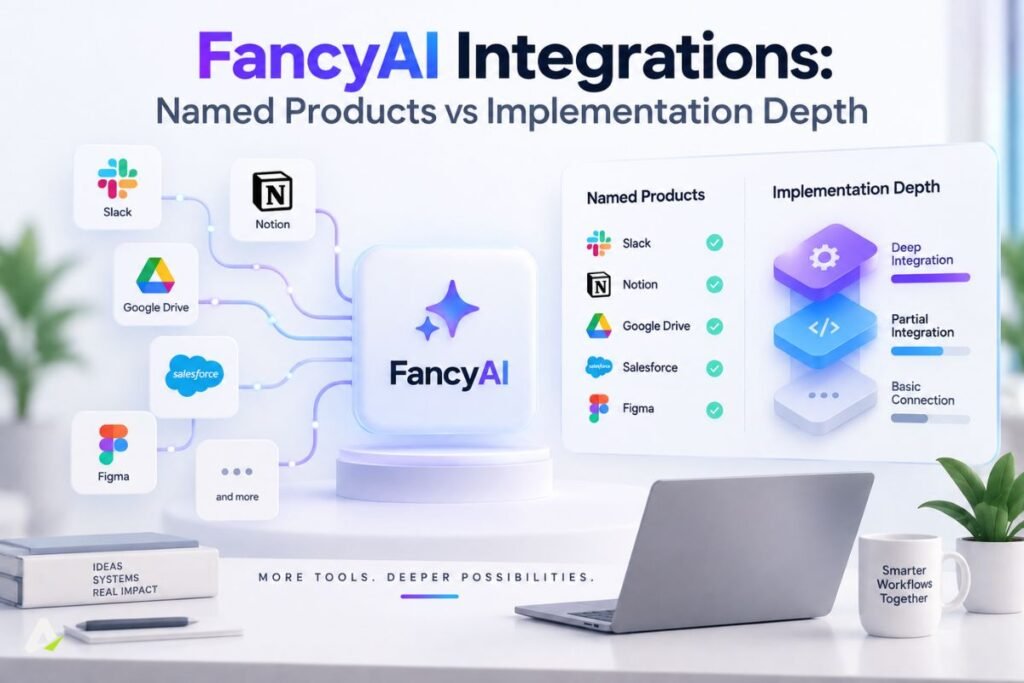
FancyAI’s integration list is vendor-documented. Its implementation depth is not. Those are different statements, and the second one is the one that affects your timeline.
Named products: Salesforce, HubSpot, Meta Ads, TikTok Ads, Instagram, Slack, Gmail, Google Drive, Notion, Canva.
Categories, not products: “ERP systems” and “DAM library.”
Projects stall on the second group. Which ERP? SAP, NetSuite, Odoo, and a homegrown Oracle instance are four separate engineering problems sharing three letters.
SaaS CRM Review found no public implementation documentation for individual connections, leaving native, beta, and roadmap indistinguishable from outside.
The accurate framing: these integrations are vendor-documented, but their production readiness is not publicly evidenced. A logo wall states intent until someone shows your data moving through it.
FancyAI Pricing in 2026: What Changed and What You Still Can’t Calculate
As of September 2026, FancyAI’s public pricing page sells pay-as-you-go API credits, not subscriptions.
| Option | Detail |
|---|---|
| Credit packs | $10, $25, $50, $100, or a custom amount |
| Payment | Stripe checkout |
| Coverage | Access to all models on the FancyAI gateway |
| Commitment | None required |
| Expiry | Balance never expires |
| Management | API keys and usage tracking in-account |
This is a change. Third-party research verified subscription tiers at $34.90 monthly, $88.90 quarterly, and $349.90 annually in July 2026. Those tiers no longer appear on the public pricing page.
One detail suggests a model still in transition: the pricing page’s own meta description continues to advertise monthly, quarterly, and annual subscriptions while the visible page sells credits. The help centre also still describes a consumer Fcoin system, a free three-coin allowance, and a $0.99 introductory week. Whether the consumer tier coexists with API credits or is simply stale documentation cannot be determined from outside.
Check the live checkout before you budget anything.
What remains uncalculable either way: FancyAI does not publish how many credits each tool or model consumes. Video is where that hurts, because frame count and resolution drive burn rate. SaaS CRM Review found that hitting zero balance throws an insufficient-funds error — jobs stop mid-run rather than queueing.
Enterprise arrangements — forward-deployed engineering, post-trained models, custom training data — are sales-led with no public price.
FancyAI Output Quality and the Competitor Evidence Gap
No independent quality benchmark for FancyAI exists in public, and its closest competitors have made that gap wider by publishing their own unit economics.
The G2 product page for FancyAI carries zero ratings and no discussions. I found no reliable third-party user-rating profile during this review. SaaS CRM Review states openly that its evaluation involved no paid login, no API test, and no output benchmark.
Vendor-supplied figures are all that exist: roughly 90% lower shoot costs, 10x faster listing, 35% higher click-through, with logos including ASICS, Mizuno, Starbucks, Toshiba, Kimberly-Clark, Nivea, Ajmal, and UGG. Unaudited; engagement scope unstated.
Now compare that to how rivals present the same information.
FASHN documents credit cost per endpoint: Virtual Try-On v1.6 costs one credit per successful output, higher-resolution endpoints consume more, Face Reference adds three credits per image, and failed predictions consume nothing. Tier discounts are published to four decimal places. Photoroom publishes credit allowances per plan and offers a Visual QA pass that rates outputs and retries failures on qualifying enterprise work.
The observation worth carrying away: FancyAI isn’t only competing on output quality. It’s competing on how much cost and quality risk a buyer can quantify before deployment — and on that measure it currently trails specialists who publish per-operation costs and QA policies.
Five tests to run yourself before committing:
- Product accuracy. Generate your hardest SKU — patterned fabric, reflective surface, transparent packaging — and hold it against the physical item.
- Colour fidelity. Push a brand colour through five generations and measure drift. Textile colour is a known weakness across generative imaging.
- Consistency at volume. Produce twenty variants of one asset. Count how many ship unedited.
- Brand adherence. Feed your guidelines and check whether outputs obey or merely gesture.
- Edit recovery. When output lands 90% right, find out whether you fix it in-tool or regenerate. Regeneration costs credits. Editing usually doesn’t.
FancyAI Alternatives: Named Products Compared
FancyAI occupies a narrower use case than general AI assistants, but a broader one than single-purpose creative tools.
| Alternative | Choose it when you need | Main trade-off |
|---|---|---|
| Photoroom | Product imagery, batch export, marketplace publishing | Less oriented to autonomous enterprise workflows |
| FASHN | Fashion try-on with published per-endpoint costs | Narrower scope; you build the surrounding workflow |
| Claid | Product enhancement alongside model generation | Less agentic; more image-operations API |
| Runway | Generative video | Little commerce workflow integration |
| Build in-house | Full control and data sovereignty | Engineering burden, permanently |
Pricing anchors for context: Photoroom’s Pro tier starts around $7.99 monthly with 8,000 AI credits and 1,000 exports; FASHN sells on-demand API credits from $7.50 with per-endpoint costs published; Claid’s self-serve API starts around $59 for 1,000 credits.
Building in-house suits engineering-led companies, and open frameworks have matured. The choice is consequential, though — orchestration is the hardest layer to swap later, so think carefully about picking an agent framework before writing code. The trade is sovereignty for maintenance.
For cross-app business automation without the engineering commitment, Lindy’s automation approach covers broad task orchestration but won’t produce a lookbook.
Worth noting how differently the coding end of this market has developed. Public benchmarking around autonomous coding agents is routine and comparative. Creative agent software faces nothing like that scrutiny yet.
Should You Use FancyAI Agents? A Buyer Fit Checklist
No score, no threshold — just the conditions that make a pilot defensible. The more you can check, the stronger the case.
- ☐ Connected data. Products, customers, and assets already live in systems FancyAI names
- ☐ High recurring volume. Creative output is repetitive, not bespoke
- ☐ Established brand rules. Visual standards exist in writing, not in someone’s head
- ☐ Accountable owner. One named person answers for output quality
- ☐ Repeatable format. Most output is the same asset type at scale
- ☐ Security tolerance. Your IT policy permits a desktop app with local file access
- ☐ Budget flexibility. You can absorb unpredictable credit burn during a trial
Check two boxes and a general AI tool will serve you better. Check six and a pilot is worth running.
One mistake to avoid above all: pilot your highest-volume asset type, not your most interesting one. The entire value case rests on repetition. Test the dull thing you make two hundred times a month.
The Verdict on FancyAI Agents
Buy or pilot if you run high-volume commerce creative, your data already sits in connected systems, and throughput — not artistic direction — is your bottleneck.
Walk away if your work is bespoke, your assets are scattered, or your security team blocks unaudited desktop applications with filesystem access.
Three things to carry out:
- Re-check pricing at checkout. The public model shifted between July and September 2026, and the page’s own metadata disagrees with the page.
- The autonomy claims are entirely vendor-supplied. No one has independently tested what these workers can execute unsupervised. Make approval gates and rollback contractual, not assumed.
- Competitors publish what FancyAI doesn’t. Per-endpoint credit costs and QA policies are available elsewhere. Demand equivalents before committing.
Pricing, rosters, and integrations change frequently. Verify current details directly before purchasing.
FAQs
Q. How much do FancyAI agents cost in 2026?
The public pricing page now sells pay-as-you-go API credits in $10, $25, $50, and $100 packs or a custom amount, with no subscription required and a balance that never expires. Subscription tiers verified in July 2026 no longer appear there. Credit consumption per tool remains unpublished.
Q. Can FancyAI agents publish without human approval?
FancyAI documents workflows that publish to social channels and ad accounts from the desktop app. It does not publicly document whether a mandatory approval gate can be enforced, or whether actions can be reversed. Confirm both in writing before connecting a live ad account.
Q. Is FancyAI the same as getfancy.ai?
No. fancyai.com sells creative AI software. getfancy.ai is an unrelated generative-engine-optimization business.
Q. What happens when your FancyAI credits run out?
Jobs halt with an insufficient-balance error rather than queueing, so a mid-campaign burnout stops production until you top up.
Q. Is FancyAI SOC 2 or ISO 27001 certified?
I found no public documentation for either during this review. Request certification status and a trust centre link directly from the vendor.
Q. Which FancyAI alternative publishes clearer pricing?
FASHN documents credit cost per endpoint and per generation mode, and does not charge for failed predictions. Photoroom publishes credit allowances per plan tier.
Q. Can FancyAI replace a product photographer?
For flat-lay work, background swaps, and on-model variants of simple products, plausibly. For textured fabrics, reflective surfaces, and anything where exact colour is contractual, budget for physical sampling and human review.
Q. Are there independent FancyAI reviews?
Very few. Its G2 listing carries zero ratings and no discussions, and the most detailed third-party write-up was built from official documentation rather than hands-on testing.
| Disclaimer: This review is based on public sources and vendor documentation. FancyAI’s performance, integrations, and agent capabilities were not independently benchmarked and may change over time. Verify current pricing and features before using it. |

Maliha
AI is moving steadily from experimental technology into the products and workflows people rely on every day. Maliha Irfan is a technology writer covering artificial intelligence, automation, and emerging software. Her work focuses on the practical side of AI agents, exploring how these systems are being used, what they can realistically accomplish, and the limitations that matter when businesses and individuals adopt them.
More from Maliha →