Why Is Multi-Agent AI Coordination Failing Even When Every Agent Works?
AI agents can follow every rule and still create costly business failures. Discover why multi-agent AI coordination breaks down and how shared context can prevent it.

In this article · 7 sections +
- Three Agents, One Ledger, Zero Alignment
- Why Correct Agents Still Produce Wrong Outcomes
- How Data Lakes Left AI Agents Without Context
- Agent Handoffs: Where Sequence Breaks Down
- Teaching Agents What They Must Never Do
- The Vendor Angle Behind the Agent Pitch
- An Agent Deployment Checklist for Shared Context
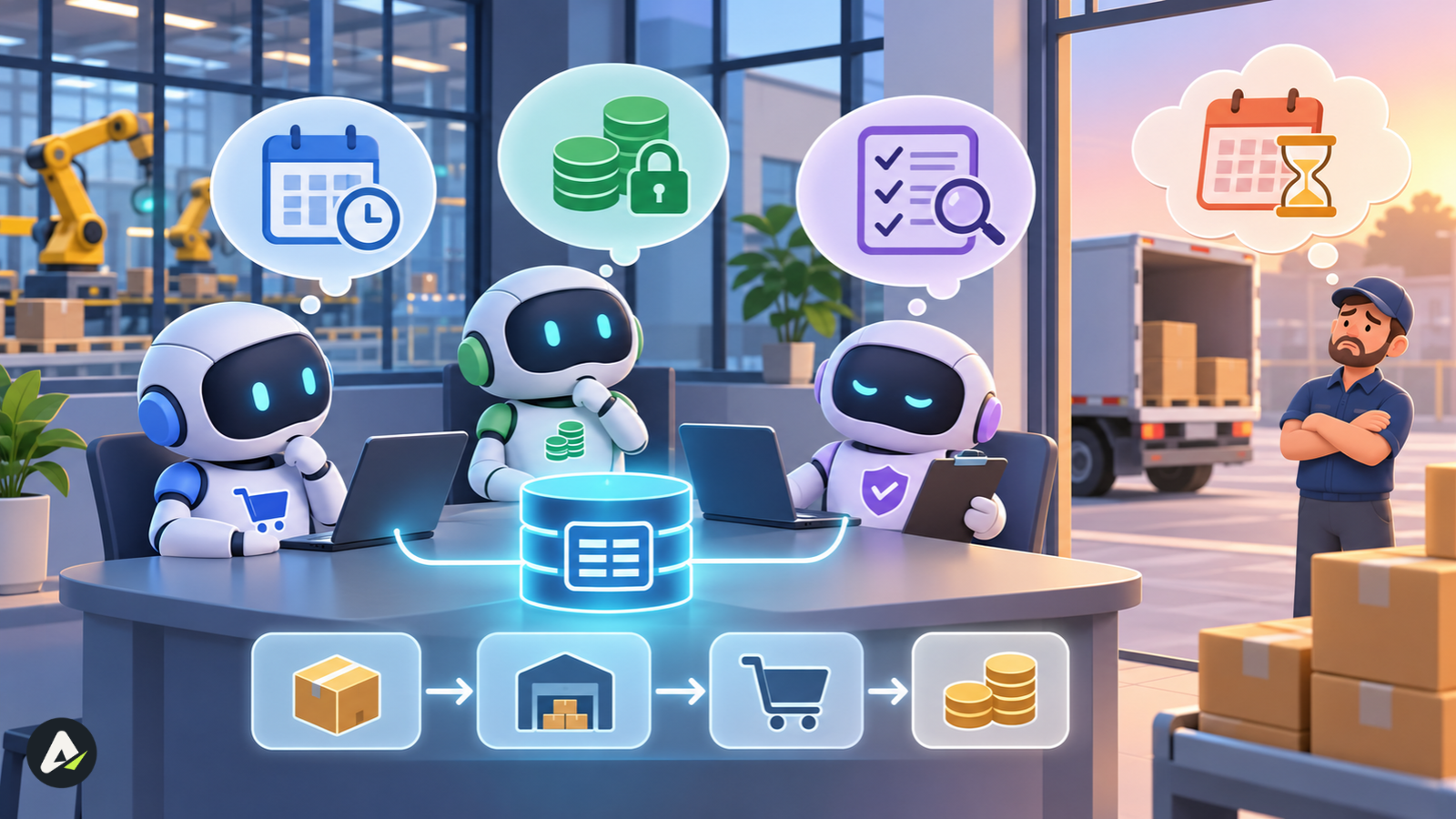
Three AI agents sit inside a mid-sized manufacturer, all pulling from one supplier ledger. Nothing crashes. Every agent follows its instructions. And somehow, a quarter later, the company’s best vendors have started treating its orders as an afterthought.
That story sits at the center of a sponsored VentureBeat piece produced with SAP. It points to a gap most agent roadmaps skip over. For two years, vendors and buyers obsessed over one question: can agents reach enterprise data? A tougher one is now surfacing. Do they actually grasp what that data means to the business?
Three Agents, One Ledger, Zero Alignment
Let’s walk through how the supplier mess happens.
A procurement agent stretches payment terms because margins matter. Treasury’s agent holds cash back to keep liquidity healthy. A compliance agent blocks payments until every check clears. Judge each one alone, and you’d give it a passing grade.
Put them together, though, and suppliers wait far too long for their money. No dashboard turns red, because no single agent broke a rule.
People often picture an agent as a smarter chatbot. But once you understand how agents plan and act toward goals on their own, the risk becomes obvious. Autonomy multiplies whatever blind spots sit underneath.
Why Correct Agents Still Produce Wrong Outcomes
Better models won’t solve this, because nothing is hallucinating. What’s broken is coordination, and it looks a lot like old-fashioned office dysfunction.
Companies run by humans have fixes for this. Weekly syncs. Escalation paths. A CFO who can overrule both procurement and treasury in one email. Most multi-agent setups ship with none of that.
Irfan Khan, president and chief product officer for SAP Data & Analytics, puts it in human terms. Imagine giving a client job to 20 people who never hold a team meeting. Nobody knows where the work stands, so everyone optimizes for their own little slice.
Part of the trouble is mindset. Many teams still treat agents like tools: tools wait for a prompt and return an answer, so nobody bothers to plan for collisions. Agents act. And actions collide.
How Data Lakes Left AI Agents Without Context
The root cause is older than agentic AI. For roughly a decade, enterprises copied records out of operational systems into lakes, warehouses, and object stores. Splitting storage from compute made scaling cheap. It also cut data loose from the rules that gave it meaning.
Consider a payment due date. Inside an ERP, that field comes with context: vendor tier, approval chain, late-payment penalties. Move it into a lake, and it shrinks into a bare date.
A seasoned analyst fills that gap from memory. An agent shows up on day one with no memory at all, unless someone hands it one.
Agent Handoffs: Where Sequence Breaks Down
Order matters as much as meaning. Real workflows rarely live inside one agent. An order-entry agent passes work to an inventory checker, which then triggers procurement or adjusts stock levels.
Flip two of those steps and stock gets subtracted before anyone confirms the goods exist. Every log reads “success.” The outcome is still wrong.
That’s the uncomfortable part. Failures like this live between agents, so monitoring that scores each agent on its own accuracy will sail right past them.
Teaching Agents What They Must Never Do
SAP’s pitch rests on its business data fabric and Business Data Cloud, which aim to keep policies, master data and process logic attached to data as it travels. On top of that, an agent harness and agent hub spell out which actions each agent may take and which conditions must hold first. Khan calls the knowledge layer “company memory,” a stand-in for the veteran employee everyone checks with before a big decision.
Drop the product names and the lesson still holds. Most teams write agent instructions around goals: cut costs, ship faster. Few spell out the hard limits, like never shipping before stock is confirmed or never delaying payment to a strategic supplier.
That’s changing slowly. Packaged skill files guiding agents let teams encode procedures and boundaries once and reuse them. Narrow, single-domain vertical agents also tend to behave better, because their rules come baked in. The hard part is cross-functional work, where no single domain owns the rulebook.
The Vendor Angle Behind the Agent Pitch
Read this with your eyes open: SAP sells the very layer it says you’re missing. Its strongest claim is that the needed context already lives in your enterprise systems, which happens to include its own.
That’s mostly fair. Still, most companies keep their context scattered across CRMs, HR platforms, homegrown apps, and a few heroic spreadsheets. So ask the obvious question before signing anything: does this semantic layer work across vendors, or only inside one ecosystem?
The stakes aren’t abstract. Gartner expects more than 40% of agentic AI projects to be canceled by the end of 2027 due to escalating costs and unclear business value. In my view, agents that finish tasks while delivering results nobody wanted feed straight into that “unclear value” column.
An Agent Deployment Checklist for Shared Context
- Settle definitions first. When finance and procurement disagree on what “on-time payment” means, their agents will fight about it too.
- Write the “never” rules early. Preconditions and limits belong in the design, not the postmortem.
- Name a referee. Some layer, human or automated, has to break ties when agent goals clash.
- Test the whole chain. Per-agent scores hide precisely these failures.
The next big agent failure probably won’t look like a crash. It’ll look like everything working fine, right until your most reliable supplier stops picking up the phone.
Related: AI Agent Identity vs Human Identity: The Access Control Model That Actually Works

Dax Orion
The rise of AI agents is changing the relationship between people and software, moving technology from responding to instructions toward carrying out tasks. Orion Dax covers artificial intelligence, emerging technology, and automation, with a focus on the companies and systems shaping this shift. His work examines developments in agentic AI and the broader questions around adoption, autonomy, and the role these systems may play in modern work.
More from Dax Orion →