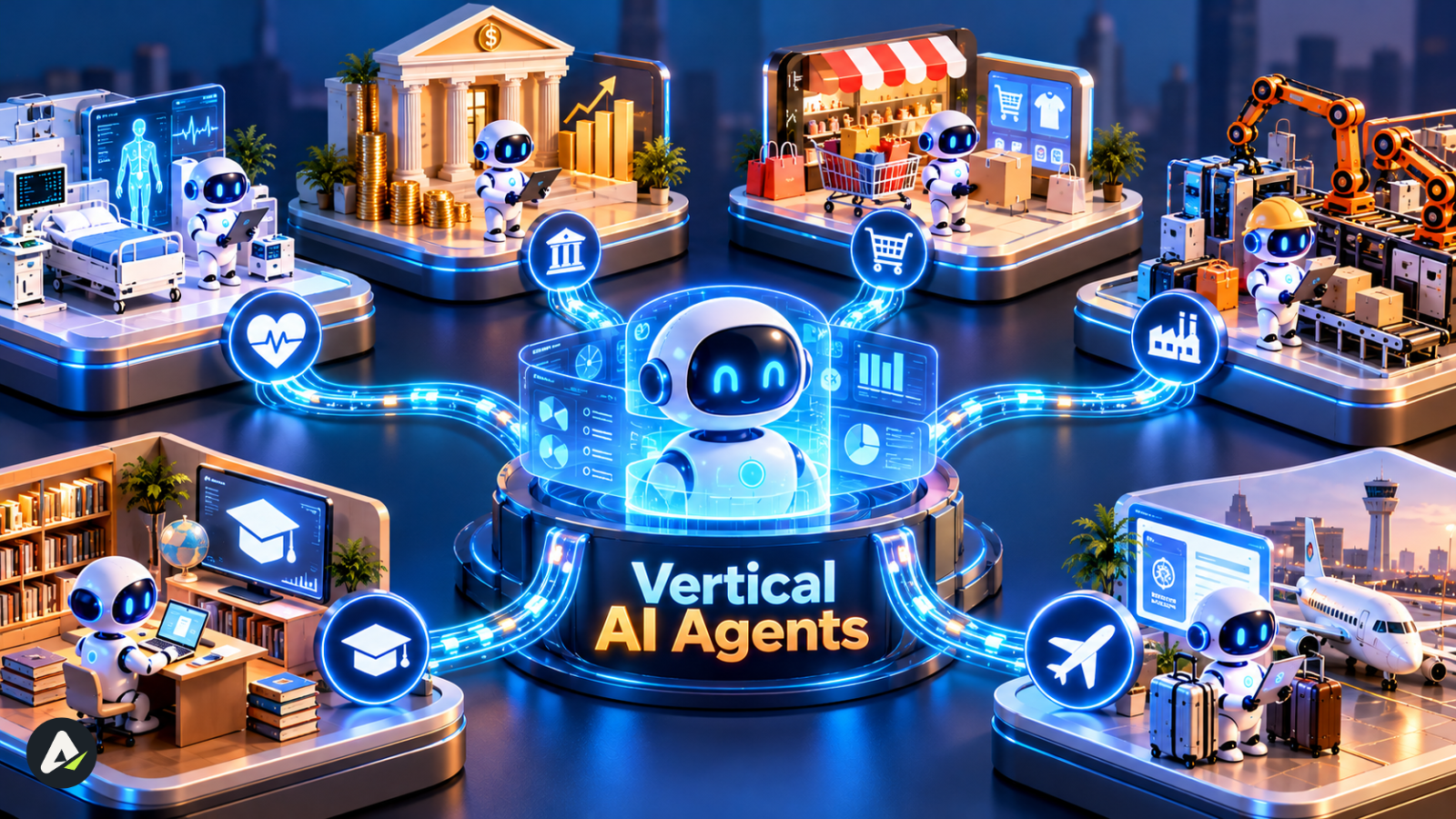
Vertical AI Agents: Examples, Uses & How They Work
Discover how vertical AI agents work in 2026, explore real-world examples across healthcare, law, finance, and more, compare costs, and learn how to choose the right industry-specific AI solution.

In this article · 19 sections +
- What Are Vertical AI Agents?
- Vertical AI Agents vs. Horizontal AI vs. RPA
- How Vertical AI Agents Work
- Design patterns behind agentic execution
- Why MCP matters for industry connectors
- Vertical AI Agent Examples by Industry
- The Vertical AI Market in 2026
- The “80% of enterprises” myth
- Vertical AI Agents vs. Vertical SaaS
- What Makes an Industry-Specific Agent Defensible?
- From one agent to compound vertical AI
- How Much Does a Vertical Agent Cost?
- The 5-Point Vertical Fit Test
- How to Build a Vertical AI Agent
- How to Evaluate a Vertical AI Vendor
- Why Agent Projects Stall in Pilot
- What’s Next for Industry-Specific Agents
- Conclusion
- Frequently Asked Questions
Most software sold as an “AI agent” today isn’t one. In a late-2025 Menlo Ventures survey, only 16% of enterprise AI deployments actually planned, acted, and adjusted on their own. The rest were fixed scripts wrapped around a language model.
That gap matters most for vertical AI agents: systems built to carry out a defined job inside one industry, using its regulations, records, and software. Buyers in healthcare, law and finance are paying real money for them. Some tools deliver. Plenty are copilots with new labels.
Here’s the uncomfortable part: the label on the box tells you almost nothing. You have to check what the software actually does on its own. This guide shows you how, covering:
- A precise definition and how industry-specific agents compare with horizontal AI and RPA
- The architecture, design patterns, and 2026 tech stack behind production systems
- Real examples, with each tool’s true level of autonomy
- Verified market data, with measured results kept apart from forecasts
- A cost formula, a screening framework and a vendor checklist
- Why many projects stall before production
What Are Vertical AI Agents?
Vertical AI agents are AI systems adapted to one industry’s data, regulations, and software so they can complete a defined stage of work, such as preparing a prior-authorization request, while a qualified person signs off on key decisions.
“Adapted” doesn’t always mean a custom-trained model. Many teams pair a general model with approved documents, coded business logic, and deep connections to platforms like EHRs or case management tools.
All AI agents run the same basic loop: perceive, decide, act, check. Unlike ordinary software, they choose their next step instead of following a fixed path. A vertical agent runs that loop with a sector’s expertise built in.
Chatbot, copilot or agent?
- Chatbot: answers questions. You do the work.
- Copilot: produces drafts you accept or edit.
- Agent: takes a goal, plans, uses tools, and acts inside your software.
What separates them is who drives the next action. Many products sit somewhere in between, which is why the difference between AI tools and AI agents is worth settling before you compare vendors.
Vertical vs. departmental AI
Analysts also separate two kinds of specialized AI:
- Vertical AI serves an industry, such as healthcare or law.
- Departmental AI serves a job function in any industry, such as sales or coding.
A claims agent built for insurers is vertical. A prospecting tool sold to any company is departmental.
Vertical AI Agents vs. Horizontal AI vs. RPA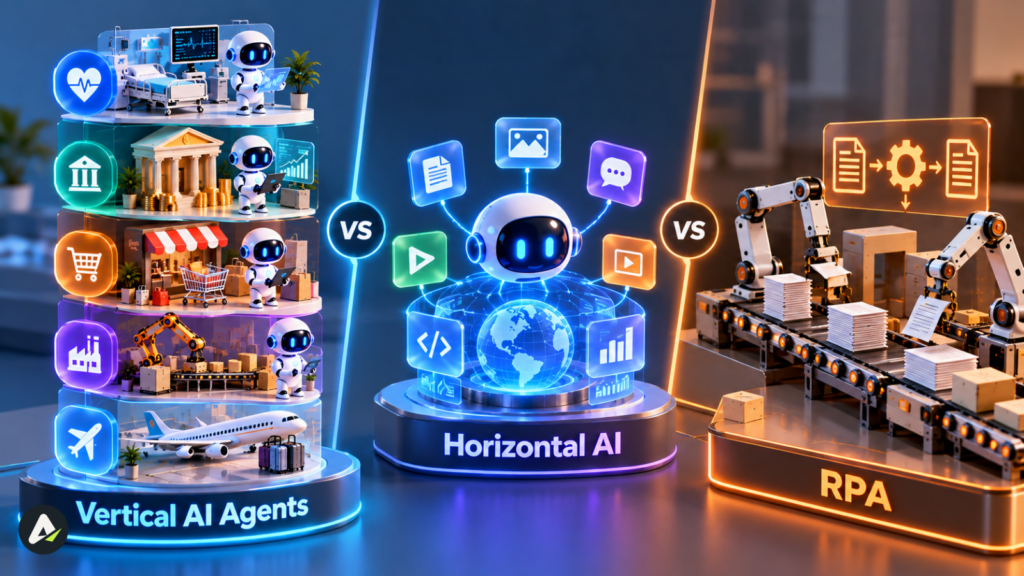
Horizontal AI covers broad tasks for any business. Industry-specific agents go deep on one sector. RPA (robotic process automation) follows fixed scripts with no judgment.
| Situation | Best fit | Why |
|---|---|---|
| Writing, research, and summaries across teams | Horizontal AI (ChatGPT Enterprise, Microsoft Copilot) | Flexible, fast to roll out |
| Stable, repetitive steps with clean data | RPA or standard automation | Cheap and predictable |
| High-volume, regulated work with messy documents and frequent exceptions | Vertical agent | Handles variation within sector constraints |
| Rare, high-consequence decisions | Human-led, AI-assisted | Mistakes cost too much to delegate |
| Mixed processes | Combination | RPA moves data, an agent handles exceptions, a person decides |
General-purpose agents keep getting stronger. Tools compared in OpenHands vs Devin vs Manus can take on wide-ranging coding and research jobs. They still depend on you to supply the domain context a vertical product carries by default.
That missing context has real costs. A 2024 Stanford RegLab study tested GPT-3.5, PaLM 2, and Llama 2 on specific federal court questions. The models hallucinated 69% to 88% of the time. The study shows the danger of raw general models on niche facts. It doesn’t prove every specialized product performs better.
How Vertical AI Agents Work
A production-grade vertical agent combines four layers (evaluation data, orchestration, integrations, and controls) with a handful of agentic design patterns.
The four layers
- Ground-truth data: a fixed set of real inputs paired with expert-approved outputs, rerun on every release to catch regressions. A few hundred well-scored cases is a common starting point; riskier, more varied work needs more.
- Orchestration: the logic that breaks a long job into steps, checks each result and saves progress outside the model. A case waiting three days for a signature picks up where it stopped. Choosing among agentic AI frameworks shapes how this layer handles state, retries and branching.
- Integrations: read and write access to the platforms that hold the official record, such as EHRs, claims systems, or loan origination software.
- Deterministic controls: spending limits, approval gates and audit logs written in code, not prompts, so the model can’t reason its way around them.
Here’s how a single case moves through those layers:
New case arrives (claim, referral, ticket)
   ↓
Orchestration: plan the steps, save progress
   ↓
Connectors: pull records from the core platform
   ↓
Model + retrieval: draft, then check against sources
   ↓
Controls: limits, approval gates, audit log
   ↓
Finished output, or escalation to a person

(The evaluation set retests this whole path on every release.)
Design patterns behind agentic execution
Most production systems combine four patterns:
- Tool use: calling APIs, databases, or search to get facts instead of guessing.
- Planning: splitting a goal into ordered subtasks before acting.
- Reflection: checking a draft against source documents and revising it.
- Multi-agent checks: one agent extracts data while a second verifies it before anything is submitted.
Sector know-how is often packaged as reusable procedures. Many teams store step-by-step playbooks as agent skills defined in SKILL.md files. These cover jobs like coding a claim or filing a motion, though a badly scoped skill can introduce its own risks.
A skill is usually a short instruction file. Here’s an illustrative example for a healthcare billing agent:
markdown
---
name: prior-auth-packet
description: Assemble a prior-authorization packet for a medication request. Use when a new PA task arrives from the EHR queue.
---
# Prior-authorization packet
1. Pull the order, diagnosis codes and recent notes from the EHR.
2. Open the payer's criteria document for this drug.
3. Match each criterion to supporting evidence in the chart.
4. If any criterion lacks evidence, stop and route the case to a nurse reviewer.
5. Draft the request. Never submit without staff approval.
Step 4 is the important part. The skill tells the agent when to stop, not just what to do.
Why MCP matters for industry connectors
The Model Context Protocol (MCP) is an open standard, introduced by Anthropic in late 2024, that lets any compatible agent reach a system through one shared interface.
Before MCP, every pairing of agent and platform needed its own custom connector. With MCP, a single server can expose the data and actions of an EHR, a document repository or a policy database to any compatible agent. Teams build one reusable connector per platform instead of many one-off integrations.
MCP doesn’t remove the hard parts. Someone still maps each customer’s fields, sets permissions and decides which actions need a human.
Connected agents also bring a security risk that ordinary software doesn’t: indirect prompt injection. An attacker hides instructions inside content the agent processes. It might be a line in a supplier invoice, a CRM note or a patient-portal message telling the agent to change payment details or forward files. The agent reads that text as part of its job, so defenses can’t rely on the model alone. Strong designs:
- Flag instruction-like text in incoming documents
- Give each connector the narrowest permissions possible
- Route payments and record sharing to a person
The 2026 vertical agent stack
| Layer | Role | Common options |
|---|---|---|
| Reasoning model | Plans and generates | Frontier APIs (Anthropic, OpenAI, Google) or open-weight models (Llama, Qwen) |
| Serving | Runs models efficiently | Managed APIs, vLLM, inference platforms |
| Retrieval | Finds approved knowledge | Vector stores such as Pinecone or pgvector |
| Orchestration and state | Manages long-running jobs | Agent frameworks, durable workflow engines like Temporal |
| Connectors | Reaches core platforms | MCP servers, vendor APIs |
| Evaluation and monitoring | Tracks quality and drift | Tools such as Braintrust or LangSmith |
Vertical AI Agent Examples by Industry
The clearest examples own one job with a countable output, such as a clinical note, a demand letter, or a booked appointment. The autonomy column shows how much each tool decides by itself.
| Industry | Example | What it handles | Autonomy level | Best fit for |
|---|---|---|---|---|
| Legal | Harvey | Contract review, research, drafting | Runs multi-step research; lawyer has final say | Large firms and in-house legal teams |
| Personal injury law | EvenUp | Demand letters, medical chronologies | Builds the package; attorney reviews | PI firms with high case volume |
| Healthcare | Abridge, Ambience | Ambient visit documentation | Drafts notes a clinician finalizes (copilot-style) | Health systems facing documentation backlogs |
| Healthcare (incumbent) | Epic: Art, Penny, Emmie | Clinician support, revenue cycle, patient messaging | Mostly prepares work for staff; Emmie can book visits | Organizations already on Epic |
| Customer support | Sierra, Decagon | Resolving inquiries across chat, email, and voice | Acts independently within set policies | Consumer brands with large ticket volume |
| Field services | Avoca | Answering calls, quoting, booking trade jobs | Schedules jobs unaided | Plumbing, HVAC and roofing businesses |
| Accounting | Rillet, Numeric | Month-end close and AI-first ERP | Automates close steps; accountants verify | Finance teams at growing companies |
The pattern is telling. In regulated fields, most tools prepare work and a professional decides. Full independence shows up where errors are easy to spot and reverse, as in scheduling or routine support.
Most enterprise vendors in this category quote prices privately after a scoping call. The cost section below gives you a way to compare those quotes.
Emerging verticals
Domain-tuned agents are also spreading into:
- Lending: collecting borrower documents, pulling data, and pre-screening applications before an underwriter decides. The mechanics are laid out in how lending automation agents work.
- Logistics: freight quoting, carrier emails, and shipment-exception follow-up.
- Insurance: first-notice-of-loss intake and underwriting submission triage.
- Real estate: lease abstraction and tenant inquiries.
Few clear leaders exist in these sectors yet.
Documented deployment results
Measured outcomes are rarer than marketing claims. Epic shared these at HIMSS26 (Fierce Healthcare):
- At Summit Health, Penny cut medication prior-authorization submission time by 42%.
- 92% of Penny’s AI-generated responses went out without edits.
- Separately, Epic said Emmie saved Ochsner Health about 750 staff hours.
All three figures are vendor-reported, so use them as benchmarks rather than guarantees.
The Vertical AI Market in 2026
Industry-specific AI spending nearly tripled in 2025, and analysts expect agents to spread quickly through enterprise software.
Measured (2025), from Menlo Ventures’ survey of 495 U.S. enterprise decision-makers:
- Vertical AI spending reached $3.5 billion, up from $1.2 billion in 2024.
- Healthcare made up about $1.5 billion (43%), legal about $650 million, and ambient scribes alone about $600 million.
- 47% of AI deals reached production, compared with 25% for traditional software.
Forecast:
- Gartner expects 40% of enterprise applications to include task-specific agents by the end of 2026, up from under 5% in 2025.
Reported company figures (unaudited):
- Harvey announced a $550 million raise at about a $15.5 billion valuation in September 2026.
- Bloomberg reported its annual recurring revenue above $400 million. Private-company numbers like these can shift fast.
The “80% of enterprises” myth
A widely shared claim says Gartner predicted 80% of enterprises would adopt vertical AI agents by 2026. I couldn’t trace it to any Gartner publication. The published forecast is the 40%-of-applications figure, which measures something different.
Vertical AI Agents vs. Vertical SaaS
Vertical SaaS gives an industry better software that employees run. A vertical agent runs that software for a specific job.
| Vertical SaaS | Vertical agent | |
|---|---|---|
| Who does the work | Staff | Agent, with human checkpoints |
| Pricing models | Per seat | Seat, usage, per-outcome or hybrid |
| Who carries error risk | Mostly the user | Shared, depending on contract and controls |
| Budget it draws from | Software | Software plus labor |
Pure per-outcome pricing, such as a fee per resolved ticket, is still uncommon. Buyers want predictable bills, and both sides argue over what “resolved” means. Many vendors therefore use a hybrid: a platform or seat fee as a floor, plus usage or outcome charges on top.
Incumbents aren’t standing still. Epic says more than 85% of its customers use its AI features. It has also previewed Agent Factory, which lets health systems build their own agents inside Epic. Before adding a standalone tool, check whether your current platform already covers the job well enough.
What Makes an Industry-Specific Agent Defensible?
Lasting advantage usually comes from permissioned data, integration depth, and compliance work, not from the model itself.
- Data flywheel: each expert correction becomes new evaluation material, so the agent improves on edge cases newcomers haven’t seen. This only works when contracts let the vendor learn from customer records.
- Integration depth: connectors, permission mappings and exception handling take a long time for a rival to rebuild.
- Compliance posture: business associate agreements, security reviews, and audit trails are work many generalist vendors avoid. Industry focus doesn’t make a product compliant on its own, though. Configuration and day-to-day operation decide that.
- Model strategy: most vendors build on frontier models, and a few leaders add their own. Harvey, for example, released Tenet, a fine-tuned legal model. Fine-tuning can cut costs on narrow jobs but adds upkeep, and Menlo found it’s still uncommon in enterprise deployments.
From one agent to compound vertical AI
Vendors that win one job rarely stop there. Once their connectors, permissions, and evaluation data are in place, adding a neighboring agent costs far less than the first one did. The result is compound vertical AI: several specialized agents passing work along one process.
Epic shows the pattern. Its clinician agent Art and patient agent Emmie now build shared visit agendas, combining what the patient asked with what the clinician needs. An intake agent hands off to a documentation agent, which feeds a billing agent.
For buyers, compound products mean fewer vendors to manage. They also mean deeper lock-in, so check how easily you could swap out a single piece.
How Much Does a Vertical Agent Cost?
Cost per accepted outcome is total operating cost divided by outputs that pass review without rework. It’s the fairest way to compare an agent with human staff.
Cost per accepted outcome = Total operating cost ÷ Accepted outputs
Include vendor fees, model usage, integration upkeep, and reviewer time in the total. Agree on what “accepted” means before you start counting.
Illustrative example (hypothetical):
| Item | Monthly |
|---|---|
| Vendor fees | $25,000 |
| Model usage | $5,000 |
| Reviewer time | $10,000 |
| Total | $40,000 |
| Claims processed | 10,000 |
| Accepted without rework | 8,000 |
| Cost per accepted claim | $5.00 |
If a staff member costs $12 per claim, the agent comes out ahead. If only half the outputs pass, the figure climbs to $8, and the advantage shrinks quickly. That’s why acceptance rate matters as much as price.
Watch margins, not just price. A single agent run can trigger dozens of model calls, and heavy users consume far more than light ones. Per-call inference prices keep falling, but total spend often rises because usage grows faster.
Vendors protect margins by:
- Sending simple steps to small, cheap models and saving frontier models for hard ones
- Caching repeated context
- Capping retries
When you evaluate a vendor, ask how its pricing holds up if your volume triples. A vendor losing money on every heavy customer may change its terms later.
The 5-Point Vertical Fit Test
This is an editorial screening heuristic, not a validated ROI model. Rate a candidate job from 1 to 5 on each factor:
- Volume: does it happen hundreds or thousands of times a month?
- Regulation: is it shaped by legal requirements, formats or sector standards?
- Data rights: can you legally use past cases for testing and improvement?
- Countable output: is there a clear finished unit?
- Reversibility: can errors be caught before they cause harm?
How to read the score:
- 20–25: worth a serious pilot.
- 13–19: automate one narrow step first.
- Below 13: use simpler tools.
- A Regulation score of 1–2 suggests a horizontal tool may be enough, whatever the total.
Worked example
| Factor | Password-reset tickets | Prior-authorization requests | Autonomous diagnosis |
|---|---|---|---|
| Volume | 5 | 5 | 4 |
| Regulation | 2 | 5 | 5 |
| Data rights | 4 | 3 | 2 |
| Countable output | 5 | 5 | 3 |
| Reversibility | 5 | 3 | 1 |
| Total | 21 | 21 | 15 |
| Verdict | Horizontal tool suffices | Strong fit, with checkpoints | Keep human-led |
When to skip a vertical agent
- Volume is too low to repay setup costs.
- The process is undocumented or keeps changing.
- Outputs can’t be verified before they take effect.
- Errors are irreversible and serious.
- You lack rights to the data needed for testing.
How to Build a Vertical AI Agent
Treat the build as a series of gates, where each stage meets its exit criterion before the next begins.
| Stage | Deliverable | Exit criterion |
|---|---|---|
| 1. Choose the job | Baseline cost, volume and error rate | A budget owner tracks the cost |
| 2. Secure data | Agreements with 3–5 design partners | Contracts permit testing on real records |
| 3. Solve cold start | First evaluation set | Experts have scored common and edge cases |
| 4. Build evals | Automated test harness | Every release runs the same tests |
| 5. Pilot one step | Agent live on a narrow stage | Cost per accepted outcome beats the baseline |
| 6. Expand | Next adjacent step | The customer trusts step one in production |
On cold start: regulated customers rarely hand over thousands of records on day one. Teams bootstrap with de-identified samples, expert-written examples, and sometimes synthetic data. Synthetic data widens coverage but misses real-world messiness, so validate on genuine cases before launch.
How to Evaluate a Vertical AI Vendor
Judge vendors on measured results in your environment, not polished demos. Before signing, ask for:
- Results on a sample of your own cases
- Acceptance and completion rates from a time-boxed pilot
- What the system does when it’s unsure: escalate, not guess
- Connector reliability with your core platform, including failure handling
- Security specifics:
- Permission scopes
- Data retention
- Whether your data trains shared models
- Prompt-injection defenses
- BAAs where required
- Complete audit logs and rollback for every action
- Projected cost per accepted outcome at your real volume
Why Agent Projects Stall in Pilot
Projects usually stall on integration effort, oversized scope, and unclear ownership, rarely on model quality alone.
- A Cisco survey of its major enterprise customers found 85% running AI agent pilots but only 5% with agents in production, reported by VentureBeat in April 2026. That covers agents of every kind, including coding and chat tools. No comparable public figure exists for vertical agents alone, so read it as a warning about agent projects in general.
- Gartner forecasts that more than 40% of agentic AI projects will be canceled by the end of 2027, citing cost, unclear value, and weak risk controlS.
Mistakes to avoid:
- Ignoring compounding error. Ten independent steps at 90% accuracy each succeed together only about 35% of the time. Real errors can be correlated, and checks between steps help, so treat the number as an illustration.
- Scheduling integration last. Authentication, monitoring, and rollback often take longer than the agent itself.
- Starting too big. Win one stage before claiming the whole process.
- Leaving exceptions ownerless. If nobody is assigned to handle escalated cases, they pile up and trust collapses.
What’s Next for Industry-Specific Agents
Gartner expects specialized agents to become standard inside enterprise apps, then to coordinate with each other. These are forecasts, not certainties. The same Gartner release sketches the path:
- 2026: task-specific agents embedded in many enterprise apps
- 2027: several agents collaborating inside one application
- 2028: agent networks operating across applications
- 2035: agentic AI driving roughly 30% of enterprise application software revenue, above $450 billion
The near-term contest pits platform owners adding agents to existing products against startups going deep in neglected sectors.
Conclusion
Vertical AI agents prove their worth by owning one well-defined stage of industry work inside the software where it already happens. The essentials:
- Judge autonomy, not labels. In regulated fields, many “agents” prepare work rather than finish it.
- Durable value comes from data rights, integrations, and compliance, not the model alone.
- Cost per accepted outcome reveals more than any demo.
- Narrow, well-tested pilots are the ones that reach production.
Next step: score your costliest repetitive job with the 5-Point Vertical Fit Test. If it lands above 20, run a time-boxed pilot with acceptance criteria agreed up front.
Frequently Asked Questions
Q. What is a vertical AI agent in simple terms?
It’s software that does one specialized job for a particular industry. A legal agent drafting demand letters or a healthcare agent preparing insurance paperwork are typical examples.
Q. What is the difference between vertical and horizontal AI agents?
Horizontal agents are generalists that help any business with broad work. Vertical agents are specialists that know one sector’s terminology, regulations, and software, and usually take longer to set up.
Q. Is ChatGPT a vertical AI agent?
No. ChatGPT is a general-purpose assistant. Companies can build specialized agents on similar models by adding industry data, policies, and software connections.
Q. What are the 5 types of AI agents?
The textbook types are simple reflex, model-based reflex, goal-based, utility-based, and learning agents. Most vertical agents blend goal-based planning with learning from expert corrections.
Q. How much does a vertical AI agent cost?
Prices range widely and may be charged per seat, per use, or per outcome. Integration and review time often add as much as the license itself.
Q. Are vertical AI agents automatically HIPAA compliant?
No. HIPAA compliance depends on signed agreements, access controls, data retention, and how the system is operated, not on the product’s industry label.
Q. Will vertical AI agents replace SaaS?
More likely, they’ll reshape it. Agents take over jobs staff once did inside software, and established vendors are building agents into their own platforms.
Related: Best AI Agent Development Services in 2026
| Disclaimer: This article is for informational purposes only and does not constitute professional advice. Company names and products are mentioned for educational and comparison purposes. We are not affiliated with or endorsed by any of the companies discussed. |

Maliha
AI is moving steadily from experimental technology into the products and workflows people rely on every day. Maliha Irfan is a technology writer covering artificial intelligence, automation, and emerging software. Her work focuses on the practical side of AI agents, exploring how these systems are being used, what they can realistically accomplish, and the limitations that matter when businesses and individuals adopt them.
More from Maliha →