OpenAI AgentKit Shutdown 2026: Features & Best Alternatives
OpenAI AgentKit is changing in 2026: Agent Builder and the hosted Evals platform are scheduled to shut down on November 30, while ChatKit remains available. This guide explains what the AgentKit shutdown means, which components still work, the best alternatives for developers and no-code teams,

In this article · 20 sections +
- What Is OpenAI AgentKit?
- Is ChatGPT an agent or an LLM?
- Is OpenAI AgentKit Being Discontinued in 2026?
- Don’t overlook reusable prompts
- Why OpenAI changed course (our analysis)
- Which AgentKit Components Still Work?
- ChatKit: keep the front end, swap the backend
- Connector Registry: governance, not a builder
- AgentKit vs Agents SDK vs Agents API vs Responses API
- What Agents SDK code looks like
- Best AgentKit Alternatives for Different Use Cases
- The four-question shortcut
- Options outside OpenAI
- How to Migrate Before November 30, 2026
- What the export gives you, and what it doesn’t
- Replacing hosted Evals
- Migration checklist
- OpenAI AgentKit vs Coinbase AgentKit vs BytePlus AgentKit
- Conclusion: Your Next Move With AgentKit
- Frequently Asked Questions
One year after launch, the most-hyped part of OpenAI AgentKit has an end date. Agent Builder, the drag-and-drop canvas that made agents feel no-code, shuts down on November 30, 2026, along with OpenAI’s hosted Evals platform. ChatKit and the rest of OpenAI’s agent stack carry on.
That makes OpenAI AgentKit a harder call for new projects than it was a year ago. Your replacement depends on what matters most: code you control, a runtime OpenAI operates, or a no-code workflow your team builds inside ChatGPT.
Start with the official schedule, check which components still run, then pick a successor from the decision matrix. The migration section covers what an export leaves behind and how to save your eval data before it locks.
Watch for a naming trap, too. Coinbase and ByteDance each sell something called AgentKit, and neither has anything to do with OpenAI.
What Is OpenAI AgentKit?
OpenAI AgentKit is a suite of developer building blocks for designing, embedding, and improving AI agents, launched at DevDay on October 6, 2025. It sits on top of OpenAI’s Responses API and Agents SDK rather than replacing them.
At launch, the suite included:
- Agent Builder: a visual canvas for creating and versioning multi-agent workflows
- ChatKit: an embeddable chat interface for putting agents inside your product
- Connector Registry: an admin panel for governing data and tool connections
- Expanded Evals: datasets, trace grading, and automated prompt optimization
- Guardrails and reinforcement fine-tuning: safety checks and model tuning for agent tasks
OpenAI pitched the bundle as a way to cut glue code between those layers. Its launch post reported that LY Corporation built a work assistant in Agent Builder in under two hours.
Is ChatGPT an agent or an LLM?
Both, at different layers. The models underneath, such as the GPT-5.x and GPT-6 families, are large language models. ChatGPT is an app built on them, with agent features that plan, act, and use tools. AgentKit gave developers the parts to build their own agents on those same models.
Is OpenAI AgentKit Being Discontinued in 2026?
Partly. On June 3, 2026, OpenAI announced that Agent Builder, the hosted Evals platform, and reusable prompt objects will shut down on November 30, 2026; ChatKit remains available. OpenAI’s deprecations page lists every date below.
| Date | What happens |
|---|---|
| Nov 30, 2026 | Agent Builder, the Evals dashboard and API, and the v1/prompts API shut down |
| Oct 31, 2026 | Existing evals become read-only |
| Jun 3, 2026 | Deprecation announced for all three products |
OpenAI recommends two paths forward: the Agents SDK for workflows that should live as code, and Workspace Agents in ChatGPT for teams that prefer building in plain language.
Don’t confuse this with the older Assistants API retirement. That API was removed on August 26, 2026, with OpenAI pointing developers to the Responses and Conversations APIs. It’s a separate deprecation on a separate schedule.
Don’t overlook reusable prompts
Most coverage skips the third deprecation. If your Agent Builder workflows or API calls referenced stored prompt IDs, those references break on the same day. OpenAI’s guidance is to move prompt content into your application code, which also puts your prompts under normal version control.
Why OpenAI changed course (our analysis)
OpenAI hasn’t published a detailed reason, so read this as interpretation. Its newer agent products share one engine: both the Agents API and Workspace Agents run on Codex-based infrastructure that can execute code, edit files, and work for long stretches. It’s the same agent-in-a-workspace pattern behind Devin’s autonomous coding agent and the open-source OpenHands platform. A static canvas of boxes and arrows fits awkwardly beside that model.
The practical lesson holds either way. A visual workflow helps with prototyping, but production teams also need executable code, test cases, version history, and deployment controls. A diagram alone is not a migration plan.
Which AgentKit Components Still Work?
Of AgentKit’s headline components, ChatKit and the Connector Registry remain available, while Agent Builder and hosted Evals are being phased out. Guardrails and orchestration live on in code through the Agents SDK.
| Component | What it does | Status (Oct 21, 2026) | Your move |
|---|---|---|---|
| ChatKit | Embeddable, customizable chat UI | Available | Point it at your own backend |
| Connector Registry | Admin control over connectors and MCP servers | Available to eligible Enterprise and Edu orgs with the Global Admin Console | Confirm access with your OpenAI admin |
| Agent Builder | Visual workflow canvas | Retiring | Export and rebuild |
| Evals platform | Hosted datasets, graders, trace grading | Retiring | Export data; move to Promptfoo or in-house tests |
ChatKit: keep the front end, swap the backend
ChatKit remains available, but it now needs your own backend to run the agent loop, a job a hosted Agent Builder workflow used to handle. For new apps, OpenAI’s ChatKit guide recommends the advanced integration, which connects the chat UI to an agent on your server. Customers keep the same interface while your engineers take on sessions, authentication, and agent logic.
Connector Registry: governance, not a builder
The registry was never a way to build agents. It gives admins one panel to govern how data sources and MCP servers connect across ChatGPT and the API. OpenAI rolled it out gradually to Enterprise and Edu customers, so availability depends on your plan and admin setup.
AgentKit vs Agents SDK vs Agents API vs Responses API
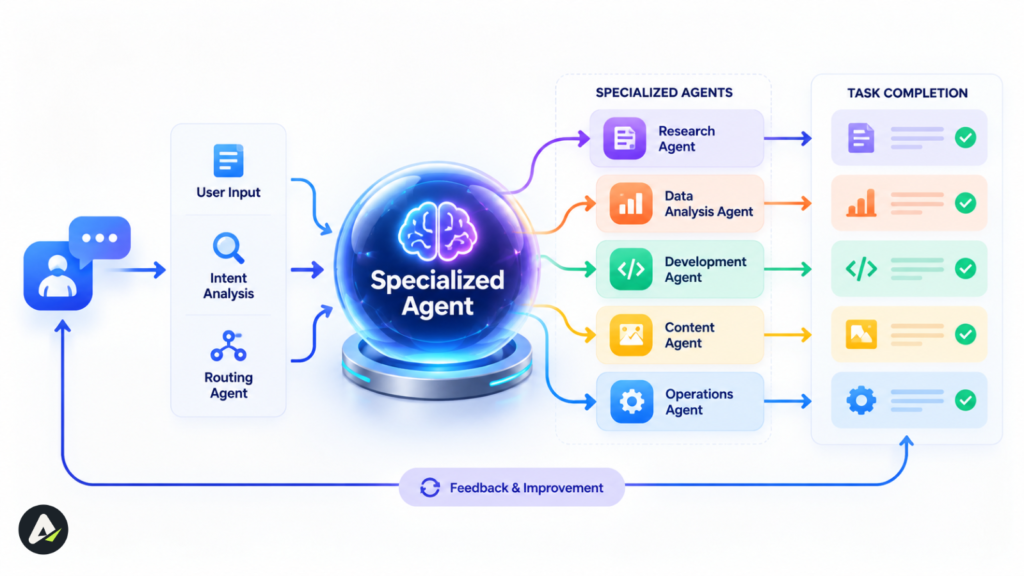
These names are layers, not tiers: the Responses API is the model interface, the Agents SDK is a framework that runs the agent loop inside your app, and the Agents API is a managed runtime where OpenAI runs the loop for you. Workspace Agents sit on top as a no-code product inside ChatGPT.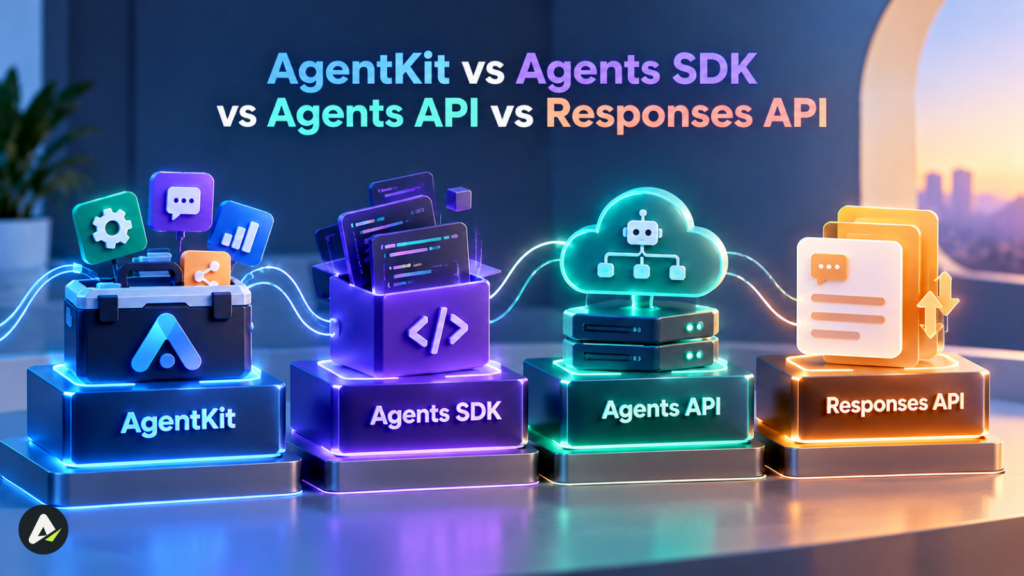
| Option | What it is | Who runs the loop | Good fit | Setup needed |
|---|---|---|---|---|
| Responses API | Model endpoint with built-in tools | Your code | Single calls, full control over every turn | Backend development |
| Agents SDK | Python and TypeScript framework for orchestration, handoffs, guardrails | SDK runner inside your app | Custom agents tied to your data, tools, and approvals | Developers plus your own hosting |
| Agents API (public beta) | Managed Codex harness with sessions and sandboxes | OpenAI | Long tasks with files, commands, or subagents | API integration; check data rules |
| Workspace Agents | Shared agents built in ChatGPT | ChatGPT | Repeatable team workflows | No-code or low-code; plan access, permissions, testing |
Data rules can settle the choice early. According to the Agents API overview, that service supports US data residency only and isn’t eligible for Zero Data Retention, even with a self-hosted sandbox. Workspace Agents need a ChatGPT Business, Enterprise, or Edu workspace with credit-based pricing, so moving non-technical builders there also changes access approvals, data governance, and billing. The API options, by contrast, charge per token, tool call, and hosted container.
The Agents API’s managed harness can also load packaged agent skill files, so reusable instructions travel with the agent rather than living inside one long prompt.
What Agents SDK code looks like
A billing agent with one tool shows the shift. In Agent Builder, this took a few connected nodes; in the SDK, it’s about a dozen lines:
from agents import Agent, Runner, function_tool

@function_tool
def lookup_invoice(invoice_id: str) -> str:
    """Return the payment status of an invoice."""
    return f"Invoice {invoice_id}: paid"  # replace with your billing system call

billing_agent = Agent(
    name="Billing assistant",
    instructions="Answer billing questions. Use lookup_invoice when given an invoice number.",
    tools=[lookup_invoice],
)

result = Runner.run_sync(billing_agent, "What's the status of invoice 1042?")
print(result.final_output)
Instructions, tools, and model choice now live in one file you can review, test, and version.
Best AgentKit Alternatives for Different Use Cases
The best AgentKit alternative depends on five criteria: data rules, who runs the infrastructure, how long tasks run, your team’s skills, and how much rework you can absorb. Score your project against the matrix below before choosing.
| Option | Data residency and retention | Who hosts it | Long-running tasks | Skill level | Effort from Agent Builder |
|---|---|---|---|---|---|
| Agents SDK | Follows the OpenAI APIs it calls | You | Yes, with sandboxes | Developer | Medium: official export produces SDK code |
| Agents API | US only; no Zero Data Retention | OpenAI (sandbox can be yours) | Built for it | Developer | Medium to high: rebuild as sessions |
| Workspace Agents | ChatGPT workspace controls | OpenAI | Yes | No-code or low-code | Low to medium: paste the export into the builder |
| Responses API | Broadest data-control options | You | You build the loop | Strong backend skills | High |
The four-question shortcut
- Who maintains it? Non-developers lean toward Workspace Agents, though that trades one OpenAI-hosted builder for another; developers keep going.
- Must it run in your infrastructure, or under strict data rules? Choose the Agents SDK.
- Does each task run for minutes with files or commands? The Agents API fits, if US-only residency works for you.
- Short, controlled turns? The Agents SDK or the Responses API.
Need a chat window on any of these? Add ChatKit on top.
Options outside OpenAI
If you’d rather not stay with one model vendor, these are the common landing spots. Check current features before committing.
| Tool | Type | Best for |
|---|---|---|
| LangGraph | Open-source, code-first framework from LangChain | Stateful, branching agent workflows across model providers |
| CrewAI | Open-source Python framework | Role-based teams of cooperating agents |
| n8n | Visual workflow automation, self-hostable | Teams that miss a canvas and want AI steps inside broader automations |
| Microsoft Copilot Studio | Enterprise low-code agent builder | Organizations standardized on Microsoft 365 |
| Lindy | No-code AI agent platform | Business teams automating email, meetings, and admin tasks |
Teams that chose Agent Builder for its visual editor will find n8n, Copilot Studio, and Lindy’s no-code AI agents closest in feel. Teams that had outgrown drag-and-drop can move to LangGraph or CrewAI’s role-based agent crews for code-level control without locking into OpenAI models.
Whatever runtime you choose, expose your tools as MCP servers where possible. The Model Context Protocol is an open standard supported by OpenAI’s Agents SDK and Agents API, and by most frameworks above, so integrations built on it move with you.
How to Migrate Before November 30, 2026
Migrating off Agent Builder means exporting each workflow as Agents SDK code, then rebuilding and retesting everything the export doesn’t carry: credentials, permissions, triggers, and deployment. Copying the generated code takes seconds, but auditing environment variables, OAuth grants, and edge cases can take your engineers several days. Ongoing costs shift too: once you self-host, servers, storage, and monitoring land on your own bill.
What the export gives you, and what it doesn’t
In Agent Builder, open a workflow, select Code, choose Agents SDK, and copy the Python or TypeScript output. OpenAI’s migration guide states that the export doesn’t convert your workflow graph, and it doesn’t guarantee every behavior transfers unchanged.
| Comes across in the export | You must rebuild or re-check |
|---|---|
| Agent definitions and instructions | API keys, secrets, and environment variables |
| Tool and model choices | Connected app authentication and permissions |
| Core workflow logic, as code | Human approval steps and guardrail behavior |
| Conversation state and storage | |
| Hosting, deployment, and monitoring | |
| Regression tests against the original outputs | |
| Branch conditions, retries, and fallback routes |
Workflows that called MCP servers need one extra pass. Confirm the exported code points at the same server URLs, then re-supply tokens and approval settings, because credentials never travel with the code.
Going the Workspace Agents route? You paste the export into ChatGPT’s agent builder and review what it flags. OpenAI warns that workflows with strong determinism at their core may not convert faithfully, so rigid, rule-based flows usually belong in the SDK.
Replacing hosted Evals
Your graded test cases are harder to recreate than workflow logic, and they go read-only first. OpenAI points teams to Promptfoo, an open-source testing tool that runs from config files and slots into CI. Before committing to a replacement, confirm it handles:
- Dataset portability: can you import your exported test cases as-is?
- Custom graders: can it reproduce your scoring rules?
- Trace evaluation: can it judge multi-step runs, not just final answers?
- Tool-call testing: can it confirm the agent called the right tool with the right inputs?
- CI integration: does it run on every change, before deployment?
Observability platforms that log production traces are useful too, but they complement a test suite rather than replace it.
Migration checklist
- Before October 31: export eval datasets and grader logic
- Inventory every Agent Builder workflow and flag the production ones
- Export each workflow as Agents SDK code, or convert it into a workspace agent
- Move stored prompts into your codebase
- Re-point ChatKit to your own server-side agent
- Rebuild credentials, permissions, approvals, and guardrails
- Run old and new versions on the same test prompts and compare outputs
- Switch traffic, then watch errors and costs for two weeks
Two traps catch teams late. Tutorials from late 2025 still rank well and still start in Agent Builder. And self-hosting with the SDK pulls your own infrastructure into compliance scope for frameworks such as SOC 2, HIPAA, or GDPR.
OpenAI AgentKit vs Coinbase AgentKit vs BytePlus AgentKit
“AgentKit” names three unrelated products: OpenAI’s agent-building suite, Coinbase’s toolkit that gives AI agents crypto wallets, and ByteDance’s Volcengine (BytePlus) platform for deploying agents as managed services. If a tutorial mentions wallets or swaps, it’s Coinbase; if it mentions Volcengine runtime or memory services, it’s ByteDance.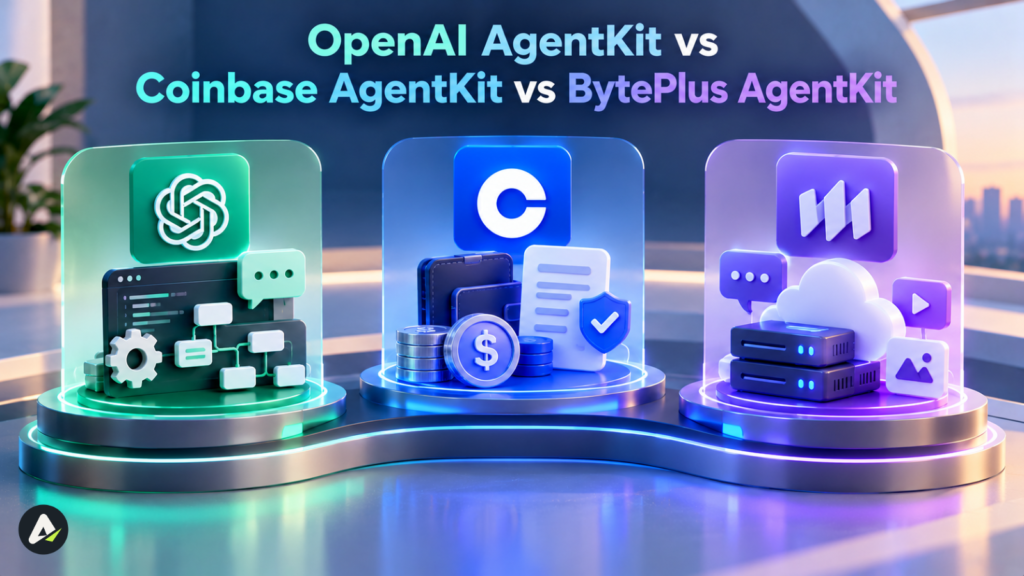
| AgentKit | Maker | What it does |
|---|---|---|
| OpenAI AgentKit | OpenAI | Builds, embeds, and evaluates agents on OpenAI models |
| Coinbase AgentKit | Coinbase Developer Platform | Onchain actions such as transfers, swaps, and contract deployment on EVM networks and Solana. |
| Volcengine / BytePlus AgentKit | ByteDance | Managed runtime, tools, memory, and knowledge services via a Python SDK |
Coinbase’s toolkit is open source and framework-agnostic, with adapters for LangChain, the Vercel AI SDK, and even OpenAI’s Agents SDK. That’s why searches like “AgentKit GitHub” or “AgentKit download” usually land on Coinbase or ByteDance: OpenAI’s AgentKit was never one downloadable package.
Conclusion: Your Next Move With AgentKit
OpenAI AgentKit lives on, just not as a drag-and-drop tool. Most migrations come down to three facts:
- ChatKit and the Connector Registry stay, so your chat front end and connector governance can carry over.
- An export is a starting point, not a finished migration.
- Your eval data is the most fragile asset and the first to lock.
Before October 31, export your evaluation datasets and grading logic. Then document each production workflow, test its exported implementation side by side with the original, and finish the switch before the November cutoff.
Frequently Asked Questions
Q. What is AgentKit?
AgentKit is OpenAI’s suite of tools for building, embedding, and improving AI agents, launched in October 2025. Its main parts were Agent Builder, ChatKit, the Connector Registry, and expanded Evals.
Q. What happens to my Agent Builder workflows after the shutdown?
They stop being available on the OpenAI platform. Export each one as Agents SDK code before then, or use the export to create a workspace agent in ChatGPT.
Q. Can I still use ChatKit without Agent Builder?
Yes. ChatKit remains available. New apps connect it to your own server-side agent through OpenAI’s advanced integration instead of a hosted workflow.
Q. Is AgentKit free?
AgentKit has no separate subscription. You pay for underlying API usage, such as model tokens, tools, and hosted containers. Workspace Agents use credit-based pricing on ChatGPT business plans.
Q. Is there an agent API for ChatGPT?
Developers can use OpenAI’s Agents API, now in public beta, where OpenAI runs the agent loop and manages sessions. For full control, the Responses API and Agents SDK remain available. Business teams can also trigger published workspace agents.
Q. What are the big 4 AI agents?
There’s no official “big 4.” Developers most often compare agent toolkits from OpenAI (Agents SDK), Anthropic (Claude Agent SDK), Google (Agent Development Kit), and Microsoft. Rankings shift quickly, so judge them on your own use case.
Related: Lightspeed Filter Agent: What It Sees, What It Blocks & How It Works
| Disclaimer: This article is based on available OpenAI documentation and independent analysis. We are not affiliated with or endorsed by OpenAI, Coinbase, or ByteDance. Product features, pricing, and shutdown dates may change; verify critical details against official documentation before migrating. |

Maliha
AI is moving steadily from experimental technology into the products and workflows people rely on every day. Maliha Irfan is a technology writer covering artificial intelligence, automation, and emerging software. Her work focuses on the practical side of AI agents, exploring how these systems are being used, what they can realistically accomplish, and the limitations that matter when businesses and individuals adopt them.
More from Maliha →