TaxGPT Review 2026: Features, Pricing & Is It Legit?
Is TaxGPT worth using for tax professionals in 2026? Explore its AI research, Agent Andrew, Cowork automation, pricing, limitations, and alternatives to see whether it fits your accounting practice.

In this article · 21 sections +
- TaxGPT at a Glance
- How Much Should You Trust TaxGPT’s Performance Claims?
- What Is TaxGPT and Who Is It For?
- What Does Each TaxGPT Tool Do?
- How Does Agent Andrew Review Tax Returns?
- What Is TaxGPT Cowork, and Can It Prepare Returns?
- The Browser Automation Risk During Tax Season
- Where Agent Prep Still Needs a Person
- How Accurate Is TaxGPT’s AI Tax Research?
- TaxGPT Pricing, Plans and Trial
- Is TaxGPT Legit and Safe for Client Data?
- Section 7216: Look at Where the Data Goes, Not Only Who Signs
- What Do TaxGPT Users Say?
- TaxGPT vs Basis, Blue J, CCT, CCH and ChatGPT
- Can Individuals or Small Businesses Use TaxGPT?
- How to Log In, Book a Demo and Test TaxGPT
- A five-step test plan
- Demo checklist
- TaxGPT’s Biggest Limitations
- Is TaxGPT Worth It?
- Frequently Asked Questions
TaxGPT is an AI tax platform built for CPAs, enrolled agents, and accounting firms. Research, return review, and agent-run preparation sit behind one login, which is the main thing that separates it from research-only tools. Before you spend time on a demo, here is what it does well, where it asks you to take things on faith, and what to check first.
TaxGPT at a Glance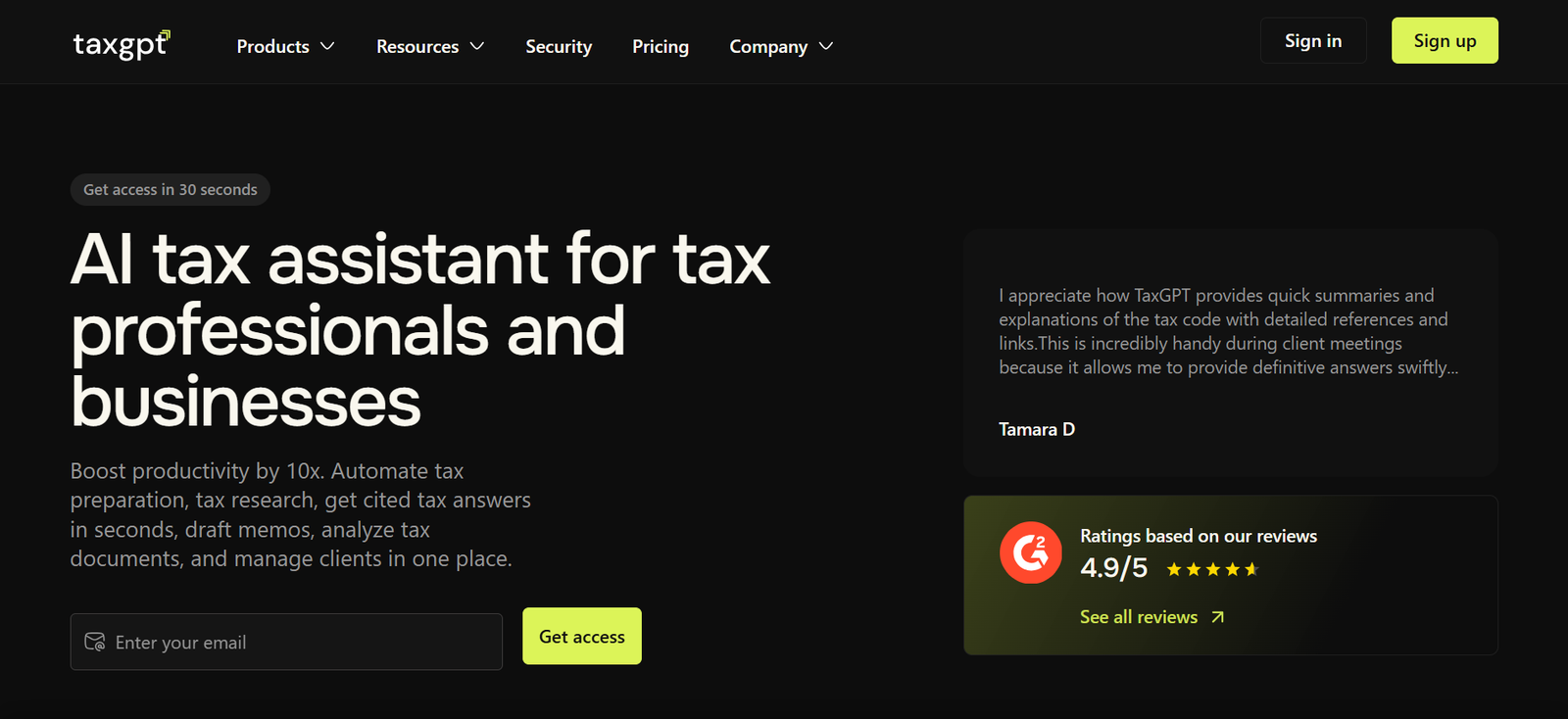
| Details | |
|---|---|
| Best for | Small and mid-size firms with heavy research and review loads |
| Skip if | You need public pricing, self-serve signup, or coverage outside the US and Canada |
| Standout | Research, Agent Andrew return review and Cowork prep agents in one product |
| Pricing | Custom quote after a required demo |
| G2 rating | 4.6/5 from 21 reviews (November 2026) |
This review draws on TaxGPT’s product, pricing, security and FAQ pages, G2 reviews, accounting trade coverage and practitioner threads on Reddit. I did not test a paid account, and most performance numbers come from TaxGPT itself, so the next section shows how much weight each one deserves.
How Much Should You Trust TaxGPT’s Performance Claims?
| Claim | Source | How to read it |
|---|---|---|
| 80,000+ active users, 650,000+ questions answered | TaxGPT FAQ | Vendor-reported usage, and it likely includes free individual accounts |
| Agent Andrew automates up to 90% of return review | TaxGPT FAQ and G2 listing | A workload-coverage figure, not an error-catch rate |
| 90% less first-pass prep time, about 45 minutes saved per 1040 | TaxGPT launch coverage, March 2026 | Vendor claim with no independent study yet |
| 14 citations per answer, 0% citation hallucination | TaxGPT benchmark posts | Self-run benchmark |
The 90% figure is the one people misread: it describes how much of the checking Andrew takes on, not how many errors it catches or how much reviewer time you’ll get back. Treat every number above as a hypothesis to test during your trial.
What Is TaxGPT and Who Is It For?
TaxGPT Inc. is a San Francisco company founded in 2023 by Kashif Ali (CEO) and Isabella Maceda-Ali (CTO). It went through Y Combinator’s Summer 2024 batch and raised a $4.6 million seed round in February 2025. Accounting firms are the core market, with lighter tiers for businesses, financial advisors, and individuals.
Coverage includes US federal law, all 50 states, US territories, Canadian federal and provincial law, and treaty questions involving either country. Nothing outside that map is covered.
The sweet spot is a practice that loses hours to research, multi-state questions, IRS notice replies, and first-pass review. Larger firms already paying for Checkpoint, CCH, or Bloomberg Tax will find the research overlaps, though the return review and prep agents don’t.
What Does Each TaxGPT Tool Do?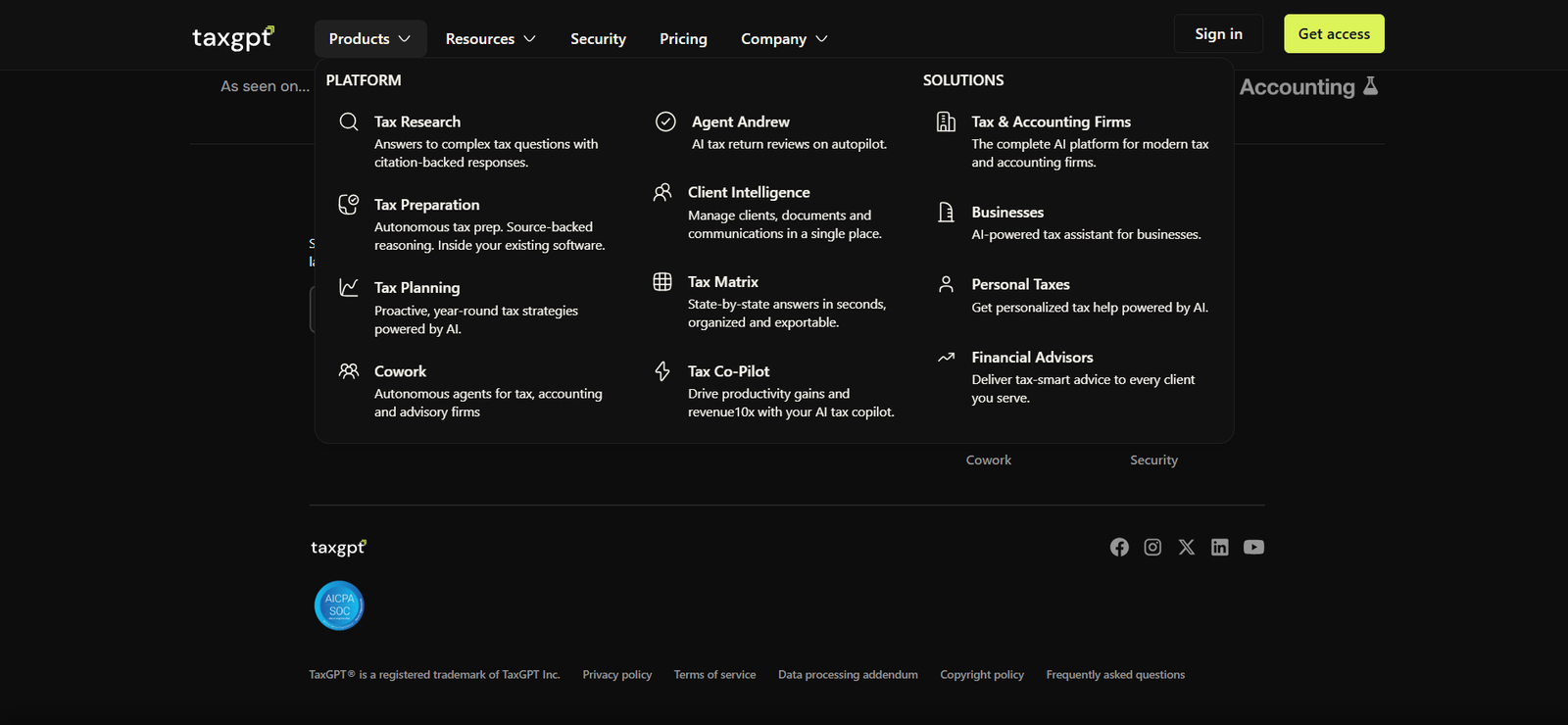
There are seven tools. Research and Matrix find tax authority, Writer turns findings into deliverables, Document Analysis and Client Intelligence hold client context, Agent Andrew checks finished returns, and Cowork runs whole engagements.
| Tool | What it does | Plan |
|---|---|---|
| AI Tax Research | Answers plain-English questions with links to the IRC, Treasury Regulations, court cases, and agency guidance | Pro and up |
| Tax Matrix | Runs one question across many states and returns an editable, exportable comparison table | Pro and up |
| Tax Writer | Drafts memos, engagement letters, client emails, and IRS or CRA notice replies such as the CP2000 | Pro and up |
| Document Analysis | Reads an uploaded return, statement, or notice and answers questions about that file | Pro and up |
| Client Intelligence | Keeps each client’s entities, elections, filing history, and files in one profile | Pro and up; unlimited entities on Enterprise |
| Agent Andrew | Reviews prepared returns against source documents and flags errors and savings | Pro and up |
| Cowork and AI Tax Preparation | Runs agent-led prep, bookkeeping, planning and R&D credit work inside your existing software | Pro Plus and up |
Client Intelligence feeds the rest, so later research and drafts pick up a client’s history without retyping it. One catch: TaxGPT’s FAQ says data import currently covers PDFs and images, not CSV, JSON, or XML. If your workflow runs on trial balances or spreadsheets, you’ll need a workaround, so put it on your demo list.
How Does Agent Andrew Review Tax Returns?
Agent Andrew compares a prepared return against its source documents and produces a downloadable report. It handles Form 1040 (individual), 1041 (estates and trusts), 1065 (partnerships), 1120 (C corporations) and 1120-S (S corporations).
The report uses three kinds of flags. Red flags mark mismatches such as transcription errors or omissions. Green flags point to possible missed savings, like a skipped home office deduction. Cleared flags record items your team resolved or rejected.
Scope has grown quickly. At its May 2025 launch, Andrew handled only federal 1040s built from digitally generated source documents, and business forms came later. So test the awkward material yourself: scanned and handwritten documents, multi-page K-1 packages and state returns. Then ask how Andrew reports what it couldn’t read. For a review tool, silent gaps do more damage than noisy flags.
What Is TaxGPT Cowork, and Can It Prepare Returns?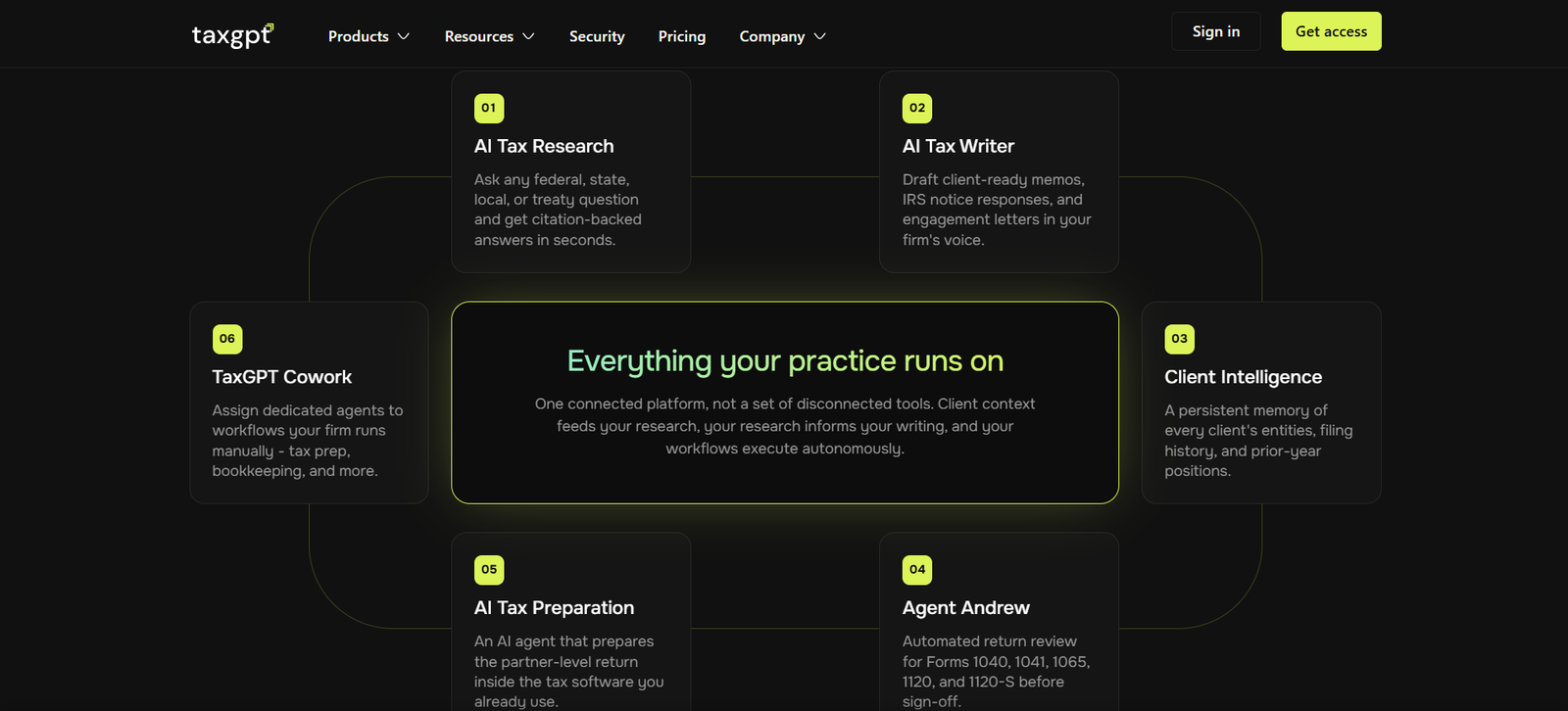
Cowork is the agent layer. Where Agent Andrew checks returns that already exist, Cowork produces them. Its agents take on whole engagements: return prep, bookkeeping, tax planning, R&D credit studies, extensions, and K-1 work. TaxGPT pitches them as staff you direct, a pattern that mirrors the rise of AI workers you configure and supervise in other industries.
Cowork prepares returns but never e-files them. A CPA reviews, signs, and files, which echoes the question banks face when they decide how much authority AI agents should get over money.
The Tax Prep Agent launched in March 2026. CPA Practice Advisor described an agent that reads source documents and operates tax software the way a human preparer does, and Accounting Today reported that each prepared return then passes to Agent Andrew and on to a CPA for sign-off. TaxGPT lists QuickBooks, Drake, ProConnect, UltraTax, CCH Axcess and Lacerte among the tools its agents work with. Cowork serves US firms only for now.
The Browser Automation Risk During Tax Season
Cowork works by driving a browser. The agent clicks through web-based tax software like a person would, which sidesteps the API integrations most tax vendors never built. That is the appeal: UltraTax, Drake, and similar products offer limited or gated write-back APIs, so a browser agent works today instead of after a multi-year vendor roadmap. That constraint isn’t unique to TaxGPT: any independent agent working through these suites faces the same gap, so ask every vendor you evaluate how it handles breakage.
The cost is that screen-driven automation is only as stable as the screens. Tax software vendors push hotfixes and interface changes, often right when volume peaks between February and April. If a layout shifts overnight, a run can halt midway through a batch, or, worse, keep going and enter something into the wrong field. For a firm racing a deadline, that isn’t a minor technical note. It’s an operational risk you should price in, and it mirrors where workflow automation tends to break in practice.
I’d treat these as non-negotiable questions before you rely on Cowork in season:
- How does TaxGPT detect a failed or drifting run, and does it alert you or only log it?
- What is the typical repair time after a vendor interface change, and is that in writing?
- Which steps pause for human confirmation before anything is saved to a client file?
- Can you pilot it on a few returns in the off-season first, rather than meeting it for the first time in March?
Where Agent Prep Still Needs a Person
Early coverage said individual returns came first, with partnership and corporate forms to follow. TaxGPT’s FAQ now lists 1040, 1065, 1120 and 1120-S workflows. Ask for a live run on your hardest file type: multi-state apportionment, a stack of K-1s from tiered partnerships, or a client who sends phone photos. Those cases show quickly where a human still has to step in.
How Accurate Is TaxGPT’s AI Tax Research?
A valid citation proves a source exists. It doesn’t prove the source fits your client’s facts. TaxGPT’s own FAQ calls the tool a research aid and tells users to verify key conclusions against primary sources, which leaves the professional liability with you. Read each answer as a strong first draft.
Five failure points show up in almost any AI tax research tool:
- A real citation that misses the facts, such as a C corporation rule applied to an S corporation question.
- A sound federal answer that skips a state’s decoupling or a local rule.
- An answer built on the wrong tax year after a mid-year law change.
- A correct rule paired with a missed election or deadline that flips the outcome.
- Contrary authority, like an adverse ruling or circuit split, that never surfaces.
TaxGPT says its library updates in real time and that a QA team of CPAs and tax attorneys reviews flagged answers. Those safeguards help, but they don’t move the burden. Also ask which AI model providers sit underneath and how TaxGPT re-tests its answers when those providers update their models, because behavior can shift between versions. Under IRS Circular 230, the practitioner answers for the advice and the return, not the software.
TaxGPT Pricing, Plans and Trial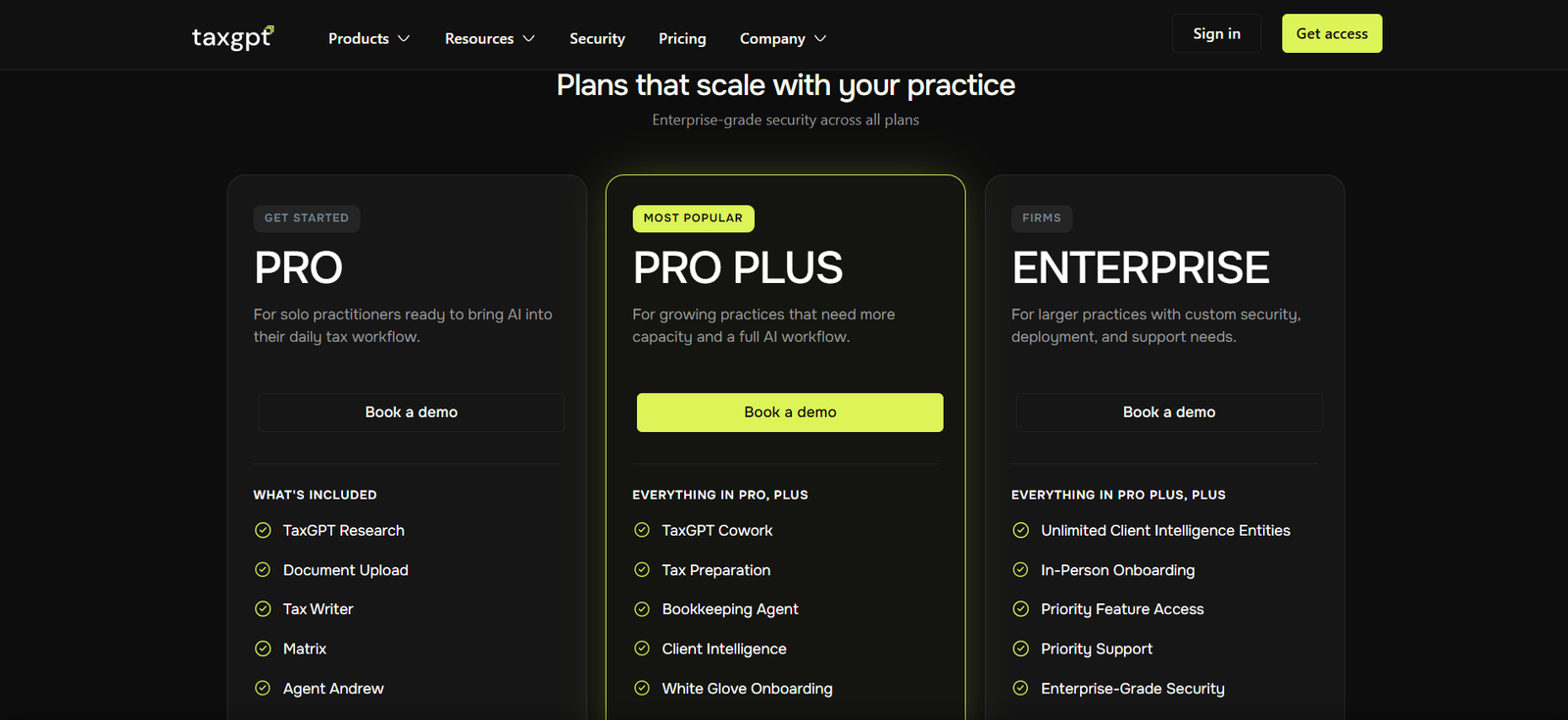
TaxGPT publishes no prices. Pro, Pro Plus and Enterprise (labeled “For Firms”) all run on custom quotes based on team size, client count and features. The pricing page shows plan contents and a demo button, and nothing else. You only see a figure during a live demo, which TaxGPT requires before it activates an account.
| Plan | Built for | What it adds |
|---|---|---|
| Pro | Solo practitioners and small teams | Core tools above, self-guided onboarding, email support |
| Pro Plus | Growing practices | Cowork, AI Tax Preparation, Bookkeeping Agent, white-glove onboarding |
| Enterprise | Larger firms | Unlimited Client Intelligence entities, in-person onboarding, priority features and support |
Directory sites list estimated TaxGPT prices, but none are confirmed by the company. For comparison, Blue J and CCH AnswerConnect Tax each list research plans at around $1,500 per user annually, without TaxGPT’s return-review and preparation agents.
TaxGPT requires a demo before revealing its pricing, which can frustrate small firms comparing software. Its FAQ says plans have no user or question limits, but firms should confirm usage terms and contract details before signing. For a broader look at automation expenses, more AI agents for small businesses.
To assess ROI, compare staff time spent reviewing 20 returns before and during the trial. If Agent Andrew and Cowork save more in labor costs than the subscription adds, the investment may make sense.
Is TaxGPT Legit and Safe for Client Data?
TaxGPT is a real, venture-backed company with named founders, Y Combinator backing, a registered trademark, and coverage in Accounting Today and CPA Practice Advisor. It has no affiliation with OpenAI.
On security, it states SOC 2 Type II compliance, AES-256 encryption, US-hosted data on AWS and Azure, and no training on customer data. It also lists multi-factor authentication, role-based access, activity logs, automatic PII redaction, and isolation of client data from the internet, and it publishes a data processing addendum and a Trust Centre.
Those are vendor statements. A SOC 2 report covers controls, not every workflow, and agents that act on client files bring the kind of exposure attackers have already shown they can exploit in agent deployments. Your firm owns the due diligence.
Section 7216: Look at Where the Data Goes, Not Only Who Signs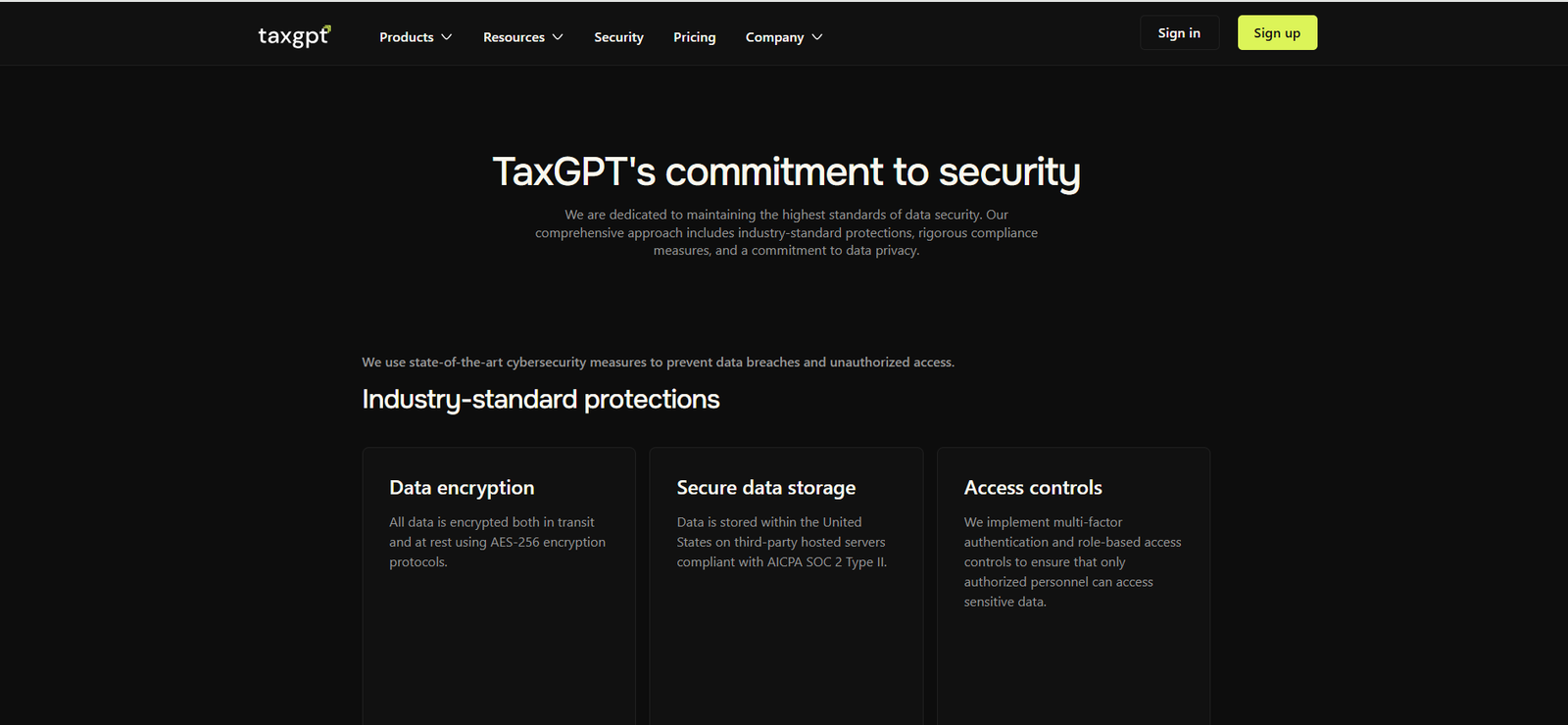
IRC Section 7216 carries criminal penalties for preparers who knowingly or recklessly disclose or use tax return information without authority. Section 6713 adds civil penalties. Many firms reduce this to a yes-or-no consent question, but the real exposure sits in the data path.
Three things matter. First, geography: the rules around sending return information to anyone outside the United States are stricter than the rules for US-based providers, so you need to know where TaxGPT’s hosting and its underlying AI model providers process your data. “US-hosted on AWS and Azure” covers storage. It doesn’t automatically answer where a prompt gets processed. Second, retention: ask whether model providers operate under zero-data-retention terms and whether anything is logged. Third, the exceptions: some disclosures to US-based service providers who help with preparation can fall under an exception, but whether an AI vendor and its model subprocessors qualify is still debated, and practitioners disagree.
The conservative path is simple. Update your engagement letters to name AI tools, and collect written consent before deploying Cowork on client files. That consent has to be a signed document meeting Treas. Reg. 301.7216-3 and, for Form 1040 clients, Rev. Proc. 2013-14. The CPA Journal’s guide to Section 7216 consents walks through the format rules. Whichever way you go, run the plan past your own counsel and your E&O carrier before you upload a single return.
Insurance is the quieter gap. Carriers are still working out how to treat AI-prepared work, and if an agent mis-enters a K-1 or skips an asset class after a screen glitch, it isn’t obvious how responsibility splits between you, the vendor, and your insurer. Ask your carrier in writing whether AI-assisted preparation affects your coverage, and ask TaxGPT what its contract says about liability for agent errors.
What Do TaxGPT Users Say?
Feedback leans positive but comes from a small pool. TaxGPT’s G2 page shows 4.6 out of 5 across 21 reviews as of November 2026. That sits below the 4.9/5 its homepage displays, which comes from reviews TaxGPT collects itself. Reddit’s r/taxpros threads run more mixed.
Users like the fast, source-backed answers during client meetings and the time saved on memo drafting, especially solo practitioners. Complaints center on speed, cost, and a learning curve. A few found it slow or pricey, and several said you need good prompting to beat a general chatbot. Treat forum posts as sentiment rather than evidence, and check the dates, because reviews from 2024 predate Agent Andrew and Cowork.
TaxGPT vs Basis, Blue J, CCT, CCH and ChatGPT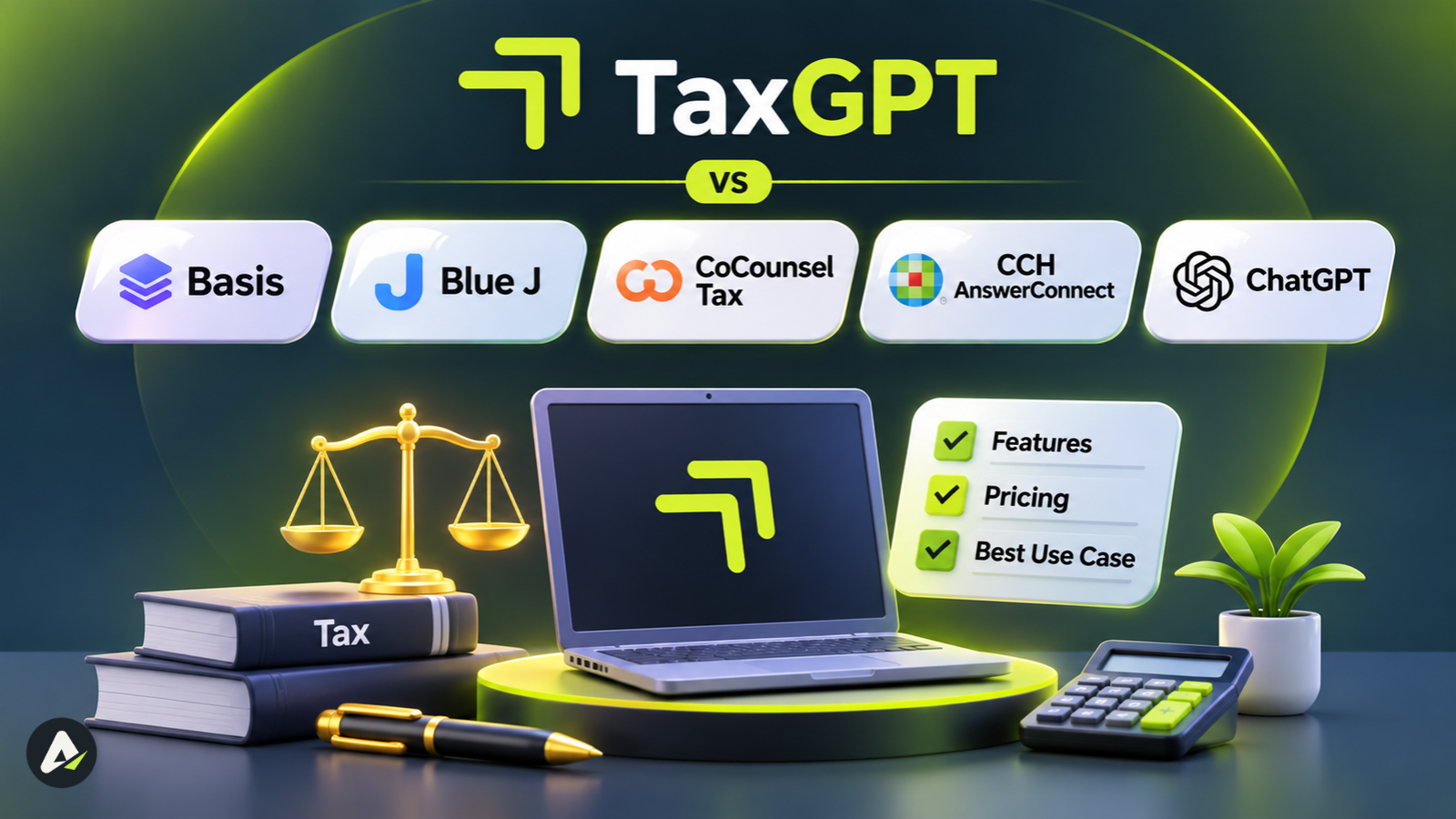
TaxGPT’s nearest rivals include other agentic AI platforms built for professional accounting firms. Basis, valued at $1.15 billion following its $100 million Series B, says around 30% of the top 25 accounting firms use its platform. Its agents handle complex, multi-step workflows across accounting, tax, and audit. Black Ore also competes in this space through Tax Autopilot and Byron, which focus on automating CPA tax preparation.
This shift toward embedding AI agents directly into existing business software is not limited to accounting. Salesforce follows a similar approach with its sales assistant agent capabilities, showing how specialized agents can support workflows within an established business platform.
The traditional tools play a different game. CoCounsel Tax, CCH AnswerConnect, and Bloomberg Tax ground their answers in large editorial libraries with expert commentary, which is what you pay for when the work is complex, corporate, international, or niche. Blue J sits closer to TaxGPT in size but centers on research and drafting. ChatGPT is a general assistant, not a tax practice tool.
TaxGPT vs Alternatives Comparison
| Tool | Core strength | Return review or prep | Published pricing |
|---|---|---|---|
| TaxGPT | Research, drafting, return review and prep agents in one platform | Yes, through Agent Andrew and Cowork | Custom quote after demo |
| Basis | Long-horizon agents across accounting, tax and audit for larger firms | Yes, including end-to-end return demos | Not published |
| Blue J | AI tax research and drafting built for practitioners | Not advertised | Individual plan at $1,498 per user per year |
| CoCounsel Tax (Thomson Reuters) | AI answers grounded in Checkpoint content and expert editors | Agent-led client file review and memo drafting | Not published |
| CCH AnswerConnect (Wolters Kluwer) | Expert-reviewed CCH content with AI search, linked to CCH ProSystem fx, ATX and TaxWise | Research only | AnswerConnect Tax listed at $1,499 |
| Bloomberg Tax | AI Assistant over Tax Management Portfolios and tax news | Research, plus separate provision and workpaper products | Not published |
| ChatGPT | General drafting, explanation and brainstorming; can browse and read uploads | No | Public plans, including a free tier |
These are differences in positioning, not a performance ranking. A rough way to choose:
- TaxGPT if one tool should cover research plus first-pass review and prep, and your firm runs on software it supports.
- Basis or a similar agent platform if you’re a larger firm that wants agents across accounting, tax, and audit.
- CoCounsel Tax, CCH AnswerConnect or Bloomberg Tax if deep editorial analysis matters most, or you already live in that vendor’s ecosystem.
- Blue J if you mainly want research and drafting with a published price.
- ChatGPT for general explanations and first drafts, not client-specific positions. It has no return-review or prep workflow, and its data handling depends on your plan and settings.
Most head-to-head benchmarks in this market come from the vendors. The fairest test is to run the same five questions from your own files through each trial and compare the sources each tool cites.
Can Individuals or Small Businesses Use TaxGPT?
Yes, within limits. Individuals can ask about forms like the 1040, Schedule C, and Schedule SE and run one free return review, but TaxGPT doesn’t file personal returns. Small business owners can use it to make sense of notices, deductions, or multi-state rules, though its deepest features target firms preparing returns at volume.
Personal answers are labeled informational, not tax advice. To file, you need tax software, a free IRS filing option, or a preparer, and a business sale, inheritance, foreign assets, or an audit calls for a licensed professional. If you’re after sales tax automation or bookkeeping software, look elsewhere, since TaxGPT doesn’t calculate or file sales tax.
How to Log In, Book a Demo and Test TaxGPT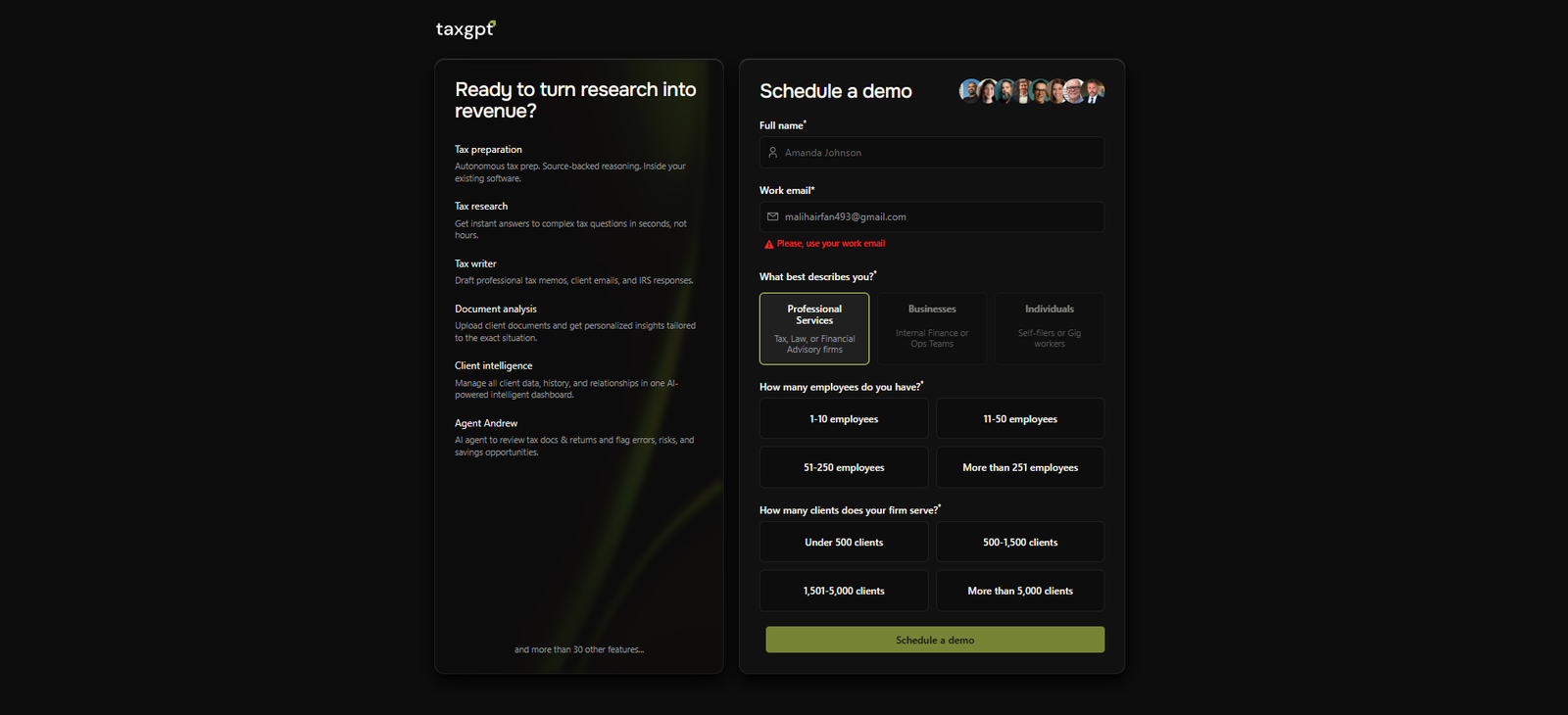
Existing users sign in at app.taxgpt.com/login, through the iOS and Android apps, or with the Chrome extension. New firms enter a work email, then book a live demo of under 30 minutes covering needs, a walkthrough, security, and a quote. The trial that follows is your chance to test it on real work.
A five-step test plan
- Research: ask three questions you’ve already answered, one with a state twist, and confirm every citation fits the facts and the tax year.
- Matrix: run one multi-state question and compare the table with your current source.
- Agent Andrew: upload an anonymized return with a known error, plus a scanned or handwritten document, and see what gets flagged and what gets missed.
- Writer: draft a reply to a past IRS notice and compare it with the one you sent.
- Time: log minutes per task with and without the tool.
Demo checklist
- Pricing: Does cost scale by seat, client entity, or both? Do Cowork agents carry usage caps or per-return charges? Does onboarding cost extra? What is the minimum term, and can you add seats for busy season only?
- Trial: How long does it last, and what does it include?
- Data import: How do trial balances, CSVs and other spreadsheets get in?
- Agent reliability: How is a broken browser run detected, how fast is it repaired, and how do desktop programs fit in?
- Review gaps: How does Andrew treat scanned documents and state returns, and how does it surface what it misses?
- Data path: Which cloud and AI model providers touch client data, where do they process it, and are they under zero-data-retention terms?
- Retention and deletion: How long do uploads and chat history persist, and how do you purge them?
- Internal access: Who in your firm sees which clients, and what do the logs record?
- Contract terms: What does the data processing addendum promise in writing?
- Insurance: Does your errors and omissions policy cover AI-assisted work?
TaxGPT’s Biggest Limitations
The weak spots sit around buying, scope, and proof rather than the core features. None of them breaks the product, but each deserves a direct answer before you sign.
- Pricing and access: no public numbers, and no quiet self-serve testing.
- Jurisdictions: nothing outside the US, Canada, and related treaty questions, and Cowork serves US firms only.
- Data import: structured files like CSV need a workaround.
- Automation fragility: browser-driven agents can stall or misfire when vendor software changes its screens.
- Evidence: the headline time savings come from TaxGPT, not outside studies.
Is TaxGPT Worth It?
TaxGPT deserves a trial if you want research, return review, and agent-assisted preparation without leaving your current tax software. Its strongest point is the link between finding an answer and acting on it. The main reservations are the demo-gated pricing and the browser-automation risk, and both deserve a hard look before tax season.
Solo practitioners focused on tax research and return review can start with Pro. Growing firms looking to automate first-pass preparation and bookkeeping should compare Pro Plus with their workflow needs. Larger firms should request security documentation and review contract terms early, while comparing TaxGPT with alternatives such as Basis.
Firms that need more specialized automation than existing tax platforms provide may consider building custom AI agents, making the choice of an experienced AI agent development company an important part of the decision.
Rather than relying on automation percentages, verify the citations, measure the review time your team actually saves, and evaluate TaxGPT using your own files and workflows.
Frequently Asked Questions
Q. How much does TaxGPT cost per month?
TaxGPT doesn’t publish monthly prices. Every plan uses a custom quote based on seats, client count and features, shared during the demo.
Q. Is TaxGPT legit?
Yes. TaxGPT Inc. launched in 2023, has Y Combinator and venture backing, and states SOC 2 Type II compliance. Like any AI tool, its output still needs a practitioner’s check.
Q. Is TaxGPT better than ChatGPT for taxes?
For client work, usually. TaxGPT ties answers to primary tax authorities and reviews finished returns. ChatGPT is better suited to general explanations and drafting.
Q. Can TaxGPT prepare or file my taxes?
It can prepare returns, but only for firms, through Cowork agents working inside professional tax software. It doesn’t e-file anything, so a CPA files. Individuals can ask questions and get a return reviewed, but they have to file through other software or a preparer.
Q. Does TaxGPT work with Drake or UltraTax?
Yes. TaxGPT lists Drake, UltraTax, ProConnect, Lacerte, CCH Axcess, and QuickBooks among the software it works with. Cowork agents operate inside those tools rather than replacing them.
Q. Does TaxGPT need taxpayer consent under Section 7216?
Plan on getting written consent. Whether AI vendors fit the exceptions is still debated, so many firms name AI tools in engagement letters and collect signed consent first. Confirm the approach with your own counsel.
Q. Can TaxGPT replace Checkpoint or CCH?
For everyday federal and state questions, it can cover a lot of ground faster. For deep editorial analysis on complex corporate, international, or niche topics, many firms will still want a library such as CoCounsel Tax, CCH AnswerConnect, or Bloomberg Tax.
Related: Lightspeed Filter Agent: What It Sees, What It Blocks & How It Works
| Disclaimer: This article is based on publicly available information, product documentation, and user feedback. We are not affiliated with TaxGPT or its developers. Features, pricing, and performance claims may change over time. Always verify important tax-related information with a qualified professional. |

Maliha
AI is moving steadily from experimental technology into the products and workflows people rely on every day. Maliha Irfan is a technology writer covering artificial intelligence, automation, and emerging software. Her work focuses on the practical side of AI agents, exploring how these systems are being used, what they can realistically accomplish, and the limitations that matter when businesses and individuals adopt them.
More from Maliha →