How Can You Monitor Knowledge Base Drift and AI Agent Calibration?
Learn how to detect knowledge base drift, measure AI agent confidence with ECE, and use open-source tools to maintain reliable RAG systems.

In this article · 23 sections +
- What is knowledge base drift detection AI agent calibrations?
- What Types of Drift Affect RAG Agents?
- How Does Retrieval Pipeline Drift Reduce RAG Accuracy?
- How Does Tool-Schema and API Drift Affect AI Agents?
- How Do You Detect Knowledge Base Drift?
- How Should You Manage Labels for Drift and Calibration?
- What Is AI Agent Calibration?
- Mapping methods, by what the model exposes:
- Why Is Final-Answer Calibration Not Enough for Agents?
- What to instrument:
- How Does Knowledge Base Drift Affect Agent Calibration?
- Which Drift Signals Prove an Answer Is Wrong?
- What Action Should Each Drift Signal Trigger?
- Which GitHub Tools Help With Knowledge Base Drift Detection and AI Agent Calibration?
- What Does a Knowledge Base Drift Detection and AI Agent Calibration Example Look Like?
- Step 1: Version where metadata allows
- Step 2: Test for semantic drift weekly
- Step 3: Measure calibration with a reliability curve and ECE
- Step 4: Apply a stopgap calibrator while the fix is pending.
- Step 5: Re-index, collect fresh labels, re-measure
- Step 6: Test selective prediction and cascades
- What Are the Limitations of Drift Detection and Calibration?
- FAQs
An AI agent can pass offline evaluations and fail in production. The vector database returns HTTP 200, the agent keeps its assured tone, and latency dashboards stay green while accuracy slides. A frequent cause is a shifting knowledge base: edited documents, deleted sources, new user intents, changed APIs, or an embedding upgrade. Standard RAG evaluation suites miss this because they score against a fixed ground truth with no temporal component.
Drift detection asks whether the agent’s knowledge environment has shifted. Calibration asks whether the agent’s scores predict its accuracy under those conditions, at each step and across the whole run.
This guide uses three terms precisely:
- Predicted probability: a 0–1 score that a calibrator maps to the chance an answer or step is correct.
- Verbalized confidence: a claim the model writes as text, such as “I’m 80% sure.”
- Token logprobs: raw model likelihoods for generated tokens.
What is knowledge base drift detection AI agent calibrations?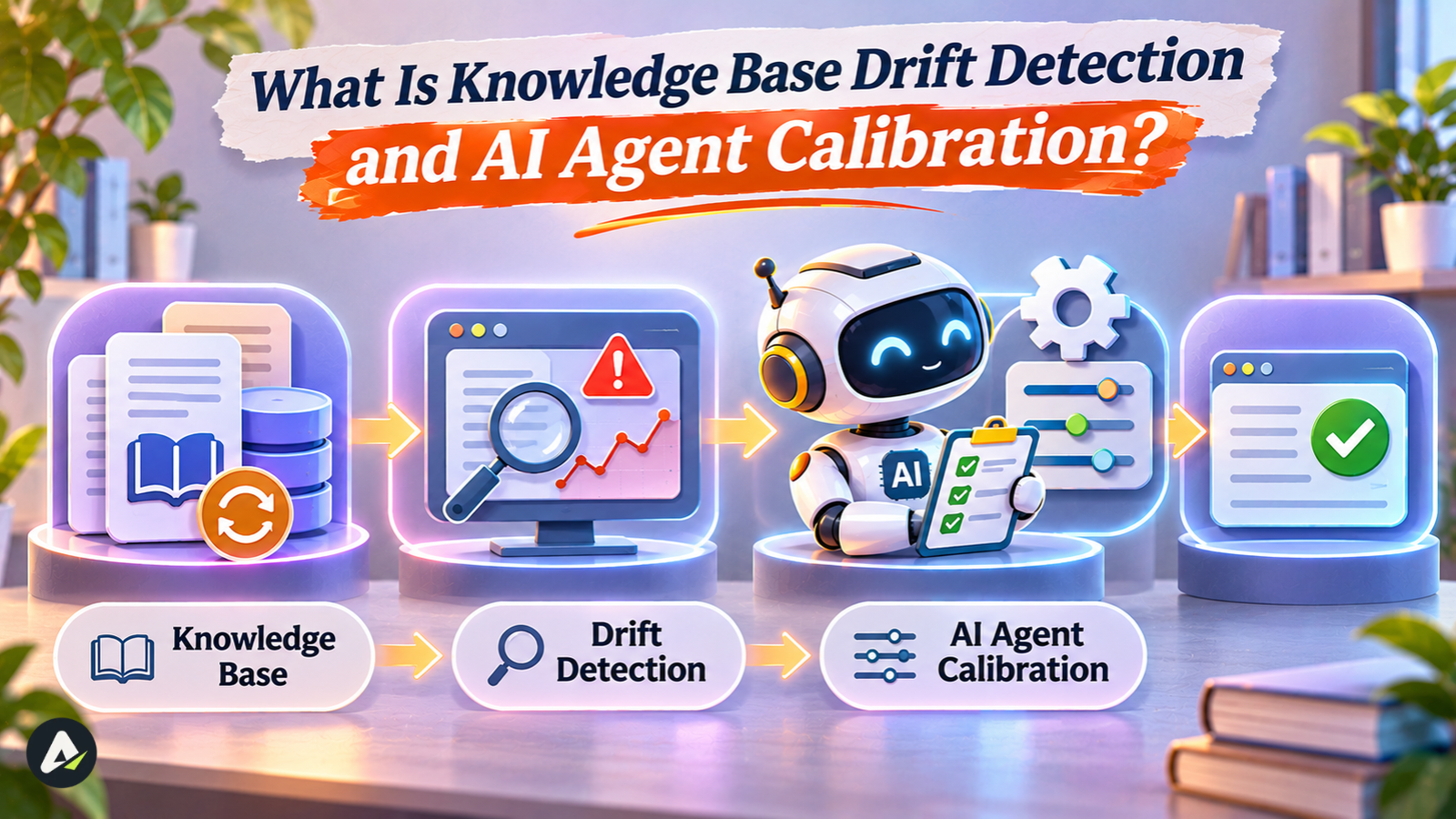
Knowledge base drift is a widening gap, over time, between what an agent can retrieve or call and what users need or what’s currently true. For agents, “knowledge” spans more than vector chunks: it includes rankers, query rewriters, tool schemas, and the agent’s own memory. Each layer can shift independently.
In multi-step agentic workflows, one outdated fact travels from a retrieval into tool calls, plans, and final actions, so a single shifted layer can corrupt an entire run.
What Types of Drift Affect RAG Agents?
Nine types accumulate across four layers: the corpus, the retrieval pipeline, the agent’s tools, and its memory. A single drift score catches some and misses the rest, so map each type to a dedicated check before choosing tools. The table below pairs each type with its primary detector.
| Layer | Drift type | What happens | Primary check |
|---|---|---|---|
| Corpus | Content staleness | Source edited; vector unchanged | SHA-256 content-hash comparison |
| Corpus | Orphaned vectors | Source deleted; vector remains retrievable | Source-ID registry scan |
| Corpus | Query drift | Users ask about poorly covered topics | Embedding distribution tests |
| Pipeline | Embedding or chunker drift | New model, chunking, or preprocessing | Version metadata plus re-evaluation |
| Pipeline | Index degradation | ANN graph or centroids decay after updates | Recall against exact search |
| Pipeline | Reranker and query-rewrite drift | Ranker or rewriter behavior changes | Reranker score distributions; rewritten-query logs |
| Pipeline | Mixed-context conflict | Top-K blends current and outdated chunks | Version-conflict scan of top-K results |
| Tools | Tool-schema and API drift | Upstream fields, endpoints, or states change | Contract tests on tool responses |
| Memory | Memory write-back drift | Agent stores its own errors or reasoning as facts | Write provenance and trust scoring |
How Does Retrieval Pipeline Drift Reduce RAG Accuracy?
Embedding or chunker drift. Vectors from different embedding models or configurations don’t share a coordinate system, so never mix them in one index. Chunking and normalization changes can shift retrieval even with the same model.
Index degradation. Graph indexes handle deletions unevenly. In HNSW, a deleted node typically becomes a tombstone whose edges remain, so traversal keeps visiting dead nodes and query latency rises. Recall suffers when physical deletions or delayed repairs tear holes in the graph and strand greedy search before compaction runs. IVF indexes carry a related weakness: centroid assignments reflect the data distribution at build time. Compare ANN results against exact search on sampled queries, and rebuild or compact when recall drops below target.
Reranker and query-rewrite drift. Modern agentic RAG rarely runs a single dense lookup. The agent rewrites a request into sub-queries, runs hybrid search (BM25 plus dense vectors), and a cross-encoder reranks the candidates. That reranker is a second model that can regress on its own: a vendor point release can push a borderline chunk out of the top results, or lift a fluent outdated chunk above a terse current one. Log reranker scores for cited chunks, alert on distribution-shape changes, and run drift tests on rewritten queries as well as raw user input.
Mixed-context conflicts. Partial drift often hurts more than full drift. A top-5 set can hold one current chunk and four outdated ones, a pattern the knowledge-conflict literature describes as common when some passages get updated while others don’t. Google’s CONFLICTS benchmark found that vanilla RAG followed the expected conflict-handling behavior only 59.4–68.3% of the time, despite high factual grounding. Grounding metrics look healthy because the answer faithfully follows the outdated majority.
How Does Tool-Schema and API Drift Affect AI Agents?
Tool-schema and API drift. A well-calibrated retriever won’t save an agent whose upstream API renamed a return field or retired an endpoint. Run contract tests against tool responses on a schedule and after vendor release notes.
Memory write-back drift. Agents that save summaries, tool outputs, and reasoning to their own store can corrupt it. Mem0 describes how a model hallucination written back to memory becomes a self-reinforcing “fact,” because naive vector memory tracks similarity, not trust. Reasoning traces add risk: the FARMA memory-poisoning research describes reasoning stores of decision logs and self-reflections that agents treat as evidence of completed work.
Not drift: sources wrong at ingestion. A new document that’s factually wrong from day one is a governance failure. Change detection can’t catch it, so gate ingestion with provenance checks and source-authority review.
How Do You Detect Knowledge Base Drift?
Watch three layers separately: embedding distributions, retrieval quality, and knowledge coverage. A stable embedding distribution can conceal falling retrieval quality, so no single layer settles the question. Bookkeeping catches edits, statistical tests catch semantic shifts, and a disciplined label pipeline ties both to answer quality.
| Layer | Question it answers | Typical metrics |
|---|---|---|
| Embedding drift | Did the vector space move? | Centroid distance, classifier ROC-AUC, MMD |
| Retrieval quality | Does the system find useful evidence? | Recall@K, MRR, nDCG@10, context precision and recall |
| Knowledge coverage | Does the KB hold what users need? | Unanswerable-query rate |
Bookkeeping. Store a document ID, chunk number, source path, version, embedding-model version, and indexing timestamp with each vector. LangChain’s Record Manager and LlamaIndex’s ingestion pipeline both implement hash-based change detection for incremental updates.
Statistical tests. Evidently’s embedding drift documentation lists four methods:
model(default): trains a classifier to separate reference from current embeddings and returns ROC-AUC, with a default threshold of 0.55.ratio: tests each embedding component (Wasserstein by default, 0.1 component threshold) and flags drift when the drifted share exceeds 0.2.distanceandmmd: compare mean embeddings and full distributions.
Tune each threshold against your own week-to-week noise.
How Should You Manage Labels for Drift and Calibration?
Calibration depends on labels, so manage them as one lifecycle:
- Golden set: a fixed benchmark of questions with verified answers, rerun on a schedule to catch regressions on known intents.
- Fresh labels: newly annotated samples of recent production traffic, which cover intents the golden set never included.
- LLM-judge labels: scale fresh labeling but bring their own drift. A judge shares the agent’s knowledge gap unless you ground it in the updated corpus. Changing the judge model, its prompt, or a vendor alias can move scores overnight and create phantom alerts. Pin the judge’s exact model snapshot, prompt hash, and rubric version in each evaluation record, compare only runs with an identical judge configuration, and audit a human-reviewed sample on a regular cadence.
Runtime checks, tiered by risk. Scoring how far each answer strays from its retrieved context gives a per-response warning sign; When Does Uncertainty Measure RAG Hallucination Risk? found that a combined uncertainty and semantic-drift score improves calibration. Heavy checks cost real money: five sampled generations for semantic entropy multiply generation cost roughly fivefold, and synchronous judge calls add seconds per request. Run them asynchronously on sampled traffic, and reserve synchronous checks for high-stakes write actions.
What Is AI Agent Calibration?
An agent is calibrated when its predicted probabilities match observed accuracy: across all responses assigned 0.80, about 80% should be correct. A calibration result holds only for the configuration it was measured on, because changes to the knowledge base, model, prompts, retrieval settings, or query mix can break the match.
Expected Calibration Error (ECE) sorts N predictions into M probability bins and averages the gap between accuracy and mean predicted probability in each bin Bₘ, weighted by bin size:
$$\text{ECE} = \sum_{m=1}^{M} \frac{|B_m|}{N}\,\big|\text{acc}(B_m) – \text{conf}(B_m)\big|$$
A score of 0 means perfect calibration. ECE varies with binning and sample size and can hide overconfidence within subgroups, so report bin counts and a reliability diagram alongside it.
Raw signals aren’t probabilities. Token logprobs measure lexical certainty, meaning how predictable the next word is, not whether the retrieved fact is true. Verbalized confidence is generated text that tends to cluster high regardless of accuracy. Frontier agents overestimate their odds: the Agentic Uncertainty Reveals Agentic Overconfidence study found GPT-5.2-Codex-based post-execution agents predicting 73% success against a true rate of 35% on SWE-bench Pro. The same gap drives agreeable AI agent behavior, where output sounds surer than its evidence allows. Neither signal belongs in an ECE calculation until a trained mapping converts it into a predicted probability.
Mapping methods, by what the model exposes:
- Temperature scaling divides logits by one learned parameter, so it requires logit access. Guo et al. found it surprisingly effective, describing it as a single-parameter variant of Platt scaling.
- Platt scaling fits a logistic curve to any raw score, including verbalized confidence or sampling agreement. Isotonic regression fits a flexible, non-parametric mapping.
- Sampling signals suit API-only setups. Agreement across repeated answers doesn’t prove accuracy, since a model can repeat a wrong answer. Semantic entropy groups answers by meaning, but validate it against labels before relying on it.
Why Is Final-Answer Calibration Not Enough for Agents?
ECE on final answers can look healthy while a cascade runs underneath. An uncalibrated 0.99 score on a faulty step-one retrieval poisons the context for steps two through five, and each downstream tool call builds on the error. Agents need calibration per step, across the trajectory, and on how they use retrieved context.
Step-level and trajectory-level calibration. Multiplying per-step scores doesn’t fix this. The Uncertainty Quantification for LLM Agents survey shows that an early observation error can affect all later decisions, so a product of step scores can mislead even when each step is well calibrated. Three independent steps at 75% finish together only about 42% of the time (0.75³ ≈ 0.42), yet real agent steps rarely fail independently. This chain reaction also drives many multi-agent coordination failures.
Salesforce AI Research’s Agentic Confidence Calibration paper introduces Holistic Trajectory Calibration (HTC), which extracts process-level features from confidence signals along the full trajectory and trains a simple, interpretable calibrator on them. HTC works from the trajectory’s token logprobs, so teams on APIs that hide logprobs, or on reasoning models that hide thinking tokens, need proxy signals first.
Attribution drift. An agent can retrieve the right chunk and produce a wrong synthesis anyway. Facet-level research on RAG hallucination found that errors often stem from systematic retrieval–generation misalignment, not retrieval failure alone. In multi-step agents, tool-call arguments and intermediate reasoning pile up in the context window and can pull the answer away from the evidence, even with a clean vector store.
What to instrument:
- Log scores, inputs, and outputs for each span: tool calls, retrievals, and reasoning-to-action transitions.
- Compute ECE per step type, not only for final answers.
- Calibrate decisions too: the retrieval router, tool selection, and the choice to clarify or abstain.
- Use mid-run score drops to escalate to a human. The overconfidence study found they don’t reliably predict failure on their own.
How Does Knowledge Base Drift Affect Agent Calibration?
Drift can cut accuracy while predicted probabilities hold steady, opening a reliability gap. Statistical drift is a trigger, not a verdict: a product launch shifts query embeddings without necessarily hurting accuracy. Use alerts to route targeted evaluations, and refit a calibrator only when fresh labels confirm the gap.
Which Drift Signals Prove an Answer Is Wrong?
Most monitoring signals flag risk, not failure. Only a contract failure or a measured drop in correctness confirms wrong answers.
| Signal | What it shows | Proves answers are wrong? |
|---|---|---|
| Hash mismatch | Source edited | No |
| Orphaned vector | Indexing fault | No |
| Embedding or rewritten-query shift | Semantic change | No |
| Reranker score-shape change | Ranking degradation | No, but raises risk |
| Version conflict in top-K | Mixed current and outdated context | No, but raises risk |
| Tool contract failure | API or schema change | Yes, for affected tool calls |
| Recall decline | Retrieval degradation | Partly |
| Step-level ECE increase | Calibration degrading at one stage | Partly |
| Correctness decline | More wrong answers | Yes, against reliable labels |
What Action Should Each Drift Signal Trigger?
Pair each alert with ECE on fresh labels before you act. The loop runs in reverse too: a sudden ECE spike on the golden set signals drift, often before embedding statistics cross a threshold.
| Drift signal | ECE on fresh labels | Action |
|---|---|---|
| Hash or orphan alerts | Stable | Re-embed edited chunks; retire orphans |
| Query shift | Stable | Fill coverage gaps; keep the calibrator |
| Query or content shift | Rising | Fix the KB, collect post-reindex labels, re-measure |
| Reranker shift | Rising | Pin or roll back the reranker version; re-run ranking evals |
| Tool contract failure | Any | Patch the tool adapter; block affected actions until fixed |
| None detected | Rising | Check judge configuration, model, prompt, and memory changes |
| Index recall drop | Any | Rebuild or compact the index, then re-measure ECE |
| Model or chunker change | Unknown | Full re-index, re-evaluation, and new calibration fit |
Which GitHub Tools Help With Knowledge Base Drift Detection and AI Agent Calibration?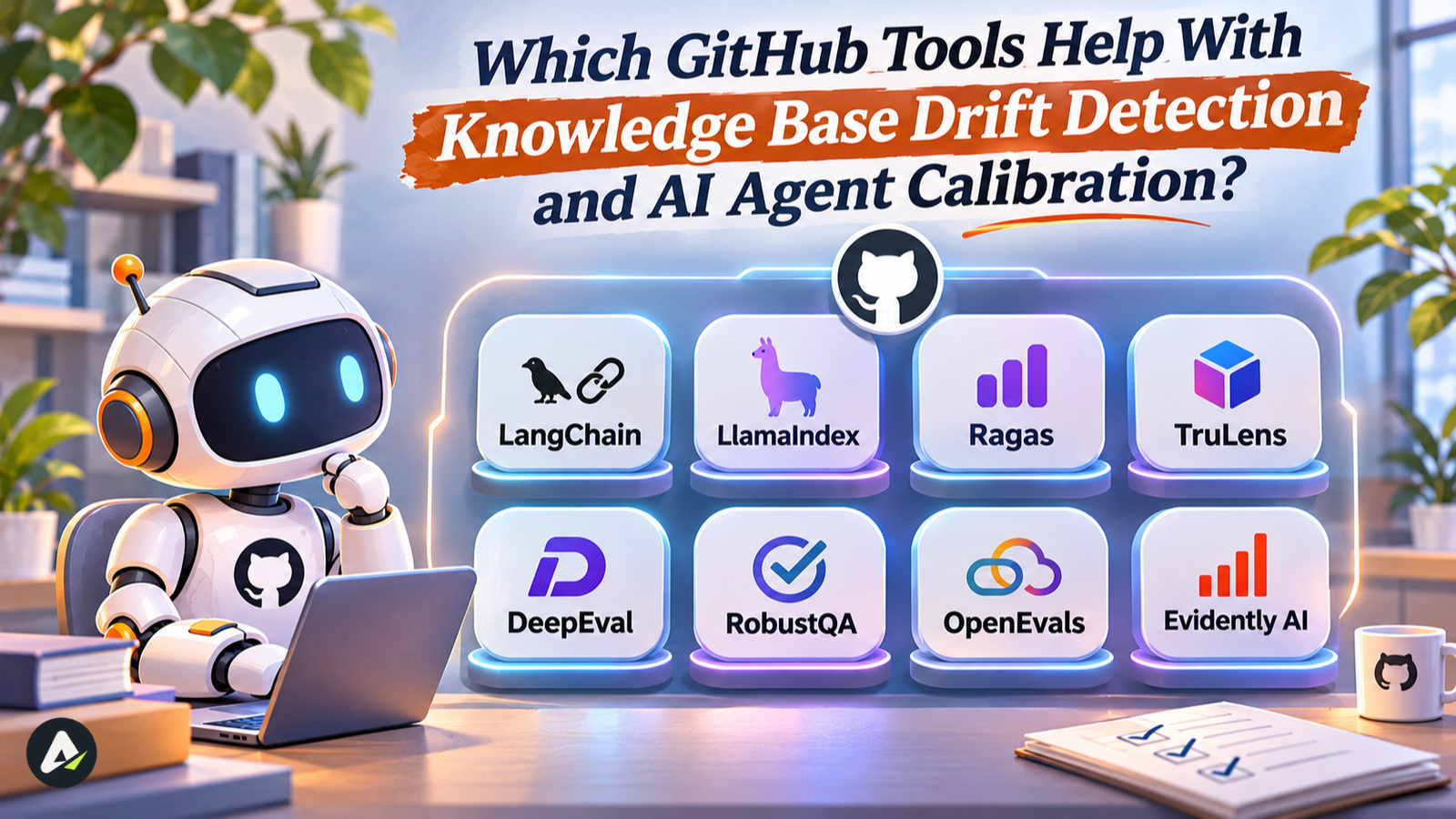
Evidently, Alibi Detect, and Arize Phoenix handle drift detection and tracing. Ragas covers retrieval and agent evaluation, and scikit-learn handles probability calibration. No single GitHub repository covers the full loop, so combine tools and pin their versions in production.
| Tool | Best use | Key limitation |
|---|---|---|
Evidently (evidentlyai/evidently) |
Embedding and data drift reports | Its docs list embedding drift as “coming soon” to the new API |
Alibi Detect (SeldonIO/alibi-detect) |
MMD, classifier, and kernel tests | Business Source License 1.1 from version 0.11.5; production use falls under separate license terms |
Arize Phoenix (Arize-ai/phoenix) |
Embedding visualization and span-level tracing | Visual clusters don’t establish correctness |
| Ragas | Retrieval, generation, and agent metrics | Scores aren’t calibrated probabilities; judge drift applies |
| scikit-learn | Platt, isotonic, calibration_curve |
Raw LLM signals need a mapping first |
Phoenix uses Euclidean distance as its primary embedding drift measure, adds UMAP point clouds and clustering, and records the per-span traces that step-level calibration needs. Ragas offers multi-turn metrics such as AgentGoalAccuracy, which can feed fresh labels once you audit the judge behind them.
What Does a Knowledge Base Drift Detection and AI Agent Calibration Example Look Like?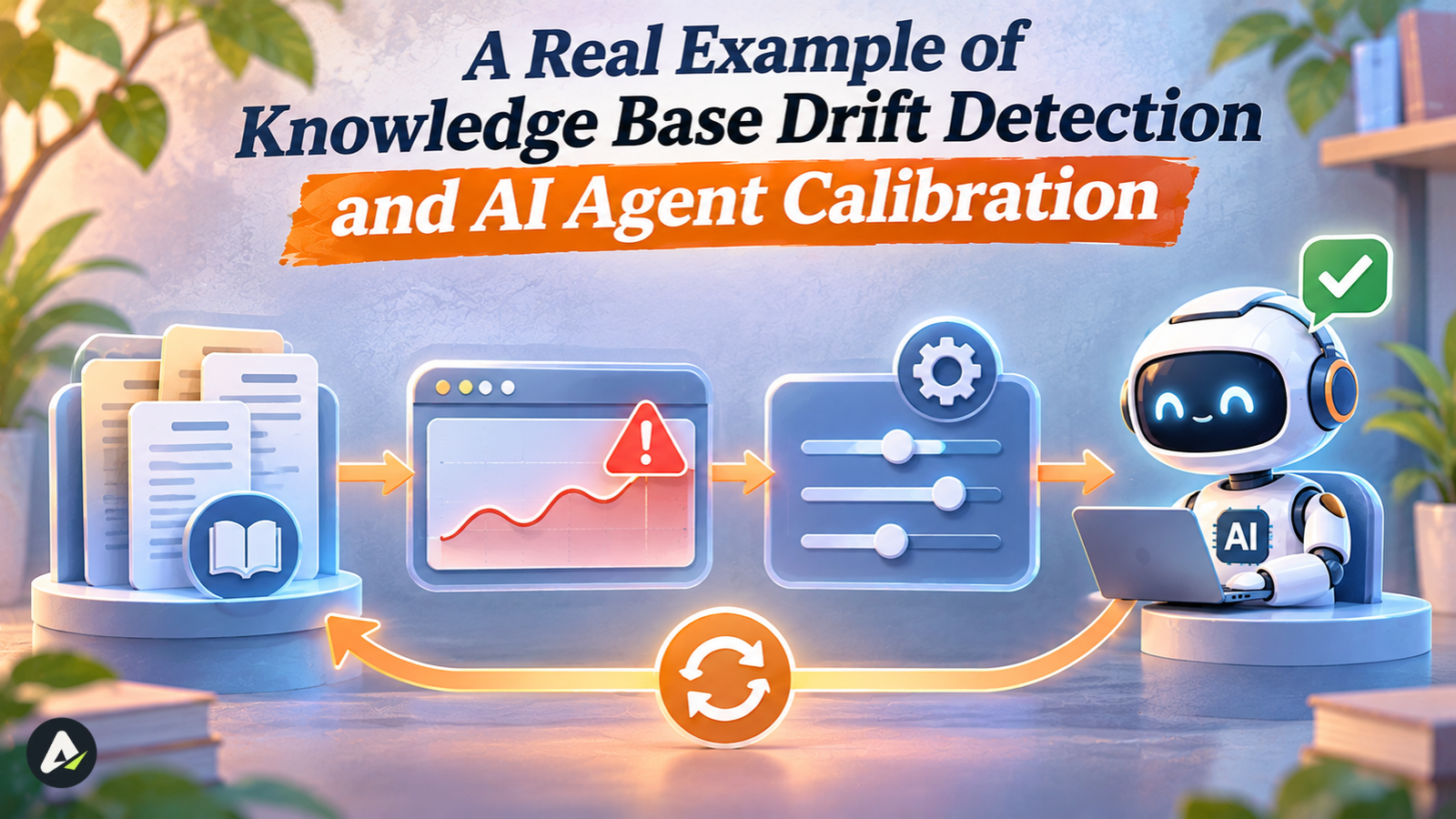
This walkthrough runs the full loop on simulated data with fixed random seeds: classifier-based drift tests, reliability curves, ECE, a stopgap calibrator while a fix is pending, and a second measurement after re-indexing. All numbers come from running the code below, not from a production case study.
Scenario: an IT-support agent answers questions from help-desk articles, and a policy overhaul changes about 30% of user topics.
Step 1: Version where metadata allows
For structured content such as policies and contracts, give replaced documents effective and expiry dates, so the agent serves the current policy by default and can answer “What was our refund policy in Q1?” Most enterprise knowledge (Slack threads, wiki pages, tickets) lacks clean expiry fields, and two contradictory pages can both stay active. For that content, combine recency weighting, source-authority ranking, and conflict detection.
Step 2: Test for semantic drift weekly
This domain-classifier test mirrors the method behind Evidently’s default:
import numpy as np
from sklearn.linear_model import LogisticRegression
from sklearn.model_selection import cross_val_score

def classifier_drift_auc(ref: np.ndarray, cur: np.ndarray, folds: int = 5) -> float:
    """Domain-classifier drift: ROC-AUC near 0.5 = no shift, near 1.0 = strong shift."""
    X = np.vstack([ref, cur])
    y = np.r_[np.zeros(len(ref)), np.ones(len(cur))]
    clf = LogisticRegression(max_iter=1000)
    return float(cross_val_score(clf, X, y, cv=folds, scoring="roc_auc").mean())
A stable week scored 0.448 and the overhaul week 0.581, crossing the 0.55 default threshold. A centroid cosine check on the same data moved from 0.015 to 0.109, but centroid distance misses shifts that leave the average unchanged, so use it only as a quick screen.
Step 3: Measure calibration with a reliability curve and ECE
from sklearn.calibration import calibration_curve

def expected_calibration_error(conf, correct, n_bins: int = 10) -> float:
    conf = np.asarray(conf, dtype=float)
    correct = np.asarray(correct, dtype=float)
    if conf.size == 0 or conf.size != correct.size:
        raise ValueError("Inputs must have equal, nonzero length")
    if np.any((conf < 0) | (conf > 1)):
        raise ValueError("Probabilities must lie in [0, 1]")
    edges = np.linspace(0.0, 1.0, n_bins + 1)
    ece = 0.0
    for i in range(n_bins):
        lo, hi = edges[i], edges[i + 1]
        if i == 0:
            mask = (conf >= lo) & (conf <= hi)
        else:
            mask = (conf > lo) & (conf <= hi)
        if mask.any():
            ece += mask.mean() * abs(correct[mask].mean() - conf[mask].mean())
    return float(ece)

# conf: predicted probabilities (0-1); correct: 1 if the answer was right, else 0
# Reliability diagram data: mean predicted probability vs. observed accuracy per bin
prob_true, prob_pred = calibration_curve(correct, conf, n_bins=10, strategy="uniform")| 600 labeled queries | Before overhaul | After overhaul |
|---|---|---|
| Mean predicted probability | 0.795 | 0.796 |
| Accuracy | 0.775 | 0.667 |
| ECE | 0.028 | 0.141 |
The reliability curve locates the gap: after the overhaul, the 0.85 bin scored 0.71 accuracy, and the 0.94 bin scored 0.73. Low-probability bins held only a handful of samples and swung wildly, which is why bin counts belong beside each ECE figure.
Step 4: Apply a stopgap calibrator while the fix is pending.
If the KB fix takes days, a short-term mapping fitted on post-overhaul labels keeps scores honest in the meantime. Five-fold cross-validation compared two methods:
| Method | Mean held-out ECE | Range across folds |
|---|---|---|
| No recalibration | 0.150 | 0.094–0.197 |
| Platt scaling | 0.066 | 0.023–0.096 |
| Isotonic regression | 0.092 | 0.036–0.155 |
Platt scaling scored lower on average; isotonic regression swung more widely, typical with about 480 training labels per fold.
Step 5: Re-index, collect fresh labels, re-measure
After the KB fix and re-index, 600 new labels from post-reindex traffic were split in half, one half for fitting and one for scoring:
| Post-reindex scoring (300 held-out labels) | ECE |
|---|---|
| Raw agent scores | 0.051 |
| Stopgap Platt mapping, left in place | 0.139 |
| Platt refit on 300 post-reindex labels | 0.081 |
The stopgap mapping turned harmful: it pushed mean predicted probability down to 0.668 while accuracy recovered to 0.777. Refitting on a small sample also underperformed the raw scores in this run. So once you re-index, expire the old mapping, benchmark raw scores on fresh traffic, and refit only if residual miscalibration persists.
Step 6: Test selective prediction and cascades
Before the fix, answering only the top 60% of questions by score lifted accuracy just from 0.667 to 0.711, because overhauled topics carried the same high scores as the rest. Abstention thresholds can’t separate them until calibration recovers. For multi-step agents, seed later steps with plausible but wrong outputs from earlier ones and check whether the agent catches them. For corpus-level stress tests, the RAGStress benchmark pairs four corruption types (factual corruption, numeric typos, relevance poisoning, and contradiction injection) with three severity levels.
What Are the Limitations of Drift Detection and Calibration?
Detectors raise false alarms, labels cost money, and neither method pinpoints which fact went wrong. Both reduce risk without removing it, so agents acting on records need human oversight. The practical limits fall into four areas.
- Small samples: sparse bins make ECE noisy, as Steps 3 and 5 showed. Use fewer bins and per-category breakdowns.
- Trajectory labels: full-run ground truth costs far more than single-answer labels, which limits how often you can refit step-level and trajectory calibrators.
- Privacy: query baselines and span logs may fall under data-retention rules.
- Residual risk: agents that change records need clear limits on agent autonomy, and an agent deployment risk score helps decide where those limits sit.
FAQs
Q. How should a RAG pipeline handle contradictions it can’t resolve automatically?
Use a conflict-aware system prompt that tells the agent to name the contradiction, cite each source with its date, and prefer the higher-authority source. When stakes are high, route the question to a human instead of answering.
Q. How do you calibrate an agent when the provider hides token logprobs?
Use black-box proxies: agreement across sampled answers, consistency across prompt variants, or bug-finding self-review prompts. Map those signals to predicted probabilities with Platt scaling on fresh labels.
Q. How do you stop an agent from poisoning its own knowledge base?
Tag each write with its origin (user, tool, or agent), store reasoning traces apart from facts, assign agent-generated entries lower trust, and require verification before inferred facts reach high-stakes retrieval.
Q. How do you tell real drift from judge drift?
Re-score a fixed set of past outputs with the current judge. If scores on unchanged outputs move, the judge changed, not the agent.
Q. Should agents judge their own work before or after a task?
Both, for different jobs. On SWE-bench Pro, pre-execution estimates tended to separate successes from failures better than post-execution review, while bug-finding review prompts produced the best-calibrated scores.
Related: Vertical AI Agents: Examples, Uses & How They Work
| Disclaimer: This article is for informational and educational purposes only. The tools, GitHub projects, and research discussed are presented for general reference and evaluation. Technical results, performance, and features may vary depending on implementation and configuration. Always verify official documentation, licensing terms, and suitability before using any tool in production. |

Kavin Reed
As AI agents move from experimental demos into everyday workflows, the questions around how they work, where they fit, and what happens when they fail are becoming harder to ignore. Kavin Reed writes about AI agents, automation, and the systems behind them, with a focus on practical adoption and real-world impact. His work examines the ideas, trends, and technical developments shaping how businesses and people use increasingly capable AI systems.
More from Kavin Reed →