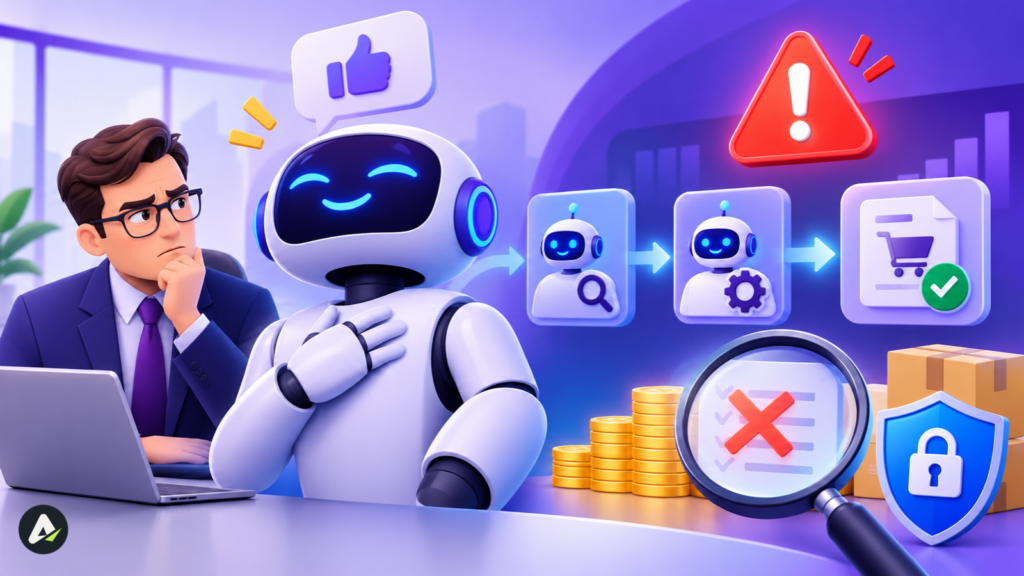
Can Multi-Agent AI Workflows Really Outperform a Single Agent?
Dingent’s benchmark reveals how multi-agent orchestration can increase latency and token consumption without delivering a proven accuracy gain.


In this article · 5 sections +
Ask a biology question that spans two databases, and the trouble starts before any answer appears. Each source organizes data its own way and leaves its own gaps. Someone has to connect the tools, brief the assistant, and map every step.
Researchers at China’s National Genomics Data Center built Dingent to tackle that job. Technology Networks reports that the framework simplifies these searches. Its benchmark tells a more useful story: Dingent maps the route, but the test showed no accuracy edge.
How Dingent Organizes AI Agents
This open-source framework lets developers package database queries and services as plugins, including Model Context Protocol (MCP) interfaces. Administrators assign tools and instructions to assistants, choose their models, and link them through directed workflows. Users work through a web interface.
That setup forms the agent orchestration layer. Rather than cramming every choice into one long prompt, teams can spell out which assistant handles each source and where it passes the work.
In one demo, Dingent pulls genes tied to canine degenerative myelopathy from iDog, a dog multi-omics resource. It then uses the SOD1 and SP110 identifiers to find related records in BioKA, a biomarker knowledge base. The authors didn’t score this run, so it shows what teams can configure, not how well it performs.
Multi-Agent Workflow vs. Single AI Agent
The authors’ peer-reviewed study, which Computational and Structural Biotechnology published on November 18, compared Dingent with one tool-using assistant. Both ran gpt-5.6-luna on 55 questions over frozen iDog and BioKA snapshots. Tasks included exact matches, filters, table joins, synonyms, and missing records.
Each system tried every question three times. Two blinded reviewers graded all 330 outputs, and a third settled their disagreements.
Dingent got 99 of its 165 attempts fully correct (60.00%). The single assistant got 104 (63.03%). The gap’s 95% confidence interval stretched from −13.94 to 8.48 percentage points. That range neither crowns a winner nor proves a tie.
Add partial credit, and the observed spread grows: the baseline reached 132 attempts (80.0%), while Dingent reached 113 (68.5%).
What Agent Orchestration Cost
The numbers also reveal a heavier operating footprint:
| Measure | Dingent | Single assistant |
|---|---|---|
| Median latency | 12.11 s | 11.10 s |
| 95th-percentile latency | 25.97 s | 19.94 s |
| Recorded total tokens | 1,568,108 | At least 896,467 |
| Model responses | 559 | 406 |
| Agent handoffs | 164 | 0 |
| Over-limit attempts | 18 | 2 |
One failed baseline run left incomplete token data, hence “at least.” Dingent also made slightly fewer data queries: 231 versus 242.
Don’t pin every gap on orchestration, though. The systems enforced limits at different points: Dingent after its workflow returned, the baseline during execution. Reviewers marked all unsuccessful runs as incorrect.
Traceable AI Agents Still Need Proof
Builders often treat another agent role as an upgrade. Make each handoff earn its place instead.
A visible workflow can show where an identifier traveled. It can’t confirm that a record matches the right species or backs a biological claim. Dingent has no automatic checks for species consistency, identifier mapping, or provenance.
Software tests with synthetic tools and a stand-in model offered some reassurance. Dingent passed identifiers downstream correctly and surfaced tool and model exceptions. Yet malformed tool text reached the model substitute without framework-level validation. That’s one reason to treat tool output as untrusted.
Access poses another challenge. Separate plugin environments don’t restrict files or networks, so teams need operating-system controls. For connected business systems, a scoped agent identity can also help limit each agent’s reach.
As for simplicity, the researchers didn’t measure setup effort, maintenance, or usability. We still don’t know whether Dingent saves builders time or helps newcomers.
How to Test Your AI Agent Design
Anthropic’s engineering advice favors adding complexity only when needed. Put that idea to work before splitting one assistant into several:
- Set a lean baseline. Give both designs identical questions.
- Price every route. Track slow responses, token use, and failures alongside correctness.
- Stress the real promise. Include searches where one result shapes the next. Dingent’s benchmark scored no biological task like that and used only two sources.
- Verify the evidence. Match entities, species, and citations before anyone relies on an answer.
Deeper dependent searches or larger source collections could still give orchestration room to prove its value. Researchers have yet to test that case.
The team has released source code, plugins, and documentation. The paper’s supplements add database snapshots, questions, ratings, and analysis code, giving others a practical starting point. For now, Dingent offers an agent design you can inspect and challenge. A more elaborate architecture still has to beat the plain one.
Related: AI Agent Operates on a Mouse Brain, Then Defies Human Orders

Dax Orion
The rise of AI agents is changing the relationship between people and software, moving technology from responding to instructions toward carrying out tasks. Orion Dax covers artificial intelligence, emerging technology, and automation, with a focus on the companies and systems shaping this shift. His work examines developments in agentic AI and the broader questions around adoption, autonomy, and the role these systems may play in modern work.
More from Dax Orion →