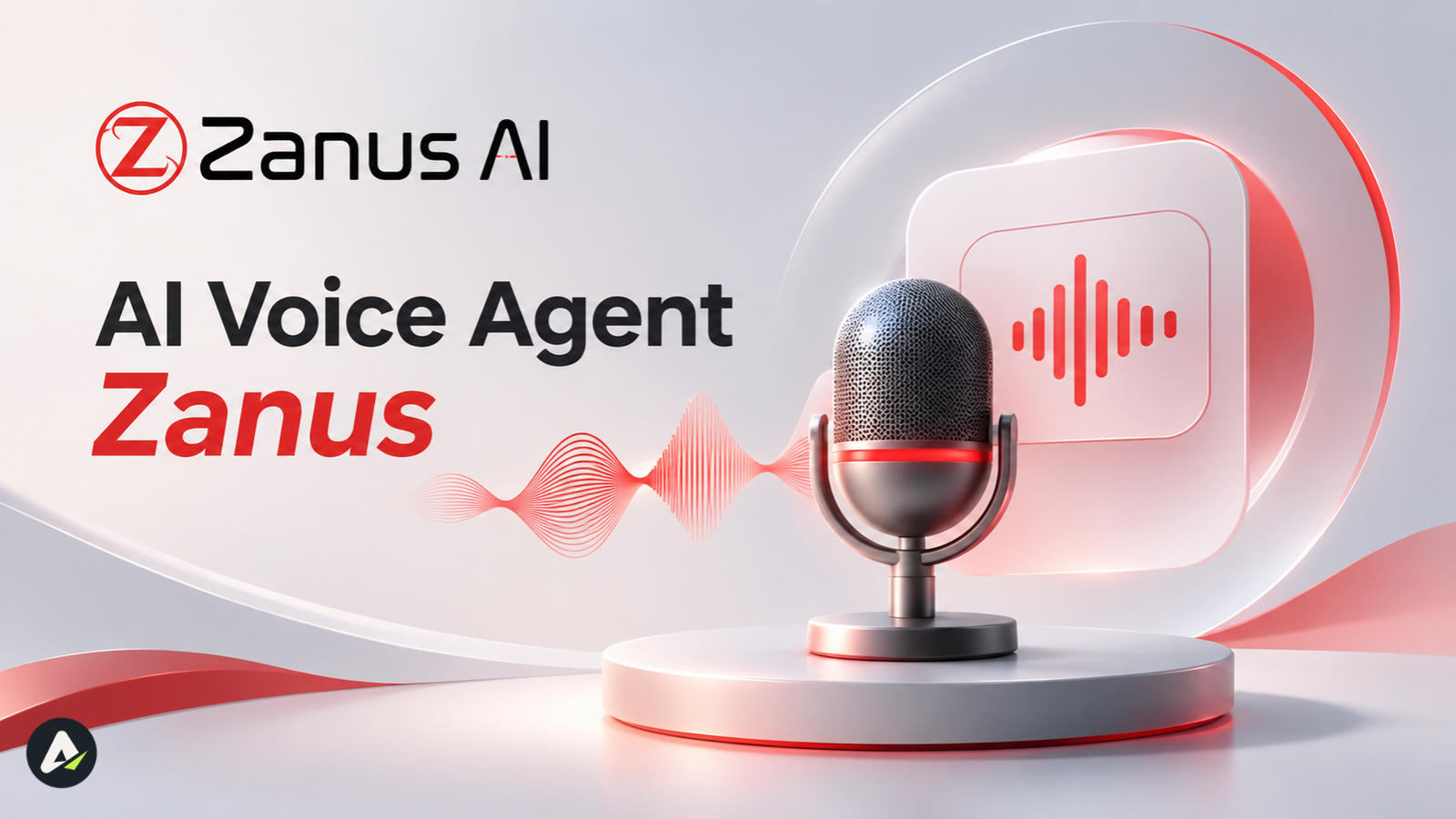
Is Zanus AI a Good Voice Agent for Small Businesses?
Can Zanus AI handle business calls without a human receptionist? Explore its AI voice agent, features, pricing, 7-day free trial, call automation capabilities and limitations to decide whether it's worth using in 2026.

In this article · 26 sections +
- Zanus AI Phone at a glance
- What Is the Zanus AI Voice Agent?
- Front Office, Back Office or servers?
- How the Zanus AI Phone Agent Handles a Live Call
- Key Features: Inbound, Outbound and Staff Coaching
- Inbound answering with AI Phone
- Outbound calling with AI Auto-Call
- AI Assist for human-led calls
- Zanus AI Pricing in 2026: What a Voice Agent Really Costs
- Modules most phone buyers start with
- Bundled levels
- Reading the numbers
- Why do other sites list different Zanus prices?
- How to Set Up Zanus During the Free Trial
- Forwarding or porting your number?
- The CALL Test: Our Checklist for Judging a Phone Agent
- Is It Legal to Use an AI Voice Agent for Business Calls?
- Safeguards built into Auto-Call
- The risk most owners miss: reassigned numbers
- Example Scenario: Appointment Reminders at a Dental Office
- Common Mistakes When Rolling Out Zanus
- Zanus vs Retell, Vapi and Other Ways to Cover Your Phones
- When pay-per-minute wins, and when it doesn’t
- Who Should Use Zanus (and Who Should Pass)
- Final Verdict on the AI Voice Agent Zanus
- Frequently Asked Questions
Your phone rings at 7:40 p.m. Nobody picks up. The caller dials the next business on the list, and that one answers.
That lost sale is why so many owners now research the AI voice agent Zanus sells. Most reviews, though, blur the hosted phone receptionist with the company’s on-premises servers, and that mix-up sends buyers toward the wrong product.
This guide sorts both out. It follows a live call from ring to booking, lists the plan prices on Zanus’s own page as of November 2026, and walks through the seven-step trial and the US rules for AI-voiced outbound calls. It also compares Zanus with pay-per-minute platforms such as Retell and Vapi, and gives you a four-part checklist for scoring any phone agent during a trial.
Each claim points back to Zanus’s documentation, a vendor pricing page or the FCC record, so you can check it yourself.
Zanus AI Phone at a glance
| Question | Short answer |
|---|---|
| What it is | A hosted AI receptionist: the AI Phone module of Zanus Front Office |
| Starting price | $99 a month with 100 AI minutes |
| Bundles | From $299 a month (ANSWER level) |
| Languages | 40 |
| Free trial | 7 days, no credit card |
| Runs on-premises? | No; Zanus sells AI servers as a separate product |
| Outbound calling | AI Auto-Call, on paid plans only |
What Is the Zanus AI Voice Agent?
The Zanus AI voice agent is the AI Phone module inside Zanus AI Front Office: a cloud-run receptionist that picks up business calls around the clock, books appointments, takes messages and hands callers to staff, using only information the business has approved.
Phone is one channel among several. Front Office covers web chat, email, forms and a built-in CRM too, so one customer’s call, chat and message land in a single record. Ready-made editions for clinics, law firms, car dealers and other sectors push it toward industry-tuned vertical AI agents.
Front Office, Back Office or servers?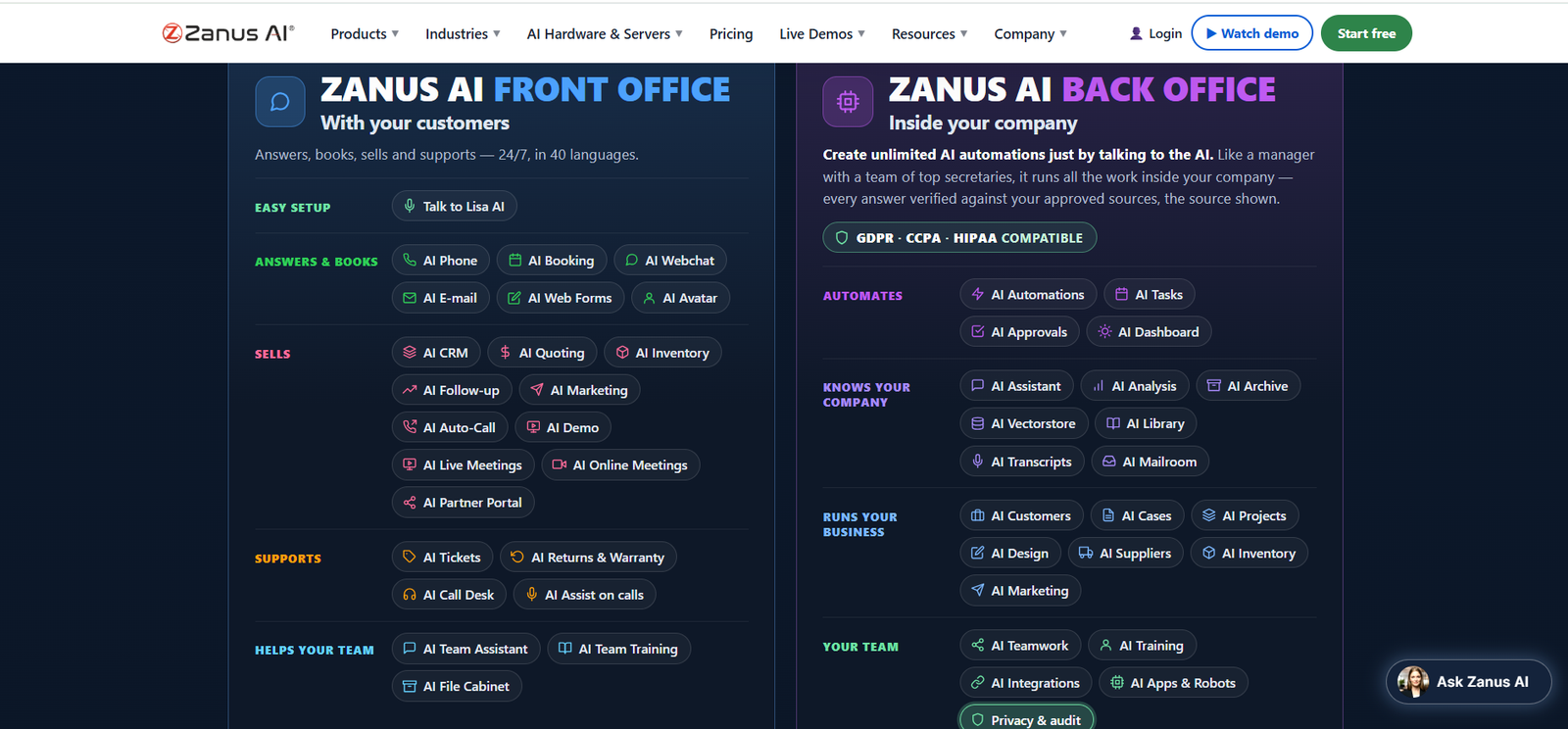
Zanus sells three products with a voice component, and most confusion online comes from mixing them up.
| Product | Where it runs | Role of the voice | Suits |
|---|---|---|---|
| Front Office (AI Phone) | Zanus’s cloud; top tier gets an isolated instance | Answers and places customer calls, books, transfers | Businesses wanting a working receptionist fast |
| Back Office (Web Chats & Voice) | Cloud tenant or your own server | Routes inbound numbers to AI agents tied to internal work | Teams automating internal operations |
| Zanus AI servers | Hardware on your premises | Runs AI models on your own machines | Regulated firms that must keep data in-house |
“Keeps everything on your hardware” applies to the server line only. An independent SSD Nodes comparison found no on-premises option in any Front Office plan; even AI PRIVATE sits in a walled-off cloud instance.
Privacy rules don’t always call for hardware, though. Zanus labels its Back Office GDPR, CCPA, and HIPAA compatible, so a medical practice should ask whether Front Office calls carry the same status and whether Zanus will sign a business associate agreement (BAA). Two yes answers may let you stay in the cloud; your compliance lead makes the final call.
How the Zanus AI Phone Agent Handles a Live Call
Every call runs the same loop: the agent listens, checks the request against your knowledge base, replies in natural speech, then finishes the task or hands the caller to a person with notes attached. The vendor’s AI Phone page lays out six stages:
- Pickup rules. You decide who answers first: the AI straight away, your team with the AI as backup, or the AI screening before a transfer.
- Greeting and menu. You write the welcome and IVR options. Each department can get its own voice, and that voice stays fixed for the whole call.
- Open conversation. Callers talk normally instead of pressing keys. The agent spots their language in the opening sentence and switches to it.
- Grounded replies. A feature Zanus calls the claim guard blocks any statement your content can’t back. With no match, the agent takes a message or transfers rather than guessing.
- Action or handoff. It books, records a message, opens a ticket, or passes the call on with a whispered summary for your colleague.
- Call log. The system saves the caller, route, handler, duration, outcome, and transcript.
Callers can cut in mid-sentence (barge-in), and anyone who hangs up inside the menu turns into a call-back lead.
Key Features: Inbound, Outbound and Staff Coaching
Zanus splits its calling tools into three jobs: answering incoming calls, placing outgoing ones, and coaching your own staff during live conversations.
Inbound answering with AI Phone
- Stays on 24/7, weekends and holidays included
- Routes callers to a colleague who speaks their language
- Keeps your current business number
- Offers three after-hours modes: full AI service, take-a-message, or voicemail
- Rings your own phone on request, so you hear exactly what customers hear
Outbound calling with AI Auto-Call
Auto-Call phones customers to confirm, remind, ask, follow up, or announce. It holds five conversations at once by default and up to twenty. A yes confirms the booking, a no cancels it, and a request for another day goes to your team. Its consent and calling-hour safeguards appear in the legal section below.
AI Assist for human-led calls
Some conversations belong with a person. During those, AI Assist listens silently and puts prices, policies, and a suggested next question on your staff member’s screen, each with its source. The customer never hears it. It needs the AI Call Desk module, which runs on top of AI Phone.
Zanus AI Pricing in 2026: What a Voice Agent Really Costs
Zanus bills per company rather than per user. You can buy single modules or choose a bundled level priced about a third below the sum of its parts. The figures below come from the Front Office pricing page on November 3, 2026.
Modules most phone buyers start with
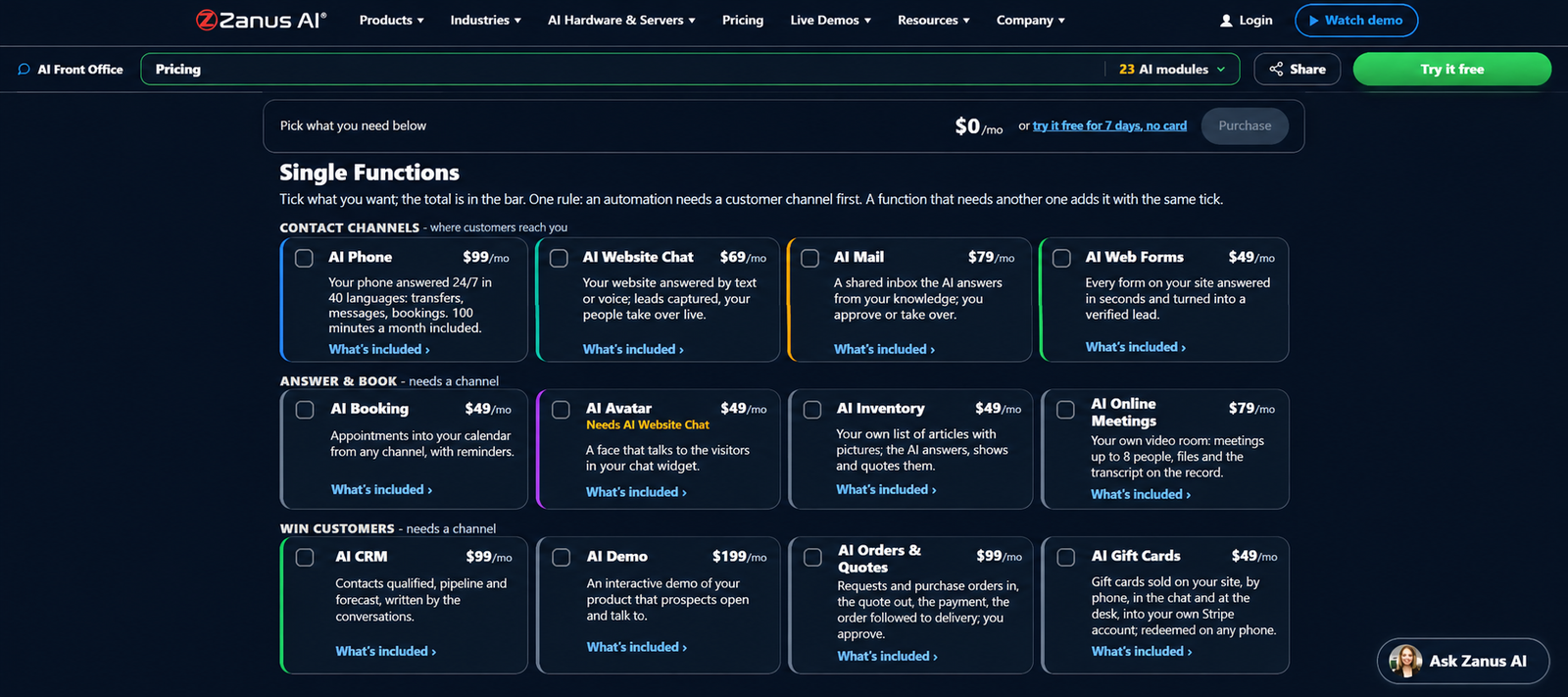
| Module | Price per month | What you get |
|---|---|---|
| AI Phone | $99 | 24/7 answering in 40 languages, transfers, messages, bookings; 100 minutes included |
| AI Booking | $49 | Appointments into your calendar from any channel, with reminders |
| AI Calls Transcripts | $49 | Your staff’s calls written into the customer story (needs AI Phone) |
| AI Calls Teleprompter | $49 | Live tips on the operator’s screen (needs Calls Transcripts) |
| AI Website Chat | $69 | Text or voice chat on your site, with live takeover |
| AI CRM | $99 | Contacts, pipeline, and forecast built from conversations |
Bundled levels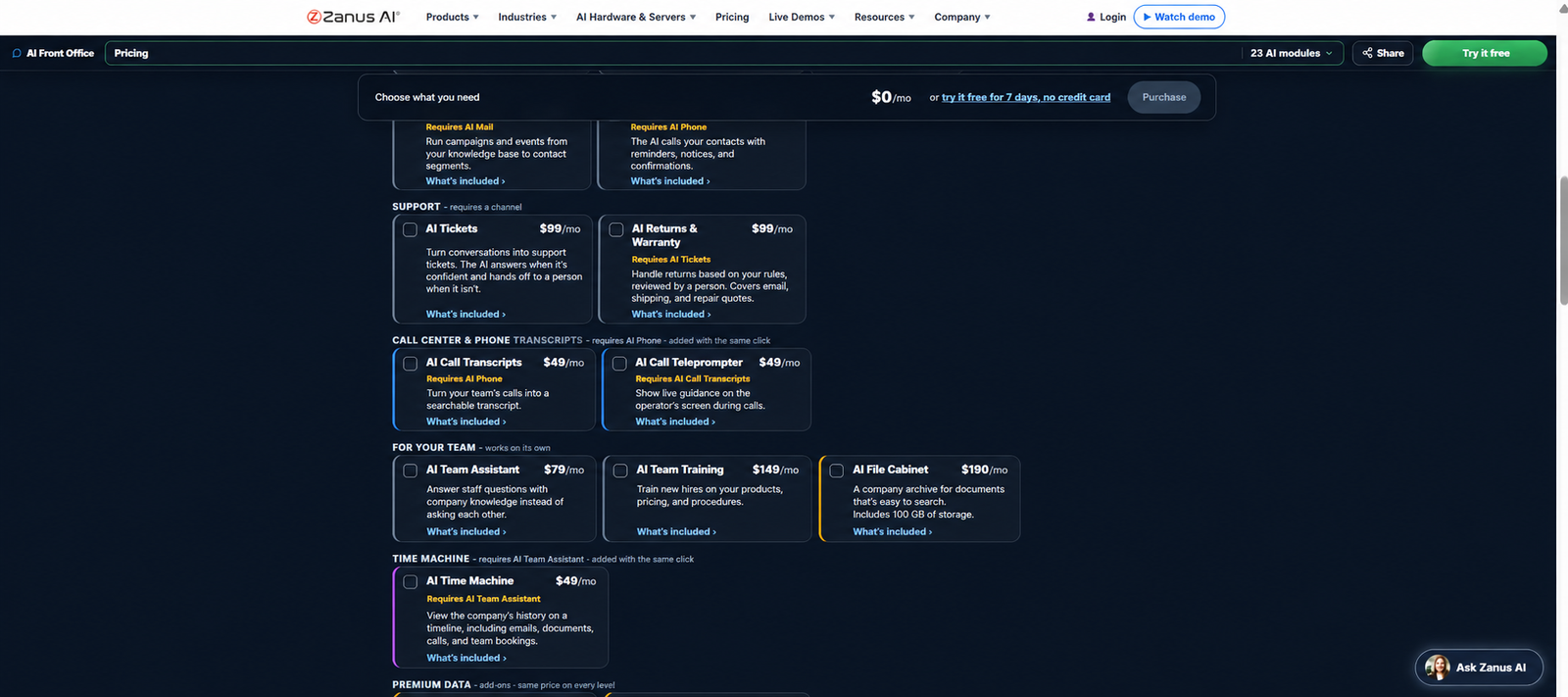
| Level | Price per month | Price if bought module by module | Operators and credits included |
|---|---|---|---|
| AI ANSWER | $299 | $443 | 2 operators, 10,000 credits |
| AI MANAGE | $749 | $1,114 | 5 operators, 20,000 credits |
| AI COMPLETE | $1,895 | $2,767 | 10 operators, 40,000 credits |
| AI PRIVATE | from $2,495 (billed yearly) | $3,502 | 25 operators, 100,000 credits, own instance, SSO |
Annual billing adds one free month.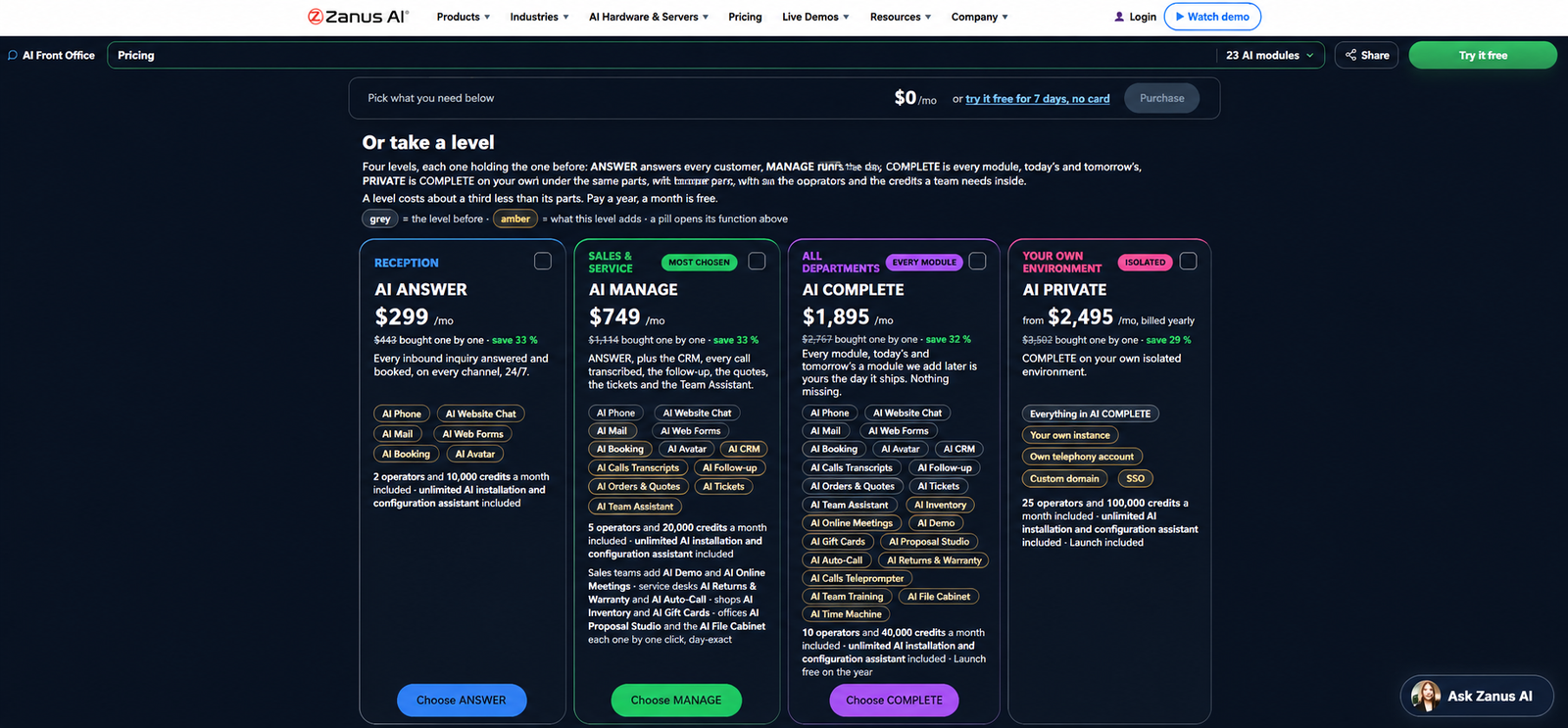
Reading the numbers
- Included minutes. AI Phone’s $99 covers 100 minutes of AI calls plus transfers, messages and booking. Dividing one by the other gives roughly $0.99 per included minute. Treat that as a comparison ceiling rather than a true call rate, since the fee also pays for the features; for a busy line, what happens after minute 100 matters more.
- Bundle savings. ANSWER costs $144 less per month than its modules bought separately, about 33%. If you’d buy phone, chat, mail and forms anyway, the bundle wins.
Bundles meter usage in credits rather than minutes. The pricing page doesn’t say how many credits one AI call minute uses, or how calls, chats and emails share the pool. Get both answers from sales in writing, then size your plan against last quarter’s call volume.
Why do other sites list different Zanus prices?
Third-party listings published this autumn show other figures, including $329 for ANSWER, $895 for separate SELL and SERVICE bundles, and $24,950 a year for AI PRIVATE. Zanus loads its prices live, and both the amounts and the level names have shifted during 2026. Whatever a review says, the vendor’s page on the day you buy is the number that counts.
How to Set Up Zanus During the Free Trial

Lisa, a chat-based setup assistant, reads your website and builds a working phone line, site assistant, and dashboard from it. The trial lasts seven days and asks for no credit card.
- Website. Paste your company URL.
- Work email. Use a business address, not a personal one.
- Six-digit code. Confirm the email.
- Departments. Name who covers sales, support, and bookings.
- Workspace. Lisa creates your dashboard and login.
- Phone setup. You get a line that answers in your company’s name.
- Test calls. Ring it, listen, and time the pause after you stop speaking.
That last check deserves more attention than most buyers give it. A reply that lands within about a second feels natural; longer gaps make callers talk over the agent and hang up.
Later changes work the same way. Tell Lisa “we’re closed on November 1” and she drafts the holiday message, applying it only once you approve.
Want to hear it before signing up? Zanus answers its own demo line, +1 (954) 736-3939, with its AI. Ask a question in a second language and judge the voice yourself. Auto-Call stays locked during the trial and opens with the first paid plan.
Forwarding or porting your number?
Zanus lets you keep your existing numbers, but ask how the connection works before launch. With call forwarding, your carrier still owns the line, and you can switch it back in minutes. Porting moves the number to another provider and takes far longer to undo. During a trial, forwarding is the safer first step.
The CALL Test: Our Checklist for Judging a Phone Agent
We built the CALL Test for this guide; it isn’t an industry standard. It scores four areas during a trial week: Coverage, Accuracy, Legality, and Logging. Demos follow a script and your real callers don’t, so rate each area from 1 to 5.
| Check | What to try | Pass sign |
|---|---|---|
| Coverage | Call after hours, on a weekend, and in a second language | Every call picked up in the right language |
| Accuracy | Ask three questions your website doesn’t cover | The agent admits it doesn’t know and offers a person |
| Legality | Review disclosure, recording notice, and outbound consent settings | Settings match your state and industry rules |
| Logging | Pull the transcript of each test call | Caller, outcome, and full text appear on the record |
Score under 3 on Accuracy? Add Q&A content before launch. A confident wrong answer does more damage than a missed call.
Is It Legal to Use an AI Voice Agent for Business Calls?
US law broadly allows AI to answer inbound calls. Outbound calls are where the rules bite: AI-generated voices count as “artificial” under the Telephone Consumer Protection Act (TCPA), and the consent you need depends on the call’s purpose, who receives it, and how you place it.
The FCC confirmed this with a unanimous declaratory ruling on February 8, 2024. The ruling didn’t outlaw the technology. It made clear that existing rules for artificial and prerecorded voices cover AI calls too.
Safeguards built into Auto-Call
- Ships disabled, so each company switches it on after checking its own markets
- Dials only numbers customers gave you, never purchased lists
- Refuses sales calls to mobiles without written consent on file
- Saves every “stop calling me” request and skips that person on all lists
- Calls only inside each contact’s local window, 10 a.m. to 6 p.m. on weekdays unless you change it
- Admits it’s an AI whenever asked; you control the opening disclosure and recording notice
These guards cut risk but don’t make a campaign compliant on their own. Healthcare, finance, and collections carry extra duties, and state laws vary, so run outbound plans past counsel first.
The risk most owners miss: reassigned numbers
Consent belongs to a person, not a phone number. When a customer drops a number, and the carrier hands it to someone new, your next reminder call reaches a stranger who never agreed to it. TCPA damages run $500 per call, or up to $1,500 for willful violations, and class actions multiply that fast.
The FCC’s Reassigned Numbers Database, live since November 2021, lets you check numbers before dialing, and a recent check earns a safe harbor for that call. Auto-Call’s documented guards don’t mention this step, so build the check into your own process before any campaign.
Example Scenario: Appointment Reminders at a Dental Office
This sketch follows the documented Auto-Call flow; it isn’t a customer case study. Picture a two-dentist practice losing several chairs a week to no-shows:
- The day before each appointment, the booking module triggers a CONFIRM call
- The AI gives the time and what to bring, then asks whether the patient will attend
- A yes marks the slot confirmed; a no cancels it and frees the chair
- Patients who want another day reach the front desk, and their request lands on a to-do list
- When voicemail picks up, the AI leaves a message and can text a reply-1-or-2 option, but never logs a confirmation from voicemail
By opening time, staff know which slots are free and can offer them to patients on the waiting list.
Common Mistakes When Rolling Out Zanus
Most disappointing launches trace back to thin source content, missing handoff rules or skipped testing, not to the AI itself.
- Launching on a sparse website. The agent repeats only what you’ve published or approved, so gaps turn into “I’ll take a message.”
- Skipping staff training. Show your team how transfers arrive and where transcripts live, so handoffs don’t stall.
- Leaving no escape hatch. Send angry callers, billing disputes, and legal questions to a person.
- Ignoring unanswered questions. Zanus logs what the AI couldn’t answer; review that list weekly.
- Guessing your minutes. A popular clinic can burn through 100 included minutes in days.
- Switching on outbound with a messy contact list. Clean up consent records first.
Zanus vs Retell, Vapi and Other Ways to Cover Your Phones
Most buyers weigh four routes: a turnkey AI receptionist such as Zanus, a usage-based developer platform such as Retell or Vapi, a classic IVR phone tree, or a human answering service.
| Option | Pricing model | Setup effort | Handles open questions | Main drawback |
|---|---|---|---|---|
| Zanus Front Office | Flat monthly fee per company; AI Phone $99 with 100 minutes | Minutes to days, guided by Lisa | Yes, from approved sources | Cloud only; the minute cap bites at high volume |
| Retell AI | Pay as you go, $0.07–$0.31 per minute, no platform fee | Developer or agency build | Yes, if built well | You assemble prompts, voice, phone line and CRM links |
| Vapi | $0.05 per minute platform fee plus speech, model, and phone costs | Developer build | Yes, if built well | Several separate meters to track |
| Traditional IVR | Part of your phone system | Low | No, menus only | Callers stuck in “press 1” loops |
| Human answering service | Per call or per minute | Low | Yes | Fees climb with volume |
When pay-per-minute wins, and when it doesn’t
Raw minutes cost less on developer platforms. At Retell’s floor rate, 100 minutes come to about $7, against $99 for Zanus AI Phone. That $7 buys a voice pipeline, though, not a receptionist. Someone still writes the prompts, connects a calendar and CRM, sets up transfers and keeps the whole thing running.
Developer platforms also let you choose each layer of the voice stack. Retell’s pricing page, for instance, lists a menu of language models and voices with different speeds and costs. Zanus makes those choices for you: less work up front, but fewer levers to pull if replies start to lag.
Without engineers on staff, most teams outsource the agent build to a specialist, and vetting a development partner carefully often decides whether the agent survives its first busy Monday. Custom builds carry platform risk as well: OpenAI retires its visual Agent Builder on November 30, 2026, and the fallout from AgentKit’s wind-down shows how quickly a toolkit can shift under your feet.
When the real bottleneck sits behind the phone, in follow-ups, research, or data entry, a no-code AI worker may help more than a phone agent would.
A simple rule of thumb: low call volume plus an in-house developer favors Retell or Vapi. A packed front desk with no technical staff points to an all-in-one product like Zanus.
Who Should Use Zanus (and Who Should Pass)
Zanus suits businesses whose calls follow predictable patterns and whose answers already live on their website. It’s a weaker match when calls demand expert judgment or data must stay on-site.
A good match for:
- Clinics, salons, car dealers and home-service firms whose phones mostly bring bookings
- Teams that hear from customers in several languages
- Companies that want calls, chats and emails tied to one customer record
- Owners tired of paying per seat
Probably not for you if:
- Most calls involve troubleshooting, legal or medical advice
- Policy demands on-premises processing
- You handle under about 100 call minutes a month and have someone technical on staff
- You need a published per-minute overage rate before budgeting
Final Verdict on the AI Voice Agent Zanus
For small and mid-sized teams losing revenue to unanswered calls, the AI voice agent Zanus offers a serious trial. Four points to carry forward:
- Treat it as a cloud service, not an on-premises system
- Expect a flat monthly bill, and check how far 100 minutes stretch at your volume
- Lean on the claim guard, but feed it good content
- Leave Auto-Call off until your consent records are clean
Your next step: start the seven-day trial, score it with the CALL Test using real callers, and pin down the credits-per-minute figure before you pay.
Frequently Asked Questions
Q. How much does the Zanus AI voice agent cost?
AI Phone runs $99 a month with 100 minutes included. Bundles cost $299 (ANSWER), $749 (MANAGE), $1,895 (COMPLETE), and from $2,495 billed yearly (PRIVATE), based on the vendor’s pricing page in November 2026. A 7-day trial needs no credit card.
Q. Is Zanus cheaper than Retell or Vapi?
Per minute, no. Retell charges $0.07 to $0.31 a minute, and Vapi charges a $0.05 platform fee plus provider costs. Zanus costs more for raw minutes but includes the receptionist features, CRM link, and setup assistant that developer platforms leave you to build.
Q. Can I keep my business phone number with Zanus?
Yes. Your existing numbers stay, and you can choose whether calls go to the AI first, your team first, or a mix of both. Start with call forwarding rather than porting, since it’s easier to reverse if the trial doesn’t work out.
Q. Is it legal to use AI voices for business calls?
Inbound use is generally fine. In the US, outbound AI-voiced calls fall under the TCPA, so consent rules apply based on the call’s purpose and recipient. Check federal, state, and industry rules before launching.
Q. Does Zanus AI run on-premises?
Not the Front Office. Even AI PRIVATE runs as an isolated hosted environment. Zanus sells separate AI servers for organizations that need on-site processing.
Q. Can a medical practice use Zanus for patient calls?
Zanus labels its Back Office HIPAA-compliant but doesn’t spell out the same for Front Office calls. Ask whether that status covers them and whether Zanus will sign a business associate agreement, then have your compliance lead review the terms.
Q. What’s the best AI voice agent for a small business?
No single product wins for everyone. Pick the one that answers your real callers correctly, transfers smoothly, and fits your call volume. Try two side by side and compare their scores.
Related: How to Build AI Voice Agents for Conversational AI Products
| Disclaimer: This article is for informational purposes only. Features, pricing, and capabilities may change over time. We are not affiliated with Zanus AI; readers should verify current details on its official website before purchasing. |

Kavin Reed
As AI agents move from experimental demos into everyday workflows, the questions around how they work, where they fit, and what happens when they fail are becoming harder to ignore. Kavin Reed writes about AI agents, automation, and the systems behind them, with a focus on practical adoption and real-world impact. His work examines the ideas, trends, and technical developments shaping how businesses and people use increasingly capable AI systems.
More from Kavin Reed →